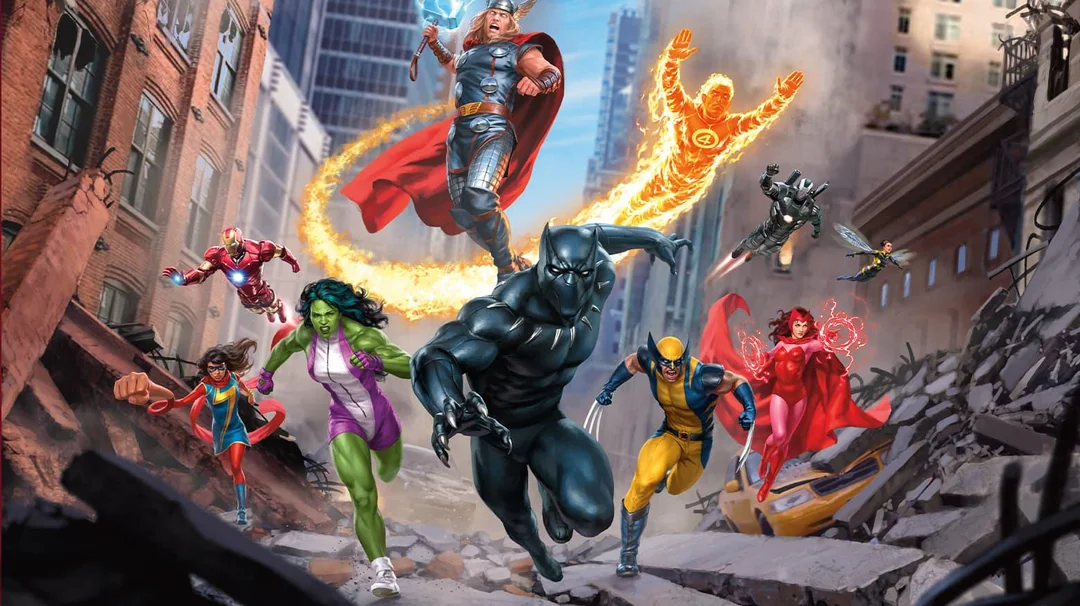
Magic: The Gathering | Marvel Super Heroes has had enough time in players‘ hands that we no longer have to judge its cards purely on preview-season hype.
The set mixes Standard-legal cards from the main release with new Commander-focused designs, and the strongest cards do very different things. Some are efficient engines that can slot into existing decks, while others are build-arounds capable of defining an entire Commander strategy.
That also means „powerful“ needs some context. A great Commander card is not automatically a Standard staple, and a card designed around a specific Hero or Villain shell may be stronger in that environment than a more generically playable card.
For this ranking, I am looking primarily at Commander impact, ceiling, efficiency and how much a card can change a game when properly supported.
1. The Mind Stone
The most dangerous card in Marvel Super Heroes may not be a creature at all.
The Mind Stone costs only , is indestructible and can tap for . That is already a serviceable mana rock, but the real payoff comes from harnessing it.
For and , you can harness The Mind Stone. Once that happens, its infinity ability turns on, allowing you at the beginning of each end step to exile another target nonland permanent you control and return it to the battlefield.
That creates an extremely flexible repeatable blink engine. Creatures with powerful enters abilities can be reused every turn, permanents can be reset, and cards with counters or other temporary baggage can be refreshed. Because the ability triggers every one of your end steps once harnessed, the long-term value can become enormous.
It requires a substantial initial investment before reaching full power, so this is not a turn-two combo piece simply because it costs two mana. But among the set’s artifacts, its combination of indestructibility, ramp and repeatable value gives it one of the highest ceilings.
2. Mjölnir, Hammer of Thor
The original article undersold the actual card by describing abilities it does not have. The real Mjölnir, Hammer of Thor is arguably more interesting.
It costs , deals 4 damage to up to one target creature when it enters, and then doubles all damage the equipped creature would deal. It also has equip worthy , allowing the hammer to be equipped cheaply to a legendary red and/or white non-Villain creature.
Damage doubling is frightening in Commander because it scales with whatever your creature was already trying to accomplish. A commander threatening 11 combat damage suddenly threatens lethal commander damage. A creature with trample becomes considerably harder to block profitably, while damage-based triggered abilities become much more threatening.
The enters removal also means Mjölnir is not merely a four-mana Equipment that does nothing until another creature is ready. It can affect the board immediately.
It is more specialized than a generic Equipment staple, but in the right red or Boros combat deck, its ceiling is exceptional.
3. Ultron, Artificial Malevolence
Ultron, Artificial Malevolence is one of the most interesting artifact commanders from the entire release.
For , you get a colorless 2/4 Robot Villain. Whenever another nontoken artifact enters under your control, you may pay to make a token copy of it. If that token is not already a creature, it becomes a 2/2 Robot Villain artifact creature in addition to its other types.
The important word is enters.
If you copy an artifact with a useful enters ability, the token can trigger that ability again. If you copy a mana rock, you gain another mana-producing permanent. If you copy an expensive utility artifact, paying only for another copy can represent an enormous mana advantage.
Ultron does require careful deck construction because he is a colorless commander and his trigger consumes a lot of mana over a long game. But once the engine is functioning, one artifact card can routinely turn into two relevant permanents.
We have a full Ultron, Artificial Malevolence Commander Deck Guide for players who want to build around the copy engine rather than simply slot him into another artifact deck.
4. Bruce Banner // The Incredible Hulk
The actual Hulk card really can produce extra combats, but the details matter.
Bruce Banner costs just and can use plus to draw X cards at sorcery speed. For , he can transform into The Incredible Hulk, an 8/8 with reach and trample.
Whenever Hulk is dealt damage, he gets a +1/+1 counter. If he is attacking when that trigger resolves, he untaps and creates an additional combat phase after the current one.
That absolutely opens the door to repeated-combat engines if your deck can damage Hulk again during successive combat phases. But calling the card an automatic infinite-combat commander would be misleading. You still need a repeatable way to damage him at the correct times without killing him.
What makes the card powerful is that the front face is useful even before you transform. Banner can turn excess mana into cards, while Hulk becomes an enormous combat engine later.
That gives the card far more flexibility than a six-mana creature that only functions when attacking.
5. Scarlet Witch, Chaotic Avenger
The original description was directionally close here, but the real mechanic is much more specific.
Scarlet Witch, Chaotic Avenger is a 3/3 flyer. Whenever she deals combat damage to a player, you look at the top two cards of your library and exile them face down. Then, during the resolution of that ability, you may cast a Hero or noncreature spell from among cards exiled with that Scarlet Witch without paying its mana cost.
That creates a genuine cheat-on-mana engine.
Unlike normal impulse draw, you are not paying for the spell you choose. If Scarlet Witch connects repeatedly, the pool of face-down exiled cards grows and gives you more options on future triggers.
The restriction to Heroes or noncreature spells matters, so this is not simply a way to drop any Eldrazi creature off the top of your library. But in a deck packed with expensive sorceries, artifacts, enchantments or Heroes, the mana advantage can become spectacular.
Protecting her and reliably connecting in combat are the main deckbuilding challenges.
6. Doctor Doom, Unrivaled
Doctor Doom, Unrivaled is completely different from the oppressive multiplayer connive card described in the old article.
The actual card costs , is a 4/4 with lifelink, and has a very simple activated ability: tap it to draw a card and lose 1 life. Then, if your library contains no cards, you win the game.
That last line changes everything.
Doom is both an incremental card-advantage engine and a win condition for decks capable of emptying their own library. Instead of requiring a separate Thassa’s Oracle-style payoff after assembling a self-mill line, Doom can sit on the battlefield as the payoff himself.
That does not make him universally strong. A normal black deck that never intends to empty its library is getting a solid 4/4 lifelinker with repeatable card draw, not a format-breaking monster.
But once the deck is intentionally built around the alternate win condition, he becomes one of the more dangerous combo-oriented legends associated with the set.
7. The Unbeatable Squirrel Girl
Sometimes the strongest plan is simply making far too many creatures.
The Unbeatable Squirrel Girl costs for a 4/4. Whenever she enters or attacks, you create a 1/1 green Squirrel token. More importantly, her activated ability creates X additional Squirrels, where X equals the number of Squirrels you already control.
That means the army can grow exponentially.
If you have six Squirrels, the activation creates six more. The next activation can potentially create twelve. Token doublers and effects that reward creatures entering make the scaling even more dangerous.
She does not make evasive Squirrels, nor does she scale them based on legendary creatures as the original article claimed. Her actual strength is much simpler: she turns an existing Squirrel board into a much larger one extraordinarily quickly.
For Commander players already interested in Squirrel typal or green token strategies, that is exactly what you want.
8. Kang Prime
Kang Prime does manipulate time, but not by delaying opponents‘ spells.
Kang is a 3/5 flyer. Whenever he enters or attacks, you exile cards from the top of your library until you find a nonland card. That card gets two time counters and gains suspend if it does not already have it.
In practical terms, Kang repeatedly converts attacks into future spells that can eventually be cast without paying their mana costs.
The ability is especially interesting with expensive cards. You do not get the spell immediately, and you do not control which nonland card you hit, but the mana advantage can be substantial when the suspended card finally comes off its last time counter.
Because Kang triggers both on entering and attacking, blink effects, haste and additional combat phases can all increase the amount of material he suspends.
He is slower than the top cards on this list, but he provides exactly the kind of recurring advantage a Commander engine wants.
9. King T’Challa // Black Panther, Hope Enduring
The original article described this as a Selesnya +1/+1-counter card, but the actual card is Azorius and operates very differently.
King T’Challa costs , has flash, and lets you draw a card whenever a player draws their second card each turn. For , he transforms into Black Panther, Hope Enduring.
The transformed side is a 3/3 with flash and double strike, prevents all damage that would be dealt to itself, and draws a card whenever it deals combat damage to a player.
The front side is arguably the more broadly interesting engine in multiplayer Commander. Opponents frequently draw second cards through normal value engines, and T’Challa can reward you every time that happens.
Once transformed, double strike means connecting with a player can produce multiple combat-damage triggers while damage prevention makes Black Panther unusually difficult to defeat through ordinary combat.
This is not a counters commander. It is a flash/card-advantage card with a powerful combat transformation.
10. Iron Man Armor
Iron Man Armor makes the list because it packs several roles into one artifact.
For , it enters and immediately attaches to a creature you control. The equipped creature gets +2/+1 and flying. You can later pay to temporarily turn the Armor itself into a 0/0 Construct Hero artifact creature with flying that gets +1/+1 for every artifact you control. It also has equip .
That gives artifact decks an Equipment that can suddenly become a substantial evasive threat of its own.
The original article’s ward claim was incorrect, and it is important not to treat this as premium protection. What makes Iron Man Armor attractive is flexibility: it grants evasion and power when used as Equipment, but in a sufficiently artifact-dense board it can transform into a large attacker.
That versatility makes it more interesting than its relatively simple front-facing stats suggest.
Cards That Just Missed the Top 10
Ares, God of War is a good example of a card I would still watch, but not for the reasons given in the old article. Ares is a 4/3 that must attack each combat if able, and whenever one of your attacking creatures dies, that card returns to its owner’s hand.
That is excellent insurance for aggressive Rakdos decks and can make sacrifice-heavy combat much less punishing, but it does not provide a universal team-wide power boost.
There are also plenty of strong cards that become exceptional only inside specific Hero, Villain, artifact or token shells. That is why I would avoid pretending this ranking is simply a list of ten automatic staples.
Marvel Super Heroes is at its best when the cards are evaluated in the decks that can actually exploit them.
The Biggest Difference Between Main-Set and Commander Power
One detail matters when comparing these cards: Marvel Super Heroes does not consist of one legality pool.
Cards with the MSH set code from the main release entered formats including Standard, Pioneer, Modern and Commander, while new cards carrying MSC or MAR codes are Commander-, Legacy- and Vintage-oriented unless another printing makes them legal elsewhere.
That makes direct power comparisons tricky.
Ultron, Artificial Malevolence can be evaluated as a build-around in multiple formats, while cards from the Commander product are primarily designed for multiplayer environments. A card can therefore be one of the strongest Commander additions in the entire Marvel release without being relevant to Standard at all.
For PreconForge readers, that distinction is useful because many of the most exciting cards here are ultimately going into the 99 or command zone rather than competitive 60-card decks.
Which Marvel Cards Should You Buy First?
If you are shopping primarily for Commander, I would not simply buy the ten cards in ranking order.
Start with the card that actually fits your deck.
Artifact players have a compelling reason to look at Ultron, Artificial Malevolence or Iron Man Armor. Red and white combat decks can make far better use of Mjölnir, Hammer of Thor than a random Commander list can. Token decks already invested in Squirrels are going to extract much more from The Unbeatable Squirrel Girl than a generic green deck.
Meanwhile, cards such as The Mind Stone offer a broader engine that can slot into a wider range of white strategies.
That is generally a better way to approach new-set purchases than treating „powerful“ as synonymous with „belongs in every deck.“
If you are buying specifically for one of the four Marvel Commander precons, our individual Marvel Commander Precon Upgrade Guides are the better next stop because they separate cards that are genuinely upgrades from cards that are simply powerful in isolation.
PreconForge Verdict
Marvel Super Heroes has plenty of flashy cards, but the strongest designs are not necessarily the ones with the longest text boxes or the biggest creatures.
The Mind Stone earns the top spot here because an indestructible mana rock that eventually becomes a repeatable blink engine has an unusually broad ceiling. Mjölnir, Hammer of Thor can turn ordinary combat damage into lethal damage, while Ultron, Artificial Malevolence can build an entire Commander strategy around paying for additional copies of your best artifacts.
Further down the list, Bruce Banner // The Incredible Hulk, Scarlet Witch, Chaotic Avenger and Doctor Doom, Unrivaled demonstrate something else the set does particularly well: creating cards that reward you for building around their exact mechanic rather than simply adding another generic staple.
That is what I would focus on when deciding which Marvel cards are worth buying. Find the ones that become exceptional in a deck you already want to play, rather than chasing every mythic because it looked unbeatable during preview season.


