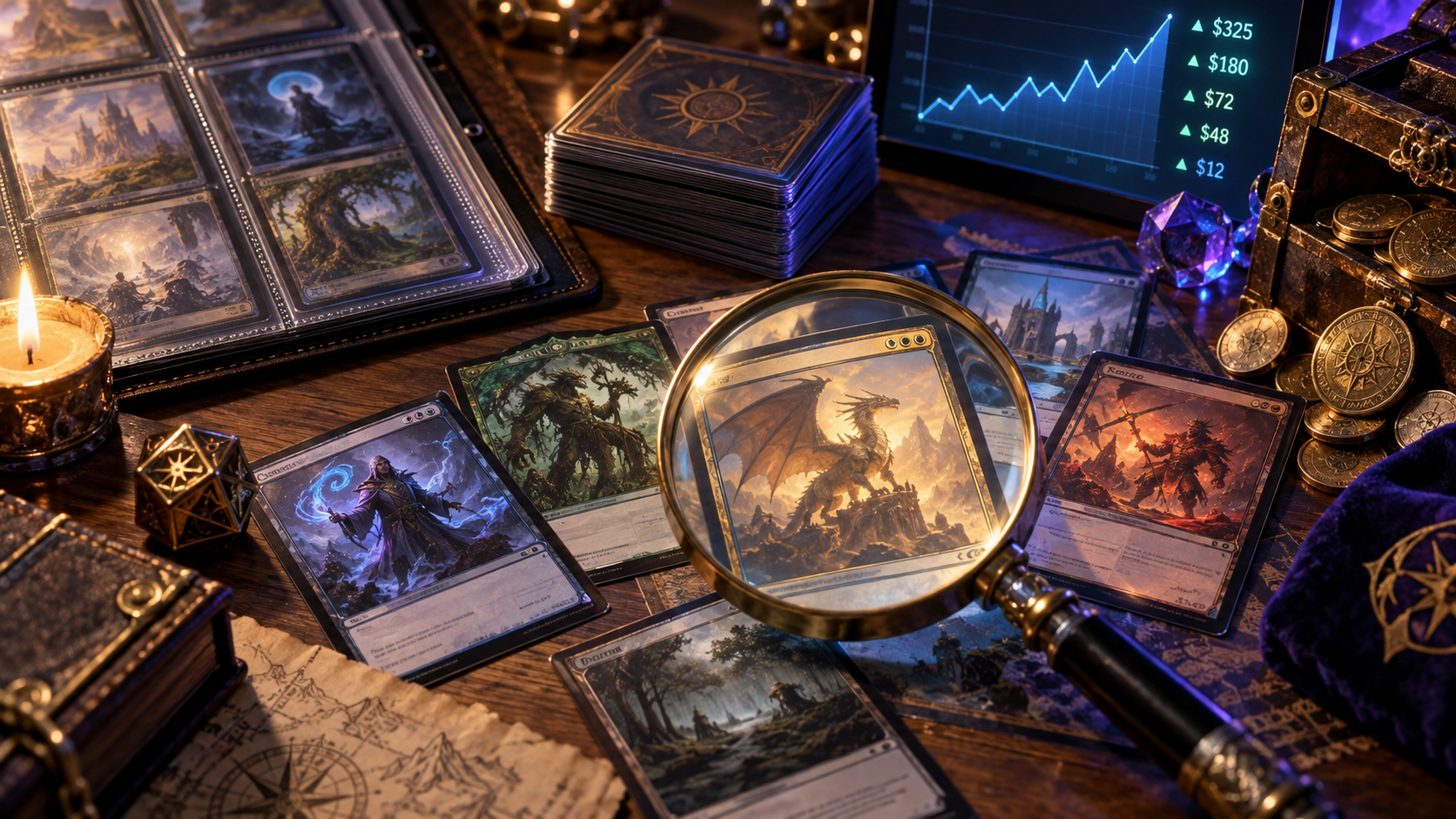
Finding an old box of Magic cards can immediately trigger one question: are any of these actually worth money?
Sometimes the answer is no. Sometimes a card that looks completely ordinary is worth more than the rare sitting next to it. And occasionally a forgotten collection contains a card valuable enough to make you very glad you checked before selling the entire box for $20.
The difficult part is that Magic card values are not determined by rarity alone. The exact printing, condition, foil treatment, artwork, demand, tournament play, Commander popularity and history of reprints can all make two cards with exactly the same name worth very different amounts.
This guide explains how to identify exactly which Magic cards you own, find realistic current prices and estimate what an individual card or an entire MTG collection is actually worth.
How Much Are My Magic Cards Worth?
The fastest way to estimate a Magic card’s value is to identify its exact printing and compare recent market prices for the same version in a similar condition.
That sounds simple, but the word exact matters.
Imagine you own Sol Ring. Searching for „Sol Ring price“ is not enough. The card has been printed many times with different artwork, frames, foils and special treatments. One version can be worth only a few dollars while a much older or scarcer printing can be worth dramatically more.
The same is true across Magic. The name tells you what the card does. It does not necessarily tell you what the physical copy in your hand is worth.
For a reasonably accurate valuation, you need to identify five things: the card name, exact set or printing, treatment or variant, condition and current market demand.
Once you know those, pricing becomes much easier.
Step 1: Identify the Exact Magic Card You Own
Start with the obvious information printed directly on the card.
Modern Magic cards usually provide enough information near the bottom of the card to identify the printing precisely. Look for the set code, collector number, language and other collector information. The expansion symbol can also help identify which set the card came from.
The collector number is particularly useful when several different versions of the same card exist within a product. A normal version, borderless version and showcase version may share a name but use different collector numbers.
Do not price the card until you are confident you have found the correct version.
Check the Set Symbol
The expansion symbol normally appears around the type line and identifies the set associated with the card. Modern symbols also use colors connected to rarity, although older Magic cards require more care because the game’s card frame and identification systems have changed substantially over the years.
For newer cards, combining the set symbol or set code with the collector number usually makes identification straightforward.
For very old cards, identifying the exact printing can be more difficult. Some early Magic sets did not use the modern collector information players are accustomed to today, and several old printings can look surprisingly similar.
If you are holding an old card that might be valuable, do not guess.
Check the Collector Number
On modern cards you will usually find a number near the bottom such as 123/281.
The first number identifies that particular card within the set. Collector numbers have become even more useful as modern Magic products have added borderless cards, showcase treatments, alternate artwork and many other variants.
Two copies of the same named card can therefore have different collector numbers and different prices.
If you are valuing a large collection, learning to look at the collector number instead of relying only on the artwork will save a considerable amount of time.
Step 2: Check Whether the Card Is Foil or a Special Variant
Magic used to make this relatively simple. You might have a normal card or a foil.
That is no longer the entire story.
Modern releases can contain traditional foils, borderless treatments, extended art, showcase frames, retro frames, alternate artwork, serialized cards and other premium versions. Some are worth considerably more than the normal printing. Others surprisingly trade for almost the same price or can even be less desirable depending on supply and demand.
Never assume that foil automatically means expensive.
A heavily printed foil version of a modern card can be worth less than an older nonfoil printing. Collector products have dramatically increased the number of premium treatments available, which means scarcity matters more than the word „foil“ itself.
When checking a price, make sure the marketplace listing shows the exact treatment you have in your hand.
Step 3: Determine the Condition of the Card
Condition can make an enormous difference to value, particularly on expensive cards.
A card that looks „pretty good“ to you may not qualify as Near Mint under a marketplace’s condition standards. Small scratches, edge whitening, dents, scuffs, bends and surface wear all matter.
The commonly used TCGplayer categories are Near Mint (NM), Lightly Played (LP), Moderately Played (MP), Heavily Played (HP) and Damaged (DMG).
Near Mint
A Near Mint card should look almost unplayed. Tiny imperfections can still exist, but there should not be substantial wear.
This is where many inexperienced sellers make mistakes. Near Mint does not simply mean „I never intentionally damaged it.“ A card that has spent years unsleeved in a box may have enough edge or surface wear to fall below NM even if nobody ever played it.
Lightly Played
Lightly Played cards can show minor wear such as light edge wear, small scratches or scuffing while remaining structurally sound.
For players who want a card for a Commander deck rather than a display collection, LP copies can sometimes offer an excellent balance between appearance and price.
Moderately Played
Moderately Played cards show more obvious signs of use. Edge wear, scratches, scuffs and other imperfections can be clearly visible.
The card can still be completely usable as a game piece, but collectors generally pay less for it.
Heavily Played
Heavily Played cards have substantial visible wear. They may still be playable when sleeved, but their condition has a significant effect on value.
On inexpensive cards, that discount may not matter much. On an old collectible worth hundreds or thousands in high condition, it can represent a very large amount of money.
Damaged
Severe creases, tears, major water damage and other serious defects can push a card into Damaged condition.
A damaged card is not necessarily worthless. If the card itself is scarce and desirable enough, buyers may still pay meaningful money for it.
A damaged Underground Sea is still an Underground Sea.
The condition simply changes what buyers are willing to pay.
Step 4: Look at Market Price, Not Just the Cheapest Listing
This is one of the most important lessons when valuing trading cards.
A listing price is not the same thing as a selling price.
Anyone can list a $10 card for $500. That does not make the card worth $500.
When possible, look at pricing information based on actual completed sales and compare several recent transactions rather than relying on one seller’s asking price.
TCGplayer’s Market Price is useful for exactly this reason because it is based on recent transactions on its marketplace. Other marketplaces may provide their own sales histories or pricing metrics.
If several Near Mint copies have recently sold around $25, that is much more meaningful than finding one copy listed for $80.
Why the Lowest Listing Can Also Be Misleading
The cheapest copy is not automatically the real market value either.
That listing might be damaged, foreign language, a different printing, offered by a seller with unusual shipping costs or simply priced aggressively for a quick sale.
Compare like with like.
Your Near Mint nonfoil English copy should ideally be compared with recent sales of the same printing, treatment, language and condition.
Step 5: Understand Why Some Magic Cards Are Valuable
Magic card prices are ultimately driven by supply and demand, but several different forces create that demand.
A card can be valuable because it is extremely powerful, scarce, collectible, popular in Commander, used competitively, visually desirable or some combination of those things.
This is why rarity symbols alone tell you surprisingly little.
Commander Demand
Commander has a huge influence on the price of many cards because a card does not need to be tournament competitive to be desirable.
A strange old card that perfectly supports a new commander can suddenly attract thousands of players who all want a copy for the same deck.
Cards such as Rhystic Study, Smothering Tithe and Cyclonic Rift are desirable because their effects are exceptionally useful in multiplayer Magic.
Commander also constantly creates new demand. Every new legendary creature can make previously overlooked cards relevant again.
If you want to see which broadly useful cards players repeatedly build around, our Best Commander Cards guide covers many of the staples that appear across the format.
Competitive Demand
Tournament formats can create another source of demand.
If a card becomes central to a successful competitive deck, players may suddenly need four copies rather than the single copy used in Commander.
That can move prices quickly when supply is limited.
The opposite can happen when a card is banned, rotates from an important format or disappears from the metagame.
Collector Demand
Some cards are valuable even when relatively few people actually play them.
Old printings, iconic artwork, scarce promos, serialized cards, unusual foils and historically significant cards can all attract collectors.
Black Lotus is the obvious extreme example. Its value is not simply the result of somebody needing another game piece for casual Friday Night Magic.
It represents a unique piece of Magic’s history.
Scarcity
Supply matters enormously.
A desirable card printed once in limited quantities behaves very differently from a card reprinted in multiple Commander decks, booster products and supplemental sets.
A card does not have to be incredibly powerful if there simply are not enough copies available for everyone who wants one.
Rarity Does Not Equal Value
This is worth repeating because it is probably the biggest misconception people have when returning to an old Magic collection.
Rare does not automatically mean valuable. Mythic rare does not automatically mean valuable either.
Thousands of rares are worth very little because demand is low or supply is enormous.
At the same time, certain uncommon and common cards can be surprisingly valuable due to scarcity, competitive usefulness or particular old printings.
If you are sorting a collection, looking only at gold and orange set symbols can cause you to miss cards worth money.
Rarity influences supply.
Value depends on whether anyone actually wants the card.
Reprints Can Change MTG Card Values
Magic is a game that continually reuses cards.
When Wizards prints another version of a desirable card, the number of available copies increases. In many situations that puts downward pressure on the price of the version players simply want as a game piece.
The effect is not always identical for every printing.
An original foil, iconic artwork or scarce old version may maintain a collector premium even when inexpensive new copies become available.
This creates an important distinction between player value and collector value.
A Commander player may simply want the cheapest legal Demonic Tutor. A collector may specifically want a particular old printing, foil treatment or artwork.
Those buyers are shopping for different things even though the card name is the same.
What Is the Reserved List?
The Reserved List is a group of older Magic cards that Wizards promised not to reprint under the policy.
That matters to collectors because normal reprints cannot increase the supply of those cards in the same way they can for most Magic singles.
Some of Magic’s most famous and expensive cards are associated with this part of the game’s history, including cards such as Black Lotus, Mox Sapphire, Gaea’s Cradle and the original dual lands such as Underground Sea.
Being on the Reserved List does not automatically make a card valuable. Demand still matters. Plenty of obscure old cards are scarce without being especially desirable.
However, when strong demand meets permanently constrained supply, prices can behave very differently from cards that remain eligible for reprinting.
How to Quickly Find Valuable Cards in a Large MTG Collection
Pricing every card individually is fine when you own 200 cards.
It becomes miserable when you own 20,000.
For a large collection, the first goal is not perfect valuation. It is separating cards likely to deserve individual attention from bulk.
Start by pulling out older cards, foils, special treatments, mythic rares and rares, but do not stop there. Also look for popular Commander cards, competitive staples, unusual lands, old uncommons and commons, promos and cards you recognize as widely played.
If the collection spans decades, take extra care with older sets. You are much more likely to regret accidentally throwing an old valuable uncommon into a bulk box than spending an extra minute checking it.
Once you have reduced thousands of cards to a smaller pile of candidates, price those individually.
Do Not Ignore Lands
Players often treat lands as background cards and overlook them while sorting.
That can be an expensive mistake.
Mana bases contain some of Magic’s most desirable cards. Fetch lands, shock lands, original dual lands, specialty lands and popular Commander utility lands can all carry meaningful value.
Even seemingly modest cards such as Bojuka Bog can have consistent demand because they perform useful jobs in Commander.
Always give the land pile a proper look before calling it bulk.
How to Value an Entire MTG Collection
The value of every card added together is not necessarily the amount somebody will pay you for the entire collection.
This distinction is crucial.
Suppose you have 500 individually saleable cards with a combined market value of $2,000. Getting the full $2,000 would require selling those cards individually at approximately market price, finding buyers, listing products, grading condition, packaging orders, paying fees and shipping cards.
A buyer purchasing the entire collection at once takes on all of that work and risk.
They will normally expect a discount.
Market Value vs Cash Value
It helps to think about collections as having at least two values.
Market value is approximately what the cards could sell for individually under normal market conditions.
Liquid or cash value is what somebody may realistically pay you today to take the collection off your hands.
Those numbers can be very different.
If maximizing every dollar matters, individual sales usually provide the highest potential return but require the most work.
If speed matters, selling an entire collection is easier but usually means accepting less money.
How to Price Bulk Magic Cards
Most Magic cards are not worth enough to justify individually listing them online.
That does not make them completely worthless.
Bulk cards can be sold by quantity, used to build casual decks, traded to local stores or organized into collections that are more attractive than random unsorted boxes.
However, be careful before labeling something as bulk just because it is common or uncommon. Prices change, and cards that were once ignored can become desirable years later.
This happens frequently in Commander when a new card suddenly creates demand for an old effect nobody cared about before.
If you have not checked an old collection for years, it can be worth rescanning it.
Why MTG Card Prices Suddenly Go Up
Sometimes a card seems to double in price almost overnight.
Usually there is a catalyst.
A newly previewed commander may create demand for an old synergy card. A competitive deck can perform well at a major event. A new rules interaction may make an overlooked card useful. Supply of a particular printing can disappear from the market.
Commander is particularly good at producing these movements because every new legendary creature sends players searching through Magic’s enormous back catalogue for synergistic cards.
Speculation can amplify the movement. Once players notice a card rising, additional buyers may purchase copies because they expect the price to continue increasing.
That does not mean it will.
Price spikes can reverse just as quickly, especially if demand was temporary or a reprint is announced.
Why MTG Card Prices Go Down
The most obvious reason is a reprint.
If players have been paying $30 for a card primarily because there are not enough copies available, a large new printing can change the equation.
Demand can also disappear. Competitive decks fall out of favor. New cards replace old staples. Bans happen. Commander strategies become less popular.
Special variants create another complication. A card can receive so many different premium treatments that none of them feels particularly scarce anymore.
This is why treating normal Magic cards as guaranteed financial investments is risky.
Buy cards because you want to own or play them. Treat future appreciation as uncertain.
Foil vs Nonfoil: Which Is Worth More?
Historically, the answer often seemed obvious: foil should be worth more.
Modern Magic is more complicated.
Collector Boosters and other premium products have dramatically increased the supply of foils and special treatments. For some cards, the traditional foil premium is relatively small. Particular nonfoil versions can even be preferred because of availability, tournament concerns, card curling or collector tastes.
Serialized cards and scarce specialty treatments are a different category because their supply can be intentionally limited.
Always check the specific version.
Never calculate a foil’s value by simply taking the normal price and assuming it must be worth twice as much.
Does the Language of an MTG Card Affect Its Value?
It can.
English copies generally have broad demand, but particular foreign-language printings can carry premiums or discounts depending on the card, market and collector community.
Japanese versions of visually distinctive or collectible cards, for example, can sometimes have special demand. For ordinary gameplay cards, a non-English copy may be harder to sell in a primarily English-speaking market.
Language therefore needs to be part of your comparison.
If your copy is German, do not automatically use the price of the English version when valuing it for sale.
Are Misprints and Miscuts Valuable?
Sometimes, but they are a specialist market.
A normal production defect does not automatically turn a $0.10 card into a $500 collectible. The severity, visual interest, rarity and demand among misprint collectors all matter.
Major miscuts, unusual printing errors and other striking anomalies can attract specialist buyers who value them very differently from the ordinary version.
If you encounter something obviously unusual, pricing it from the normal card listing may make little sense.
Research comparable errors or consult communities that specialize in Magic misprints before selling it.
How Do You Know if an MTG Card Is Fake?
The more valuable a card becomes, the more important authentication becomes.
Counterfeit Magic cards exist, particularly for expensive staples and old collectibles. Differences in print quality, cardstock, rosette patterns and other physical characteristics can help experienced buyers identify suspicious cards.
However, do not damage a potentially valuable card because you found a destructive „test“ in a random online post.
If you are uncertain about an expensive card, compare it with known genuine examples and consider having an experienced reputable dealer or authentication service inspect it.
This becomes particularly important when buying high-value older cards from unfamiliar sellers.
A bargain stops being a bargain if the card is not genuine.
Should You Grade Magic Cards?
Professional grading is very different from simply determining whether a card is Near Mint or Lightly Played.
A grading company evaluates the card, assigns it a grade and seals it inside a protective holder.
For most normal Magic gameplay cards, this is unnecessary.
A graded card cannot be shuffled into your Commander deck, and the cost of grading may make little sense relative to the value of the card.
Grading becomes more interesting for very old, rare or historically important cards where condition is a major part of collector value.
When Might Grading Make Sense?
Consider professional grading when a card is genuinely scarce, valuable enough for the grading cost to matter relatively little, in unusually strong condition or desirable primarily as a collectible rather than a game piece.
An old iconic card in exceptional condition is a very different grading candidate from a current $20 Commander staple.
Do not grade a card simply because it is your most expensive card.
The market for graded copies needs to justify the decision.
Should You Sell Expensive Cards Individually?
Usually, yes, if your goal is to maximize value.
High-value cards are much easier to evaluate individually and represent too much of a collection’s total value to casually bury inside a bulk deal.
Suppose one card represents 30% of the total value of your collection. Selling the entire collection at a wholesale-style percentage effectively gives a substantial discount on that card as well.
Separating the most valuable singles lets you choose the right selling method for each part of the collection.
Bulk can be sold as bulk.
Mid-value cards can be sold in groups or individually.
Premium singles deserve individual attention.
Where Should You Check MTG Card Prices?
Use marketplaces with meaningful sales volume and make sure you understand what the displayed number represents.
For North American pricing, TCGplayer is one of the most useful reference points because its Market Price reflects recent sales rather than only active listings.
European players frequently look at Cardmarket because its marketplace reflects a different regional market.
Prices between marketplaces will not always match. Shipping costs, availability, currency, language preferences and regional demand all affect what buyers actually pay.
The best reference is usually the market where you realistically intend to buy or sell the card.
Is TCGplayer Market Price the Actual Value of a Card?
It is a useful estimate, not a promise.
A market price based on recent sales provides far more information than one arbitrary listing, but your particular card may still sell for more or less depending on its condition, printing, language, seller reputation and how quickly you want to sell it.
Markets also move. A price based on yesterday’s transactions cannot guarantee what buyers will pay next month.
Treat market price as a strong reference point rather than a guaranteed cash-out value.
How Much Is a Commander Deck Worth?
The easiest way is to price the exact printing of every card in the deck and add those values together.
However, that total should not automatically be confused with what somebody would pay for the complete deck.
Buyers may not want every card, conditions differ and shipping or marketplace fees affect what you actually receive.
Preconstructed Commander decks create another interesting situation. Sometimes the individual cards inside are collectively worth more than the sealed product. Other times scarcity pushes the sealed price far above the practical value of its contents.
Our Precon Calculator lets you compare the value of the individual cards with the cost of the complete precon so you can see which option makes more sense before buying.
Is It Better to Buy a Precon or Singles?
It depends entirely on the deck and current prices.
A newly released precon can provide exceptional value when several useful cards are included at a reasonable retail price. An old discontinued precon can be the opposite, with collectors pushing sealed prices far beyond what it would cost to assemble the deck from singles.
That is why comparing real numbers matters.
If you primarily want to play the deck, there is little reason to pay a large collector premium for sealed packaging you intend to open immediately.
If you are choosing a ready-to-play deck, our Best Commander Precons of All Time guide compares some of the strongest precons by power, upgrade potential and overall usefulness.
For a broader comparison of Commander decks, boosters, Bundles, Collector Boosters and singles, see our complete MTG Buying Guide.
Are Expensive Commander Staples Worth It?
Price alone tells you almost nothing about how much a card will improve your deck.
A $40 staple can be fantastic, but a $2 card designed specifically for your commander might improve the deck more.
Before buying expensive singles, identify what your deck actually needs. If you constantly run out of cards, improve card advantage. If you are missing land drops, spending money on a flashy finisher will not fix the real problem.
Our Best Commander Cards guide covers staples by role, including ramp, card draw, removal, protection and board wipes, so you can decide which upgrades actually make sense for your deck.
How Often Should You Check Your MTG Collection Value?
You do not need to price thousands of cards every week.
For most players, checking the important part of the collection occasionally is enough. Pay particular attention when a new set introduces mechanics closely connected to old cards you own, a major reprint is announced or a card in your collection suddenly starts receiving attention.
Digital collection trackers can make this much easier if you maintain an accurate inventory.
For large collections, the most important thing is simply knowing what you own.
A card cannot help your deck or your wallet if it has been buried in an unidentified box for eight years.
How to Protect Valuable Magic Cards
Once a card becomes valuable, protecting it properly becomes part of preserving that value.
Cards intended for decks should use good sleeves, while expensive decks can benefit from double sleeving and sturdy deck boxes. High-value cards kept primarily for collecting may belong in quality binders, rigid holders or other appropriate storage.
Keep cards away from moisture, excessive heat, direct sunlight and environments where they can easily be bent or scratched.
Condition is not something you can restore by buying better storage later.
Protecting a Near Mint card today is much easier than trying to explain its new crease when you sell it tomorrow.
Our Best MTG Accessories guide covers sleeves, binders, deck boxes and storage options for protecting both decks and collections.
Common MTG Card Pricing Mistakes
One of the easiest ways to badly misprice a Magic card is to search only by its name. Reprints and alternate treatments mean you may accidentally compare your inexpensive modern copy with a much scarcer version.
Another mistake is using the highest active listing as evidence of value. Sellers can ask almost any price they want. Completed sales and market data provide far better evidence of what buyers are actually paying.
Condition is another frequent source of disappointment. A card you personally consider „basically mint“ may not meet marketplace standards, and the difference becomes increasingly important as card value rises.
Finally, do not assume old means valuable, foil means valuable or rare means valuable. Each of those characteristics can contribute to scarcity, but demand is what turns scarcity into money.
What Is Your Magic Collection Really Worth?
The honest answer is not whatever number appears next to the first Google result.
The value of a Magic card comes from a specific physical copy meeting a real market. You need to know exactly which printing you own, what condition it is in and what buyers have recently paid for comparable copies.
That process becomes especially important with older cards. A different set symbol, foil treatment or collector number can turn what appears to be the same card into a completely different collectible.
Start with identification. Check the condition carefully. Compare real market data. Separate expensive singles from bulk and remember that the theoretical value of an entire collection is different from the amount somebody will hand you for all of it today.
Most importantly, never assume a box is worthless until you have looked through it properly.
Magic has been around for decades, and cards that were once tossed into bulk boxes can become relevant again years later. Sometimes all it takes is one new commander, one new interaction or one player deciding they desperately need a card everyone else forgot existed.
Your old collection might contain nothing exciting. But it only takes one card to make checking worthwhile.


