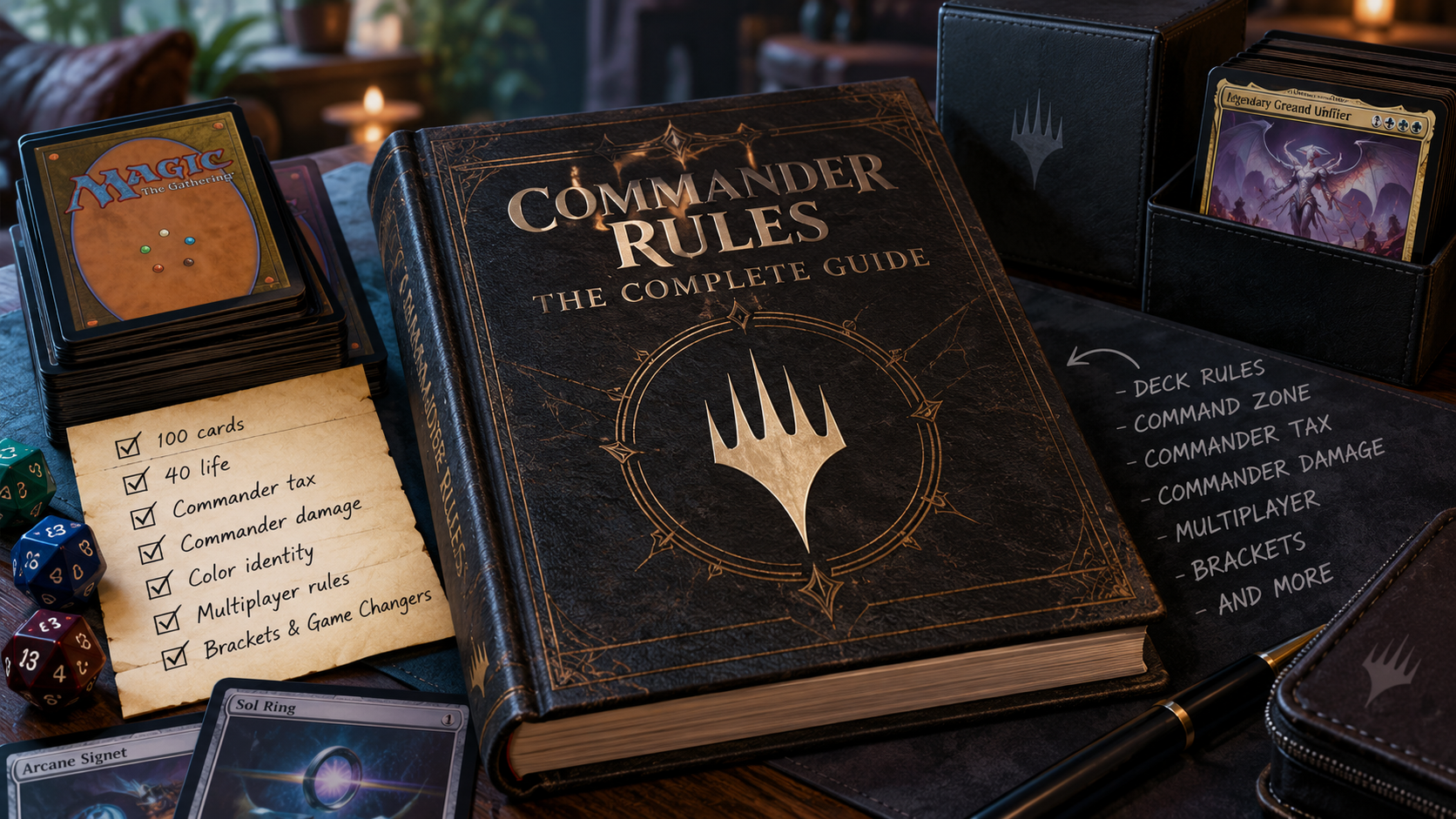
Commander looks intimidating the first time you sit down at a four-player table. Everyone starts with 40 life, there are legendary creatures sitting outside the decks, somebody mentions commander tax, another player is tracking commander damage and before the first turn someone asks what power level everyone is playing.
The good news is that Commander is much easier to learn than it first appears. Most of the normal rules of Magic still apply. Commander simply adds a handful of important rules covering deck construction, your commander, color identity and multiplayer gameplay.
This guide explains those rules from the beginning, including the situations that cause the most confusion at real Commander tables.
Commander is only one of many ways to play Magic. If you want to compare it with Standard, Modern, Pioneer, Draft and other formats, our MTG Formats guide explains the major differences.
If Commander is your very first experience with Magic, you may want to start with our beginner’s guide to playing Magic before learning Commander’s additional rules.
What Is Commander in Magic: The Gathering?
Commander is a multiplayer Magic format built around a legendary card known as your commander. A typical game contains four players, although Commander can also be played with different numbers of players.
Instead of a traditional 60-card deck, each player brings a 100-card singleton deck. Your commander normally begins the game face up in the command zone rather than being shuffled into your library.
Commander is also a non-rotating format. Cards from across Magic’s history can be used as long as they are legal in Commander and fit within your commander’s color identity.
The result is a format with enormous deck-building freedom. One table might contain Dinosaurs, Zombies, artifacts and a deck built entirely around creating Food tokens. Another might contain four highly optimized decks trying to win within only a few turns.
That variety is a large part of Commander’s appeal.
Commander Rules at a Glance
If you just want the essentials, these are the most important Commander rules to remember:
| Rule | Commander |
|---|---|
| Deck size | Exactly 100 cards including commander |
| Starting life | 40 |
| Copies of each card | Usually 1 |
| Basic lands | Any number |
| Commander | Usually a legendary creature or another card specifically allowed as a commander |
| Starting zone | Command zone |
| Commander tax | Additional for every previous cast from the command zone |
| Commander damage | 21 combat damage from the same commander causes a loss |
| Card pool | Non-rotating, subject to Commander legality |
| Typical players | 4 |
| Mulligan | Multiplayer mulligan rules |
Once you understand those concepts, most of Commander plays like normal Magic.
How Many Cards Are in a Commander Deck?
A Commander deck contains exactly 100 cards including your commander.
With one commander, that normally means:
1 commander + 99 cards in the deck = 100 cards total
Commander is not a format where 100 is simply the minimum. You cannot bring 101 or 105 cards because you could not decide what to cut.
If you have two legal commanders through mechanics such as partner, those two commanders are included within the same 100-card total, leaving 98 cards in the library.
Commander Is a Singleton Format
Commander normally allows only one card with each English card name in your deck. This is known as the singleton rule.
Basic lands are the most obvious exception, so you can include as many Plains, Island, Swamp, Mountain and Forest cards as your mana base requires.
Some individual cards also specifically allow you to break the singleton restriction. Relentless Rats, for example, contains a rule allowing any number of cards with that name in your deck.
For normal cards, however, one copy is the limit.
This rule is one reason Commander games tend to have so much variety. Even two decks built around the same commander can play very differently because they cannot simply fill themselves with four copies of their best cards.
What Can Be Your Commander?
Your commander will normally be a legendary creature. Certain cards specifically state that they can be your commander even though they would not normally qualify, and some mechanics allow two cards to share the command zone.
The important word is legendary. You cannot simply choose your favorite normal creature as your commander.
Your commander is revealed before the game and begins face up in the command zone. Everyone therefore knows which commanders they are facing before the game starts.
That information matters. Seeing Pantlaza, Sun-Favored immediately suggests Dinosaurs and large creatures. Seeing Stella Lee, Wild Card suggests a deck built around casting multiple spells. Seeing The Wise Mothman tells the table to expect milling, counters and graveyard interactions.
Your commander is not just another card in the deck. It defines both your strategy and the cards you are legally allowed to include.
What Is Commander Color Identity?
Color identity is one of the most important Commander deck-building rules and one of the easiest for new players to misunderstand.
Your commander’s color identity determines which colors can appear in your deck.
Color identity considers the colors of the card itself as well as colored mana symbols appearing in its mana cost and rules text.
For example, a commander with a color identity allows you to play cards with green, blue, green-blue or colorless identities. You cannot include a card whose color identity contains , or .
Color Identity Is Not the Same as Card Color
This distinction matters.
A card can look colorless but still have a colored identity because a colored mana symbol appears somewhere in its rules text. Likewise, simply mentioning the word „red“ or „green“ in rules text does not automatically add that color to its identity.
The actual symbols matter.
Color identity is established before the game begins and does not change just because an effect changes the color of a permanent during the game.
What About Lands?
Your mana base must also respect color identity. Lands with basic land types or colored mana symbols can create deck-building restrictions just like other cards.
A simple rule for beginners is to look at every colored mana symbol associated with a card. If a color appears that your commander does not have access to, check the card before putting it into the deck.
What Is the Command Zone?
The command zone is a special game zone where your commander begins the game. It sits face up there rather than inside your library.
You may cast your commander from the command zone as though you were casting it normally. Once it resolves, it enters the battlefield and behaves like any other permanent of its type.
The major difference appears when your commander leaves the battlefield. Commander rules give you ways to return it to the command zone rather than permanently losing access to the most important card in your deck.
This is why commanders can appear several times during the same game.
What Is Commander Tax?
Every time you cast your commander from the command zone after the first time, it costs an additional for each previous time you have cast that commander from the command zone during the game.
This additional cost is commonly called commander tax.
Imagine your commander normally costs .
The first cast from the command zone costs:
If it returns to the command zone, the next cast costs:
After another trip back, the following cast costs:
The tax keeps increasing throughout the game.
Does Commander Tax Reset?
No.
Commander tax does not reset when your commander dies, changes zones, gets shuffled somewhere or changes controller. It tracks how many times that particular commander has been cast from the command zone during the game.
It also does not increase simply because your commander entered the command zone. The tax increases because you cast it from the command zone.
That distinction matters.
Does Commander Tax Apply to Alternative Costs?
Yes. Using an alternative casting cost does not allow you to ignore commander tax. The additional for previous command-zone casts still applies.
What Happens When Your Commander Dies?
This is one of the most commonly misunderstood Commander rules.
When your commander would go to your hand or library, you can choose to move it to the command zone instead. When a commander goes to the graveyard or exile, it reaches that zone normally, then its owner gets an opportunity to move it to the command zone as state-based actions are checked.
That detail can matter because some abilities trigger when a creature dies.
If your commander dies and reaches the graveyard, relevant death triggers can still occur even if you subsequently move the commander back to the command zone.
You are also not forced to return it.
Sometimes you may intentionally leave a commander in the graveyard because your deck contains an easy way to return creatures from the graveyard to the battlefield. Moving it back to the command zone is a choice, not an automatic requirement in every situation.
Can You Put Your Commander in Your Hand?
Yes.
If an effect would put your commander into your hand, you can choose to leave it there instead of returning it to the command zone.
That can occasionally be useful because casting a commander from your hand does not involve commander tax.
The downside is information and vulnerability. Once your commander enters your hand, it behaves like a normal card in your hand and can potentially be affected by discard or other effects.
Can Your Commander Be Exiled?
Yes.
A commander can be exiled just like another permanent. After it enters exile, you normally get the opportunity to move it to the command zone.
You can also choose to leave it in exile if there is a strategic reason to do so.
The important point is that exile does not permanently solve the problem of an opposing commander. In most situations, its owner will simply move it back to the command zone and can cast it again later with the appropriate commander tax.
What Is Commander Damage?
Commander introduces an additional way to lose the game.
If a player has been dealt 21 or more combat damage by the same commander over the course of the game, that player loses.
This damage is tracked separately for each commander.
Suppose Pantlaza, Sun-Favored deals 8 combat damage to you during one turn, 7 during another and 6 later.
8 + 7 + 6 = 21.
You lose the game even if your normal life total is still above zero.
Commander Damage Must Be Combat Damage
This is extremely important.
Only combat damage dealt by a commander counts toward the 21-damage rule.
If your commander has an ability that deals 5 damage to an opponent, that damage may reduce the opponent’s normal life total, but it does not count as commander damage.
The commander needs to deal the damage as a creature in combat.
Commander Damage Is Per Commander
Damage from multiple commanders is not added together.
If one commander has dealt 12 combat damage to you and another has dealt 10, you have taken 22 total combat damage from commanders but you have not lost to commander damage.
Neither individual commander has reached 21.
This also matters in games where a player has two commanders. Each one tracks commander damage separately.
Does Commander Damage Reset?
No.
Commander damage remains tracked throughout the game. Removing the commander, returning it to the command zone or casting it again does not erase the damage it has already dealt.
Even if another player takes control of that commander, it remains the same commander for purposes of tracking commander damage.
Why Is Commander Damage 21?
The 21-damage rule makes combat-focused commanders a legitimate way to win even though every opponent begins with 40 life.
This is especially important for Voltron strategies, which invest heavily in turning one commander into a large attacker through Equipment, Auras or counters.
Without the commander-damage rule, those decks would often need to deal the full 40 points to each opponent. With commander damage, a sufficiently large commander can eliminate a player after dealing 21 combat damage over one or more attacks.
How Much Life Do You Start With in Commander?
Each player normally begins a multiplayer Commander game with 40 life.
This is double the traditional starting total of many one-on-one Magic formats and significantly changes how cards behave.
Effects that cost a few points of life are often easier to use in Commander because you begin with a larger resource pool. At the same time, you are facing multiple opponents, so 40 life can disappear much faster than it looks.
Commander damage also means a large life total does not protect you from everything. You could theoretically have 100 life and still lose after taking 21 combat damage from one commander.
Who Goes First in Commander?
Players determine the starting player using an agreed random method and turns then proceed around the table.
Unlike a duel, the game is built around several players sharing the same battlefield. You can attack different opponents with different creatures, target any legal player or permanent and make strategic decisions based on what everyone at the table is doing.
That multiplayer element changes Magic considerably.
The player currently leading the game is not necessarily the player you should attack. Another opponent may have fewer permanents but a much more dangerous engine. Sometimes helping one player deal with another is actually in your own best interest.
Commander is as much about evaluating the entire table as evaluating the cards directly in front of you.
How Does Mulligan Work in Commander?
Commander uses multiplayer mulligan rules. Players begin with seven cards and may take a mulligan if their opening hand is not suitable.
In a typical multiplayer game, the first mulligan is especially forgiving, which helps reduce games where someone effectively cannot participate because of a terrible opening hand.
After additional mulligans, the normal London mulligan system means you draw a fresh seven cards and then put an appropriate number of cards on the bottom of your library based on the mulligans taken.
The practical lesson is more important than memorizing the procedure: do not keep a nonfunctional opening hand just because it contains exciting cards.
A seven-card hand with one land and multiple six-mana spells is usually not a good Commander hand. You need enough mana to actually play the game.
Can You Attack More Than One Player?
Yes.
During your combat phase you can send different attacking creatures at different opponents. You can also attack planeswalkers or other legal battle-type objects when the rules allow it.
For example, if you have six creatures, three could attack Player A, two could attack Player B and one could attack Player C.
You are not required to choose one opponent and send everything at them.
This creates an enormous number of tactical decisions, particularly when different players have different blockers and life totals.
What Happens When a Player Loses?
Commander does not immediately end when one player loses. The remaining players continue until the game produces a winner.
When a player leaves the game, cards they own leave with them. This can create some unusual board-state changes if other players had stolen or gained control of their permanents.
For most casual games, the practical version is simple: the eliminated player collects their cards while everybody else keeps playing.
Can You Have Two Commanders?
Yes, but only when the cards or mechanics specifically allow it.
The best-known example is partner. Two commanders with compatible partner abilities can begin the game together in the command zone.
Some cards have more restrictive versions such as „partner with,“ which allows a specific pair to work together. Other mechanics have also created different ways to use two commanders.
When two commanders are legal, their combined color identities determine which cards can be included in the deck.
Commander tax is tracked independently for each commander, and commander damage is also tracked independently.
You cannot simply choose any two legendary creatures and declare them partners.
Can a Planeswalker Be a Commander?
Not normally.
Being legendary by itself is not enough for a planeswalker. A planeswalker needs an ability specifically stating that it can be your commander or another rule that makes it eligible.
For example, if a planeswalker explicitly says it can be your commander, you may build around it normally and its color identity determines your deck just like any other commander.
Always check the actual card rather than assuming every legendary planeswalker qualifies.
Can Artifacts Be Commanders?
Some legendary noncreature cards can serve as commanders when the rules or the card itself specifically allow them to do so. Commander eligibility has also expanded through particular card types and rules updates over Magic’s history.
For deck-building purposes, the safest rule is simple: do not assume every legendary permanent can automatically be your commander. Check the current card text and Commander legality when choosing anything other than a normal legendary creature.
Do Commanders Have Summoning Sickness?
Yes.
Being your commander does not allow a creature to ignore the normal rules for summoning sickness.
If your commander enters the battlefield and does not have haste, it normally cannot attack or use an ability containing or until you have controlled it continuously since the beginning of your most recent turn.
A card such as Lightning Greaves can change that by granting haste.
Moving a commander out of the command zone does not give it any special exemption from the normal rule.
Can You Counter a Commander?
Absolutely.
A commander cast from the command zone is a spell just like another spell while it is on the stack. It can therefore be countered by appropriate effects.
If the spell is countered and the commander eventually moves back to the command zone, the cast still happened.
That means commander tax will be higher next time.
This is an important distinction. Commander tax counts casts from the command zone, not successful resolutions.
Can You Steal Someone’s Commander?
Yes.
Nothing about being a commander prevents another player from taking control of it.
If you steal an opponent’s commander, it remains their commander even though you control it. It can still deal commander damage, and that damage is tracked using the identity of the commander itself.
The owner does not simply get to move it back to the command zone because another player gained control of it. A normal control-changing effect does not cause the commander to change zones.
That makes stealing a dangerous commander a legitimate strategy.
Can You Copy a Commander?
Yes, but a copy is generally not automatically considered a commander.
„Commander“ is a designation attached to the actual card that began the game as a commander. Simply copying its characteristics does not transfer that designation.
If you create a token copy of an opposing commander, that token can look and function like the copied creature, but combat damage dealt by the token does not suddenly become commander damage merely because it copied a commander.
This is a common source of confusion.
Does Commander Damage Work With Infect?
Commander damage and poison counters are separate loss conditions.
If a commander with infect deals combat damage, the interaction can become unusual because infect changes how that damage affects players. The important principle is that commander damage cares about qualifying combat damage from the commander, while poison is tracked independently under its own rules.
A deck does not need to choose only one route to victory. It can potentially pressure opponents through life totals, commander damage and poison during the same game.
What Cards Are Banned in Commander?
Commander has its own banned list.
The list contains cards considered inappropriate for the format for various reasons, including extremely powerful effects or gameplay patterns that are considered problematic. Because the banned list can change, it is better to check current legality than rely on an old printed list.
Notable banned cards currently include Black Lotus, Mana Crypt, Jeweled Lotus, Dockside Extortionist, Golos, Tireless Pilgrim and Griselbrand.
Before buying an expensive card specifically for Commander, checking its current legality takes only a moment and can save an unpleasant surprise.
Once you understand the rules, our Best Commander Cards guide can help you choose efficient staples for your first deck.
What Are Commander Brackets?
Modern Commander covers an enormous range of power levels. One group might want a relaxed game with thematic decks, while another table might be playing highly optimized lists capable of ending games extremely quickly.
Commander Brackets were introduced to make those conversations easier.
The current system divides Commander into five broad levels:
Bracket 1: Exhibition
Focused on highly social, expressive or unusual Commander experiences.
Bracket 2: Core
Designed around relatively straightforward casual Commander.
Bracket 3: Upgraded
More powerful and intentionally upgraded decks with access to a limited number of Game Changers.
Bracket 4: Optimized
Powerful decks built with efficiency and strong win conditions in mind.
Bracket 5: cEDH
Competitive Commander, where players are expected to use the strongest strategies available to win.
The important point is that brackets are not another set of normal tournament legality rules. They are primarily a tool for helping players find games with compatible expectations.
What Are Game Changers?
Game Changers are cards considered capable of having an unusually large impact on casual Commander games. They can create extreme resource advantages, enable very efficient tutoring, heavily restrict opponents or otherwise signal that a deck is operating at a different level from a normal casual list.
The bracket system uses the Game Changers list as one of several ways to describe expected power.
At the moment, lower brackets restrict them more heavily, while higher-power brackets allow greater access.
Do not think of a Game Changer as the same thing as a banned card. A banned card cannot normally be played in Commander. A Game Changer can still be legal, but its inclusion may affect the bracket and expectations around your deck.
What Is the Rule Zero Conversation?
Long before formal brackets existed, Commander players commonly used what became known as the Rule Zero conversation.
The idea is simple: talk before the game.
What kind of decks are everyone playing? Are they unmodified precons? Are infinite combos involved? Is somebody testing a highly optimized deck? Is everyone comfortable with unusual house rules?
A thirty-second conversation can prevent a miserable hour-long game.
The goal is not to calculate a scientifically perfect power level. It is to make sure four people broadly understand what kind of game they are about to play.
Commander Brackets make that conversation easier, but they do not replace common sense.
Do Commander Precons Follow the Same Rules?
Yes.
Official Commander preconstructed decks are designed as legal Commander decks when released. They contain a complete 100-card list and one or more possible commanders.
You can open a precon, choose the intended commander and start playing without constructing a deck from scratch. That makes precons one of the easiest ways to learn Commander because you can focus on understanding the game before worrying about building an entire 100-card deck.
If you are preparing for your first Commander night, our Best MTG Accessories guide explains which sleeves, deck boxes, playmats, dice and other accessories are actually useful, and which ones you can safely skip.
If you are looking for your first deck, see our Best Commander Precons of All Time guide to compare some of the strongest ready-to-play options.
Do You Need a Precon to Play Commander?
No.
You can build your own Commander deck entirely from individual cards, modify a preconstructed deck or rebuild an existing deck around a different commander.
Building from scratch gives you complete control over the strategy, budget and power level, but the number of choices can be overwhelming for a first-time player.
If you would rather build your own list, our complete How to Build a Commander Deck guide explains the entire process from choosing a commander to balancing lands, ramp, draw and removal.
Precon or Singles: Which Is Cheaper?
There is no universal answer.
Some Commander precons contain enough valuable cards that buying the complete product is excellent value. Others become expensive after going out of print even though buying the individual cards inside would cost substantially less.
Prices also change constantly as cards are reprinted and Commander strategies become more or less popular.
Use our Precon Calculator to compare the value of the cards inside a Commander deck with the cost of buying the sealed precon before you spend your money.
Common Commander Rules Players Get Wrong
Commander is full of small misconceptions that survive because somebody learned the rule from another player instead of checking how it actually works.
Commander Damage Includes Ability Damage
It does not. Commander damage specifically cares about combat damage dealt by the commander.
Commander Tax Increases Whenever the Commander Dies
It does not. Commander tax is based on previous casts from the command zone.
Commander Damage From Different Commanders Adds Together
It does not. Each commander is tracked separately.
Commanders Cannot Be Countered
They absolutely can.
A Copied Commander Deals Commander Damage
Normally it does not. Commander status belongs to the actual designated commander rather than everything that copies its characteristics.
Your Commander Must Always Return to the Command Zone
No. Returning the commander is frequently optional, and there are situations where leaving it in another zone is strategically correct.
Every Legendary Permanent Can Be a Commander
No. A normal legendary creature qualifies, while other card types require specific permission or applicable rules.
Commander Is Always Casual
Commander can be extremely casual, extremely competitive or almost anything between those extremes. The table determines what kind of game it wants to play.
The Most Important Commander Rule Is Knowing What Kind of Game You Are Playing
The technical rules make Commander function, but they are only half of what makes the format work.
Commander puts four decks with potentially thousands of different cards at the same table. One player may have bought their first precon yesterday. Another may have spent years tuning a deck full of powerful staples. Both decks can be perfectly legal while producing a terrible game when matched together.
That is why the short conversation before the first hand is so important.
You do not need to negotiate every card in your deck. Just give the table enough information to understand what you are bringing. Brackets, Game Changers and simple descriptions such as „unchanged precon,“ „upgraded tribal deck“ or „optimized combo deck“ can make that conversation much easier.
Once everybody understands the expectations, the actual rules of Commander are surprisingly straightforward. Build exactly 100 cards, stay within your commander’s color identity, start at 40 life, track commander tax and commander damage, and remember that the legendary card sitting in your command zone is going to have a very large influence on the game.
After a few matches, most of these rules stop feeling unusual at all.
Then you can focus on the part that makes Commander so addictive: figuring out what your deck can do next.


