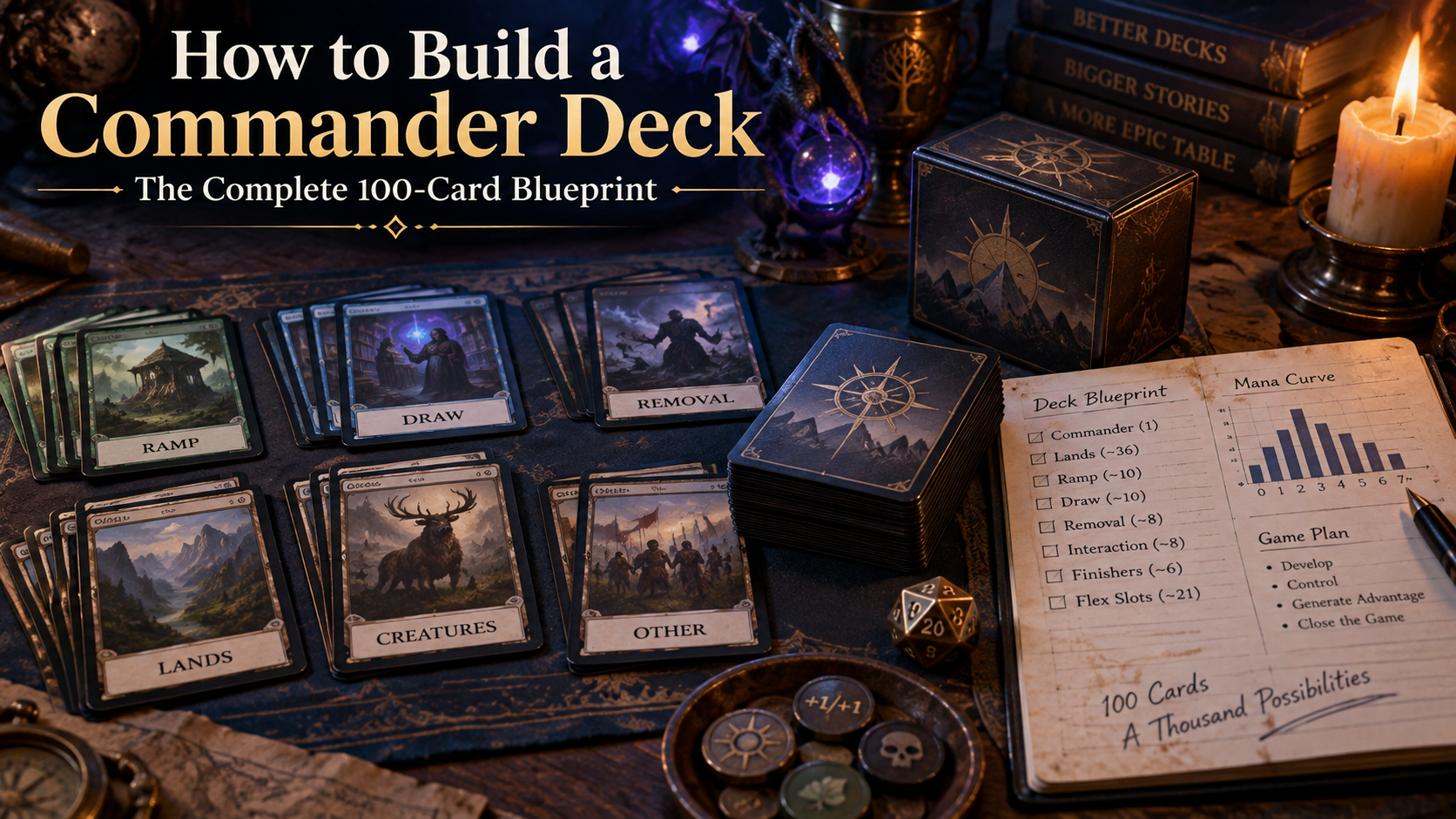
Building your first Commander deck can feel strangely difficult. You have 100 cards to fill, decades of Magic sets to choose from and thousands of cards that technically fit your colors. Open a deck-building website and it is easy to spend an hour adding interesting cards before realizing you have 137 cards, 29 lands and absolutely no plan for how the deck is supposed to win.
The good news is that building a functional Commander deck becomes much easier once you stop thinking about individual cards and start thinking about jobs. Every good deck needs mana, card advantage, ways to answer opposing threats and a clear plan for actually winning the game. Your commander and strategy determine how those jobs are filled, but the basic structure remains surprisingly consistent.
This guide will show you how to build a Commander deck from scratch using a practical 100-card blueprint. The numbers below are not rigid rules. They are starting points that you can adjust once you have played the deck and learned what it actually needs.
Commander Deck Building Rules
A standard Commander deck contains exactly 100 cards including your commander. In most cases your commander is a legendary creature, although some cards specifically allow other card types to serve as commanders.
Commander is also a singleton format. With the exception of basic lands and cards whose own rules specifically allow otherwise, you can only include one copy of each card.
Your commander’s color identity determines what can go into the deck. If your commander has a color identity, for example, your deck can contain green, blue, green-blue and colorless cards, but you cannot include cards with , or in their color identity.
Once those basic rules are satisfied, you have enormous freedom over how the remaining 99 cards are built.
This section covers the deck-building rules you need to get started, but Commander also has several gameplay rules that are unique to the format. If you want a full explanation of commander tax, commander damage, the command zone, mulligans and color identity, read our complete Commander Rules guide.
A Simple Commander Deck Blueprint
If you have no idea where to begin, a balanced Commander deck can start somewhere around 36 to 38 lands, 10 ramp cards, 10 sources of card draw or card advantage, 8 to 10 pieces of targeted interaction, 2 to 4 board wipes and several cards devoted to protection or recursion. Everything left over goes toward the actual strategy of the deck.
| Category | Starting Point |
|---|---|
| Commander | 1 |
| Lands | 36–38 |
| Ramp | 10 |
| Card Draw / Card Advantage | 10 |
| Targeted Interaction | 8–10 |
| Board Wipes | 2–4 |
| Protection / Recursion | 3–5 |
| Strategy / Synergy / Win Conditions | Remaining Slots |
These numbers are not commandments. A landfall deck may want 40 or more lands, while a low-curve spellslinger deck may be able to play fewer. A graveyard deck might use cards that provide recursion, card advantage and synergy at the same time.
That overlap is important because the strongest Commander decks rarely use every card for just one purpose. A creature that advances your strategy while drawing a card is more useful than one that only provides stats. A removal spell that can also protect one of your permanents gives you flexibility, while a land with a useful activated ability can provide value without taking up another spell slot.
Think of the blueprint as the skeleton of the deck. Your commander and strategy provide everything else.
Step 1: Choose the Right Commander
Your commander is the most important card in the deck because you have access to it every game. That does not mean you should simply choose the strongest legendary creature you can find. The better question is whether the commander supports something you actually want to do.
If you choose Pantlaza, Sun-Favored, the direction is immediately obvious. Pantlaza rewards Dinosaurs entering the battlefield, so the deck naturally wants Dinosaurs, ramp and ways to extract additional value from large creatures. Choose The Wise Mothman and suddenly you care about milling, rad counters and +1/+1 counters. Choose Stella Lee, Wild Card and creatures become much less important than cheap instants, sorceries and ways to cast several spells in one turn.
A good commander gives your deck direction. Ideally it should generate some kind of value, actively support the strategy and still leave the deck functional when it is removed. Most importantly, you should enjoy what the commander asks you to do. Commander decks often stay together for years, so there is little point in building around a strategy you do not actually enjoy playing.
Still deciding which legendary creature to build around? Our How to Choose Your First Commander guide helps you find the right commander based on your preferred playstyle, colors, budget, and experience level, with beginner-friendly examples and ready-to-play precon recommendations.
Step 2: Decide How the Deck Wins
One of the most common deck-building mistakes is starting with 99 cards instead of starting with a plan. Before filling the deck, finish one simple sentence:
My deck wants to win by…
Maybe the answer is attacking with a huge army of creature tokens. Perhaps you want one enormous commander to deal 21 commander damage. Maybe the deck plans to drain the table whenever creatures die, overwhelm opponents with Dinosaurs or assemble a specific combination of cards.
The exact plan does not matter nearly as much as having one. If you cannot explain how the deck expects to win in one or two sentences, you probably do not yet have a deck. You have a collection of cards.
It is also useful to have a secondary path to victory. A token deck might primarily win through combat but also include effects that deal damage whenever creatures enter. A graveyard deck might overwhelm opponents through recursion while keeping a large finisher as a backup. The best secondary win conditions usually use resources your deck already produces instead of forcing an unrelated combo into the list.
Step 3: Choose the Right Number of Lands
One of the most common Commander questions is also one of the hardest to answer with a single number: how many lands should a Commander deck have?
For most decks, 36 to 38 lands is a very good starting point. If you are building your first Commander deck and have no compelling reason to do otherwise, start at 37 and adjust after playing.
Decks with high mana curves, expensive commanders, heavy landfall themes or relatively little cheap ramp often want 38 to 40 lands or more. Missing a land drop in Commander can be extremely painful because while your opponents continue developing their boards, you are effectively losing access to increasingly powerful turns.
Low-curve decks with a lot of cheap card selection or efficient mana acceleration can sometimes move down toward 34 or 35 lands, but that decision should come from testing rather than wishful thinking. Cutting lands because you found another exciting seven-mana spell is not optimization. It is optimism.
Mana rocks do not directly replace lands either. A hand containing two lands and Sol Ring can be excellent, but a hand with one land and several expensive mana rocks can still be unplayable. Ramp helps you move beyond normal land drops. It does not mean you can remove ten lands from the deck.
Step 4: Add Around 10 Ramp Cards
Commander games involve expensive spells, repeated commander casts and multiple opponents, so getting ahead on mana is one of the easiest ways to make a deck function better. Around 10 ramp cards is a strong starting point for many casual decks.
Artifact ramp works in almost every color combination. Sol Ring is the obvious example, while two-mana mana rocks can help move you from two mana to four ahead of schedule.
Green decks have another option: land ramp. Cultivate and Kodama’s Reach are classic examples because they help both your battlefield and future land drops. Lands are also generally harder for opponents to remove than mana rocks.
Creature ramp can be even faster. Llanowar Elves costs only and can begin accelerating you almost immediately, although creatures are much more vulnerable to removal and board wipes.
The important thing is not simply to play as much ramp as possible. A deck containing 18 mana rocks but very little card advantage may accelerate beautifully and then run out of useful things to cast. The goal is not to generate the most mana. It is to use your mana efficiently.
Looking for specific cards to fill those roles? Our Best Commander Cards guide covers the strongest staples for ramp, draw, removal, protection and more.
Step 5: Play Enough Card Draw
Not playing enough card draw is probably the most common mistake in casual Commander decks.
Commander games last much longer than normal one-on-one Magic, and you have three opponents producing threats that need to be answered. If your deck empties its hand and then spends the next five turns drawing one card at a time, it will struggle regardless of how powerful those individual cards are.
Start with roughly 10 sources of card draw or repeatable card advantage. Some can be one-time effects, while others can stay on the battlefield and continue generating cards over several turns.
A card such as Night’s Whisper gives you an immediate burst of cards. A permanent capable of producing cards repeatedly may eventually generate far more value, although opponents also have time to remove it. Good Commander decks usually combine both types.
Your commander can also contribute toward this number. Hakbal of the Surging Soul, for example, improves card quality and can generate additional land value as your Merfolk explore. That does not mean you should remove every other card-advantage engine. Your commander can still be removed or become too expensive to cast, so the deck should continue functioning without it.
Step 6: Play Enough Interaction
Your deck is trying to do something powerful, but so are three other decks. You need ways to stop them.
Around 8 to 10 pieces of targeted interaction is a reasonable starting point for many Commander decks. This includes creature removal, artifact and enchantment removal, counterspells and flexible effects that can answer several permanent types.
Flexibility is particularly valuable because Commander is unpredictable. Against one opponent the biggest threat might be a creature, while against another it could be an enchantment, artifact or planeswalker.
Swords to Plowshares remains one of the cleanest examples of efficient creature removal. Beast Within costs more mana but can answer almost any permanent, while Generous Gift provides similar flexibility in white.
The small advantage you give an opponent often matters far less than removing the card that was about to win the game.
Step 7: Include a Few Board Wipes
Sometimes targeted removal is not enough. One player has twelve creatures, another has produced an army of tokens and trying to answer the battlefield one card at a time is no longer realistic.
That is why most Commander decks should consider around 2 to 4 board wipes.
White is famous for cards such as Wrath of God, but mass removal exists in many colors and forms. The exact number depends on your strategy. Control decks may want more, while aggressive creature decks often want fewer because repeatedly destroying your own battlefield works against your plan.
The important thing is having at least some way to recover when another player gets far ahead.
Step 8: Protect Important Cards
Players naturally focus on cards that advance their own game plan and forget that opponents have removal too. If your entire strategy depends on keeping a particular commander or permanent alive, protection becomes much more important.
Cards such as Heroic Intervention can protect a developed board from certain removal effects. Other decks may rely on counterspells, blink effects or recursion instead.
Protection and recursion solve the same problem in different ways. Protection stops important cards from leaving, while recursion brings them back afterward. Graveyard decks and sacrifice strategies may actually prefer recursion because creatures dying is already part of the plan.
A good Commander deck does not necessarily care whether something dies. It cares whether losing that permanent permanently stops the strategy.
Step 9: Fill the Deck With Synergy
Once the deck has enough mana, draw and interaction, the remaining slots are where its personality appears.
The biggest trap is filling those slots with generically powerful cards that have very little connection to one another. If you are building Pantlaza, Sun-Favored, a powerful creature is not automatically a powerful Pantlaza card. A Dinosaur that advances the strategy, triggers Pantlaza and interacts with tribal effects may contribute more to the deck than an individually stronger creature with no relevant synergy.
Whenever you add a card, ask one simple question: Why is this card in this deck?
„I like it“ is a perfectly acceptable answer in casual Commander. „It is powerful“ can also be valid. But if half the deck has no better explanation than that, you may struggle to create a coherent strategy.
Step 10: Check the Mana Curve
Once you have 99 cards and a commander, you are still not finished. Look at how much your spells actually cost.
A deck can contain the correct number of lands, ten pieces of ramp and excellent card draw while still performing badly because almost every spell costs five or more mana. If you have plenty of useful plays at two and three mana, you are more likely to develop the battlefield early. If the deck is full of six, seven and eight-mana cards, you may spend the first several turns doing very little.
Commander gives expensive cards a place to shine, but that does not mean every expensive card belongs in the same deck. High-cost spells need to justify their place by having a meaningful impact when they resolve.
If you spend seven mana on a card that does almost nothing until your next turn, compare it with another seven-mana spell that immediately draws cards, removes something, creates several permanents or threatens to win. The mana cost may be identical, but the impact is not.
Not sure if your deck has too many expensive spells or enough early-game plays? Our Commander Mana Curve Guide explains how to calculate your average mana value, balance your spell costs, and build a faster, more consistent EDH deck.
To calculate your actual mana curve, you can use our tool.
How Many Creatures Should Be in a Commander Deck?
There is no universal number. A tribal creature deck might contain 30 or more creatures, while a spellslinger deck may contain dramatically fewer.
That is why „How many creatures should a Commander deck have?“ is not quite the right question. The better question is: How many creatures does my strategy need?
A Pantlaza, Sun-Favored deck clearly wants plenty of Dinosaurs because creatures activate the commander’s main engine. A Stella Lee, Wild Card deck has very different priorities. Filling half that deck with creatures would reduce the number of instants and sorceries needed to make Stella work properly.
The strategy determines the ratio.
Still deciding whether Commander is the right way to play Magic for you? Our complete MTG Formats guide compares Commander with Standard, Pioneer, Modern, Limited and other popular formats.
Building a Commander Mana Base
Once you know how many lands the deck needs, you still have to make sure it produces the right colors. Mono-colored decks make this relatively simple, while two, three, four and five-color decks require much more planning.
Do not simply divide your basic lands evenly between your commander’s colors. Look at the cards you actually need to cast. If most of your early spells require green while blue cards tend to appear later in the curve, you probably want more green sources even if both colors appear equally in the deck.
Untapped lands matter as well. Commander players love utility lands and multicolor lands with interesting abilities, but if too many lands enter tapped, your deck effectively plays a turn behind everyone else. Tapped lands are not automatically bad, especially in budget decks, but entering tapped is still a real cost.
Utility lands can be excellent because they provide useful abilities without taking up another spell slot. Just do not overload the mana base with lands that fail to produce the colors you actually need. Its primary job is simple: let you cast your cards.
Use Cards That Perform More Than One Job
One of the best ways to improve a Commander deck is to look for cards that solve several problems at once.
If the deck needs more card draw and more creatures, a creature that draws cards helps both categories. If you need removal and tribal synergy, look for removal attached to a creature of the relevant type. If you hate drawing too many lands late in the game, utility lands can provide additional functionality.
This is how a 100-card deck becomes efficient. You do not have enough slots to solve every problem with ten completely separate packages, so the categories should overlap whenever possible.
Adjusting the Blueprint for Different Strategies
The basic deck template is only a starting point. Different archetypes naturally want different proportions.
Creature and Tribal Decks
Creature-heavy strategies often dedicate 25 to 35 slots to creatures and look for ways to attach useful effects to those creatures. A tribal deck becomes much stronger when its creatures do more than simply attack.
Spellslinger Decks
Spellslinger decks usually contain fewer creatures and far more instants and sorceries. Cheap card selection, cost reduction, instant-speed interaction, spell-copying effects and graveyard recursion become much more important.
A commander such as Stella Lee, Wild Card changes the deck’s entire structure because casting spells is not just support for the strategy. It is the strategy.
Voltron Decks
Voltron decks try to turn one creature, usually the commander, into a lethal threat. Because 21 combat damage from the same commander can eliminate a player, protection becomes especially important.
Equipment and Auras may replace many conventional creature slots, but card advantage still matters. A giant commander does not help much if an opponent removes it and you have nothing left in hand.
Aristocrats Decks
Aristocrats strategies generally want creatures to die. Sacrifice outlets, disposable creatures and death triggers are therefore more important than conventional protection.
Recursion can also outperform protection because bringing creatures back from the graveyard may generate additional value.
Lands and Landfall Decks
Land-based strategies often want more than the standard 37 lands because lands themselves are part of the engine. A deck that benefits every time a land enters the battlefield does not view drawing lands in the same way a normal deck does.
Control Decks
Control decks generally want more interaction and card advantage. They may contain fewer dedicated synergy cards because stopping opponents is itself part of the plan.
However, every control deck eventually needs a way to close the game. Controlling the table for two hours and then losing because you never included a real win condition is not a successful strategy.
How to Build a Commander Deck Step by Step
If staring at 100 empty slots still feels intimidating, use a simple order. Choose the commander first, write down your primary win condition and then build the functional core of the deck before adding the exciting cards.
Start with roughly 37 lands, 10 ramp cards, 10 sources of card advantage, 8 to 10 pieces of interaction and a few board wipes. Add protection or recursion depending on what your strategy needs. Only then fill the remaining slots with the creatures, combos, token generators, tribal pieces or other cards that actually define the deck.
Once the deck is complete, cut it back to exactly 100 cards. This is usually much harder than adding cards in the first place.
How to Cut Cards From a Commander Deck
Most players find adding cards easy. Cutting them is painful.
When your list reaches 112 cards, do not immediately remove lands and interaction just to save your favorite creatures. Start by looking for redundant effects and weak synergy.
Ask yourself whether a card directly supports the strategy, whether another card performs the same job better, whether it is only useful when you are already winning and whether the mana cost is justified by the effect. Also ask whether you would actually be happy to draw that card late in the game.
There is nothing wrong with keeping a card because you like the artwork, flavor or story behind it. Commander is a casual format. Just make that choice deliberately rather than accidentally weakening the functional parts of the deck.
Common Commander Deck-Building Mistakes
The most common mistake is simply trying to fit too many exciting cards into too little structure. Players cut lands because spells are more interesting, remove interaction to make room for another synergy piece and underestimate how many cards they need to draw over a long game.
Another common problem is building completely around the commander. Your commander should improve the strategy, but the deck should not collapse every time somebody removes it. Expect your commander to die.
Trying to do too many things at once is another classic trap. Tokens, lifegain, graveyard recursion, artifacts, +1/+1 counters, Equipment and Dragons can all be fun themes, but they rarely belong in the same deck. Focused decks generally perform better because their cards help one another.
Finally, be careful when copying deck lists online. Deck lists are excellent resources, but buying 99 cards without understanding why they are there teaches you very little. Look at what each package does and decide whether those choices match how you actually want to play.
How Much Should a Commander Deck Cost?
A Commander deck can cost almost anything.
There are surprisingly powerful budget decks because thousands of excellent cards are inexpensive. At the opposite end, optimized mana bases, premium staples and old cards can push deck prices extremely high.
Price is not the same thing as power. A poorly built $500 deck can absolutely lose to a focused $75 list.
Start with a budget and strategy, then spend money where it makes the largest difference. For many casual decks, improving the mana base and replacing inefficient cards provides a bigger upgrade than buying one expensive flashy staple.
Should Beginners Build a Commander Deck From Scratch?
You absolutely can, but you do not have to.
If the ratios, mana curves and card choices in this guide feel overwhelming, starting with a preconstructed Commander deck is one of the easiest ways to learn. A precon gives you a functioning 100-card deck immediately, and playing it several times will teach you exactly what this guide is talking about.
You will notice when you are short on cards, which expensive spells spend entire games in your hand and which cards you are always happy to draw. That experience makes building your own deck dramatically easier.
Once you have a deck ready to play, our Best MTG Accessories guide covers the sleeves, Commander deck boxes, playmats, dice and other gear that are actually worth buying.
Not sure where to start? Read our guide to the Best Commander Precons of All Time to find a ready-to-play deck that matches your style.
Precon or Singles: Which Is Better Value?
Sometimes a preconstructed deck already contains a large percentage of the cards you want, so buying the full deck and upgrading it can cost less than purchasing every card separately. Other times an older precon becomes expensive simply because sealed copies are scarce, while the individual cards inside can be bought for much less.
That is why it makes more sense to compare the numbers rather than assume one option is always cheaper.
Use our Precon Calculator to compare a complete Commander precon with the value of the individual cards inside before you buy.
Test the Deck Before Making Big Changes
Your first version will not be perfect, and it should not be.
Deck building is part of Commander. Play several games before replacing twenty cards at once and pay attention to what actually happens. Are you missing lands? Do you run out of cards? Are you regularly holding removal with no targets? Does your commander die immediately every game? Do you build a large board but struggle to finish opponents?
Real games answer those questions much better than staring at a deck list.
Change a few cards, play again and repeat. Over time, the deck becomes yours rather than somebody else’s theoretical list.
Commander Deck Building FAQ
How many cards are in a Commander deck?
A Commander deck contains exactly 100 cards including the commander. In a normal single-commander deck, that means one commander and 99 other cards.
Can you have more than 100 cards in Commander?
No. Commander decks must contain exactly 100 cards.
Can you have duplicate cards in Commander?
Generally no. Commander is a singleton format, so cards other than basic lands must have different English names unless a card specifically allows multiple copies.
How many lands should a Commander deck have?
Start with approximately 36 to 38 lands, with 37 being an excellent default for an untested casual deck.
Is 35 lands enough for Commander?
It can be, particularly in a deck with a low mana curve and efficient ramp or card selection. For a new deck, however, starting slightly higher is usually safer.
Is 40 lands too many for Commander?
Not necessarily. Landfall decks, high-curve decks and strategies that actively use lands may comfortably play 40 or more.
How much ramp should a Commander deck have?
Around 10 pieces of ramp is a strong starting point for many casual Commander decks.
How much card draw should a Commander deck have?
Aim for approximately 10 sources of card draw or meaningful card advantage in the first version of the deck.
How much removal should a Commander deck have?
Around 8 to 10 pieces of targeted interaction is a reasonable starting point. Try to include answers for several types of permanents rather than only creatures.
How many board wipes should a Commander deck have?
Most casual decks can begin with 2 to 4 board wipes. Control decks may want more, while aggressive creature strategies may want fewer.
How many creatures should a Commander deck have?
There is no universal number. Creature-heavy tribal decks may run more than 30 creatures, while spellslinger and control decks can run dramatically fewer.
What should every Commander deck have?
Almost every functional Commander deck needs reliable mana, card advantage, interaction and a clear way to win. How those roles are filled depends on the strategy.
Final Commander Deck Building Checklist
Before ordering cards or sleeving the deck, check the fundamentals. You should have exactly 100 cards including the commander, a legal color identity, enough lands and early ramp, reliable card advantage, ways to interact with creatures and other permanents, some method of recovering from a dominant battlefield and a clear win condition.
Also look at the mana curve and ask whether the deck can still function when the commander is removed. If most of those pieces are in place, stop adjusting the list for a moment.
Shuffle it and play.
No Commander deck is truly finished on a deck-building website. You only discover what the deck needs after it begins interacting with real opponents. Build a sensible foundation, play enough games to identify the weaknesses and make changes based on what actually happens.
That is how a pile of 100 cards becomes your Commander deck.


