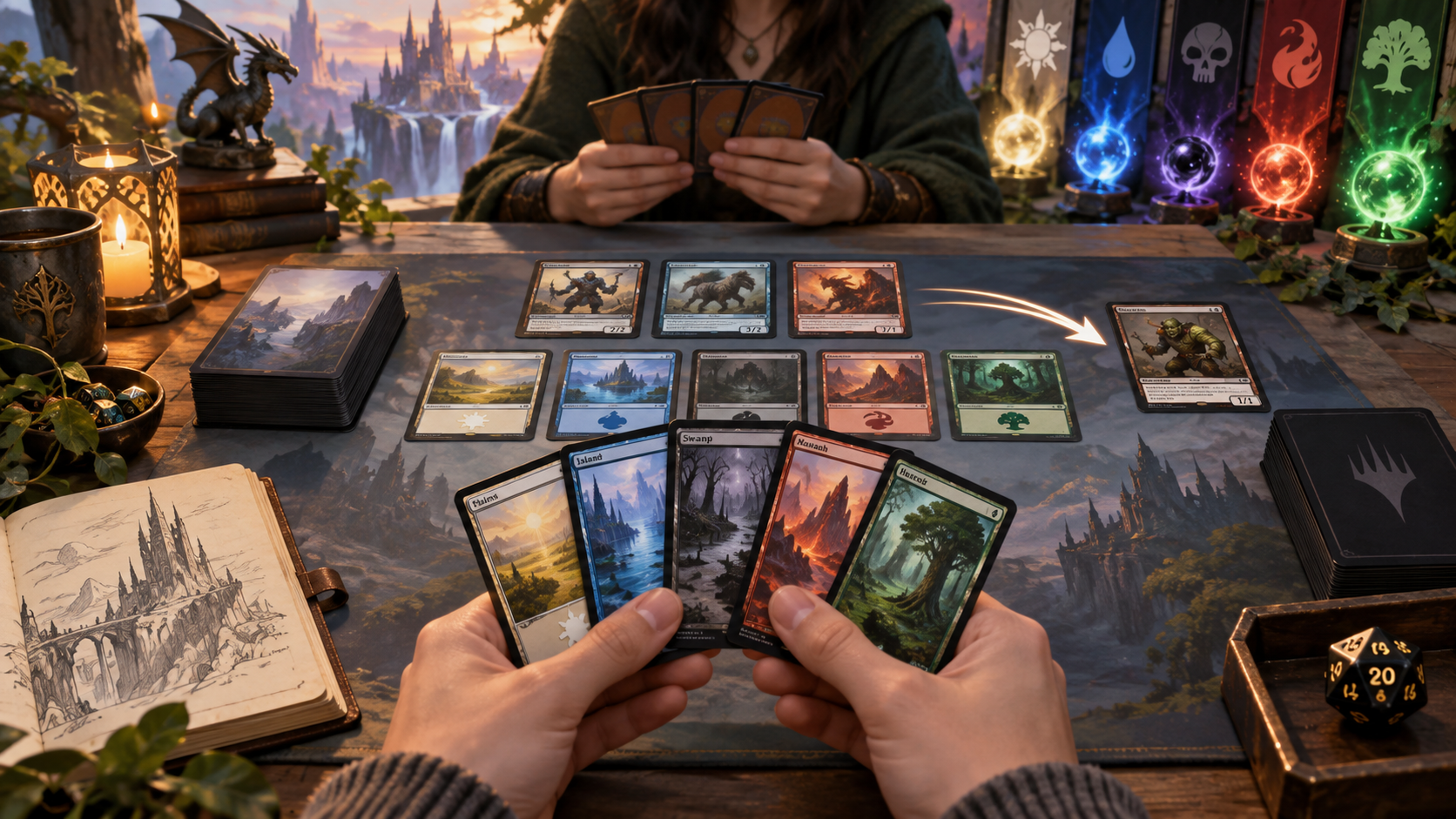
Magic: The Gathering can look almost impossible to understand the first time you watch somebody play. The table is covered in cards, players are turning things sideways, creatures attack and block, spells appear during other people’s turns and everyone seems to know what dozens of symbols and keywords mean without stopping to think about them.
The reality is much friendlier. Magic has a huge rulebook because it has been around for decades and needs to handle thousands of unusual card interactions, but the basic game is surprisingly easy to grasp. You play lands, lands give you mana, mana lets you cast spells, creatures attack and defend, and you try to defeat your opponent before they defeat you.
You do not need to understand everything before your first game. Once you know how cards work, how a turn is structured and how combat happens, you already know enough to sit down and start learning by playing.
This guide takes you through Magic from the beginning, assuming you have never played before.
Magic: The Gathering in Simple Terms
Magic is a strategy card game in which each player brings a deck, shuffles it and draws an opening hand of seven cards. In a traditional two-player game, both players usually begin at 20 life.
Most decks contain two broad categories of cards: lands and spells. Lands generate mana, which is the resource you spend to cast creatures and other spells. Creatures remain on the battlefield and can attack your opponent, while other cards can draw more cards, destroy threats, strengthen your creatures or completely change what is happening in the game.
Players alternate turns, gradually building their battlefields and trying to create an advantage. The most common way to win is reducing your opponent’s life total to zero.
That is the foundation of Magic. Almost everything else is a variation, exception or strategic layer built on top of those basic ideas.
What You Need to Play Magic
For a basic game between two people, you need two decks and some way to track life totals. A sheet of paper, dice or a phone works perfectly well.
You do not need an expensive playmat, premium deck box or large collection to start. Beginner products containing two ready-to-play decks are ideal because the decks are designed to work against each other and keep the first games relatively simple.
Once you know you enjoy Magic, sleeves and a deck box become worthwhile because your cards will be shuffled and handled frequently. Until then, focus on learning the game rather than collecting accessories.
If you are still deciding what type of Magic product actually makes sense for a beginner, our MTG Buying Guide explains the differences between Starter products, Commander decks, Play Boosters, Bundles and individual cards.
Understanding a Magic Card
Every Magic card tells you what it is, what it costs and what happens when you use it. At first the card frame may look like a wall of information, but you quickly learn to focus on a few important areas.
The card’s name appears at the top, usually next to its mana cost. The mana cost tells you how much mana you need to cast the card and which colors are required. The type line tells you whether you are looking at a creature, instant, sorcery, artifact, enchantment, land or another type of card.
Below that is the rules text, which explains what the card does. Creatures also have power and toughness. A 3/4 creature has 3 power and 4 toughness: power determines how much combat damage it deals, while toughness indicates how much damage it can take during a turn before it is normally destroyed.
You do not need to memorize every keyword before playing. When a card introduces something unfamiliar, learn that mechanic in context. Magic becomes much easier when the cards themselves teach you the rules one concept at a time.
The Five Colors of Magic
Magic is built around five colors, each representing a different approach to the game. White , blue , black , red and green are not simply cosmetic choices. They influence what kinds of cards and strategies are available to you.
White often focuses on armies, protection and efficient answers. Blue specializes in card draw, countering spells and manipulating information. Black is willing to trade life, creatures and other resources for power. Red tends to be fast and aggressive, with direct damage and explosive effects, while green excels at generating mana, growing creatures and putting enormous threats onto the battlefield.
Decks can use one color or several colors together. For a first deck, one or two colors are usually easier because the mana base is simpler and you spend less time wondering whether you drew the right kind of land.
How Mana and Lands Work
Mana is the resource used to cast most Magic spells, and lands are the most common way to produce it. During your turn, you normally get to play one land from your hand. You can then tap that land, usually by turning it sideways, to generate mana.
A Plains produces , an Island produces , a Swamp produces , a Mountain produces and a Forest produces .
Suppose a spell costs . You need three mana in total, with at least one of it being green. The represents generic mana and can usually be paid using mana of any type. A spell costing also costs three mana in total, but at least two of that mana must be blue.
This is why drawing the correct lands matters. Having plenty of mana is not useful if you cannot produce the colors your spells require.
Mana normally disappears from your mana pool as steps and phases end, but your lands remain on the battlefield. Once they untap at the beginning of your next turn, you can use them again.
What Tapping Means
Tapping simply means turning a permanent sideways to show that it has been used for something. The tap symbol is written as .
Lands tap to produce mana, creatures normally tap when they attack and many cards have abilities that require tapping as part of their cost. At the beginning of your next turn, your tapped permanents normally untap and become available again.
Being tapped does not mean a card stops existing or loses all of its abilities. It simply affects things that specifically require the permanent to be untapped.
After a few turns, tapping becomes so natural that you barely think about it.
The Main Types of Magic Cards
You will eventually encounter many specialized card types, but beginners can understand most games by learning six main categories.
Lands are your main source of mana and normally stay on the battlefield once played. Creatures also remain on the battlefield and can attack opponents or block attackers. Their power and toughness determine how effective they are in combat.
Instants and sorceries usually create an effect and then go to the graveyard. The important difference is timing. Sorceries are normally cast during one of your own main phases, while instants can be played at many more points in the game, including during an opponent’s turn.
Artifacts are permanents that often represent objects, equipment or magical devices. Some generate mana, others improve creatures or provide repeatable effects. Enchantments also remain on the battlefield and usually create ongoing effects that continue until the enchantment leaves play.
Planeswalkers, battles and more specialized card types can wait. Start with the cards you are most likely to see in a beginner deck and expand from there.
The Main Areas of the Game
Magic cards move between several zones during a game. You do not need to memorize every technical detail, but knowing the major zones makes the table much easier to understand.
Your library is your deck and normally stays face down. Your hand contains the cards you have drawn and may be able to play. The battlefield contains permanents such as creatures, lands, artifacts and enchantments that are currently in play.
The graveyard is where many destroyed, discarded or resolved cards go. It is not simply a trash pile because plenty of cards can interact with or return cards from the graveyard. Exile is another zone used by effects that remove cards from the normal flow of the game.
For your first matches, simply keep each area clear and organized. Much of the apparent complexity of Magic disappears once you can immediately see what is in play, what is in hand and what has already been used.
Starting Your First Game
Both players shuffle their decks and normally draw seven cards. A random method determines who goes first, and in a traditional two-player game the starting player skips the draw step of their first turn.
Before keeping your opening hand, check whether it can actually function. A hand full of powerful spells is not useful if you only have one land and cannot cast anything for several turns.
A beginner-friendly opening hand usually contains a few lands and at least one or two cards you can cast relatively early. You do not need a perfect combination. You simply want to participate in the game.
If the hand clearly does not work, you can take a mulligan.
Mulligans Without the Confusion
Magic currently uses the London mulligan. When you mulligan, you shuffle your hand back into your deck and draw seven new cards. After deciding to keep a hand, you put one card on the bottom of your library for each mulligan you have taken.
After one mulligan you ultimately keep six cards. After two, you keep five.
New players often refuse to mulligan because starting with fewer cards feels terrible. Sometimes it is still better than keeping seven cards that do nothing.
If your hand cannot realistically play Magic, use the mulligan.
How a Turn Works
A normal Magic turn has five main phases: the beginning phase, first main phase, combat phase, second main phase and ending phase. That sounds more formal than it feels in practice.
The rhythm is essentially this:
Untap your cards, draw a card, play things, attack, play more things and finish the turn.
During the beginning phase, your tapped permanents untap, any upkeep effects happen and you normally draw a card. The first main phase is where you can play a land, cast creatures and other spells, and begin developing your battlefield.
Combat comes next. You choose which creatures attack, your opponent chooses blockers and combat damage is dealt. After combat you receive a second main phase, giving you another opportunity to cast spells and play anything you deliberately held back before attacking.
The ending phase cleans up temporary effects and finishes the turn before your opponent begins theirs.
After a few games, you will stop consciously naming every phase. You will simply recognize the natural flow.
How Combat Works
Combat is one of the parts of Magic that initially feels unusual because attackers do not normally choose which opposing creatures they fight.
The attacking player declares which eligible creatures are attacking. Those creatures usually become tapped. The defending player then decides which creatures, if any, will block those attackers.
Suppose you attack with a 3/3 creature and your opponent blocks it with a 2/2. Under normal circumstances, both creatures deal damage to each other at the same time. Your creature deals 3 damage to the 2/2, which is enough to destroy it. The 2/2 deals 2 damage back, so your 3/3 survives.
If the attacking creature is not blocked, its combat damage is normally dealt to the player or object it attacked.
That means attacking is not always automatically correct. A creature you tap to attack may not be available to block during your opponent’s turn. Sometimes pushing damage is worth the risk. Sometimes you are better off keeping defenders.
That tension is one of the foundations of Magic strategy.
Blocking and Multiple Creatures
The defending player can sometimes use more than one creature to block the same attacker. This helps deal with large creatures that would otherwise overwhelm any single blocker.
If two 3/3 creatures block a 5/5 attacker, the blockers collectively have enough power to destroy it. The attacking creature assigns its damage among the blockers according to the combat rules.
Keywords such as first strike, double strike, deathtouch and trample make combat more interesting later, but you do not need them to understand the basic system.
Declare attackers, declare blockers, deal damage.
Everything else builds on that.
Summoning Sickness
A creature normally cannot attack or use an ability requiring or unless you have controlled it continuously since the beginning of your most recent turn. Players usually call this summoning sickness.
That means a creature you cast during your main phase generally has to wait until your next turn before attacking.
It can still block during your opponent’s turn, and abilities that do not require tapping can still work normally.
Creatures with haste can ignore the relevant restriction and attack immediately.
Casting Spells
To cast a spell, you take the card from your hand, announce what you are casting, make any necessary choices and pay the required cost.
For a beginner, that usually means tapping enough lands to generate the mana shown in the card’s upper-right corner.
If you cast Llanowar Elves, which costs , you can tap a Forest for and use that mana to pay for the spell. If nothing interferes, the creature resolves and enters the battlefield.
Creature spells, artifacts and enchantments normally remain on the battlefield after resolving. Instants and sorceries perform their effect and normally go to the graveyard.
The interesting part is that opponents often have a chance to respond before a spell resolves.
Instants, Responses and the Stack
One of Magic’s defining features is that players can interact with things while they are happening.
Suppose you cast a spell that strengthens one of your creatures. Your opponent may respond with an instant that destroys that creature before your spell resolves. Both spells are temporarily waiting to happen, and Magic uses the stack to determine their order.
The easiest way to understand the stack is to imagine placing objects on top of one another. The newest spell or ability goes on top. When nobody wants to add anything else, the top object resolves first.
If you cast Spell A and your opponent responds with Spell B, Spell B resolves before Spell A.
That is enough stack knowledge for your first games.
You do not need to understand every priority shortcut or complicated rules interaction. Just remember that instants and many abilities can be used in response to something before it happens.
Instants vs Sorceries
Sorceries normally need to wait for one of your own main phases while nothing else is waiting to resolve. Instants are much more flexible and can be played during an opponent’s turn or in response to other actions.
That flexibility is extremely important.
An instant can destroy an attacking creature before damage, counter a dangerous spell or unexpectedly strengthen one of your own creatures after blockers have been chosen.
One of the first strategic lessons new players learn is that you do not always want to cast an instant as soon as you can. Sometimes leaving mana untapped gives you more options and forces your opponent to wonder what you might have.
Card Abilities
Cards can also affect the game through abilities rather than spells cast from your hand.
Activated abilities typically have a cost followed by a colon and then an effect. Something written as : Add means tapping the permanent is part of the cost and the ability produces when it resolves.
Triggered abilities usually contain words such as when, whenever or at. They happen automatically when their stated event occurs.
Other abilities are simply active as long as the card is in the appropriate zone.
You will naturally become better at distinguishing these as you play. For now, read the card carefully and do exactly what it says.
How Creatures Die
The most basic way a creature dies is taking lethal damage. If damage marked on it during the turn is equal to or greater than its toughness, it is normally destroyed and goes to the graveyard.
A 3/3 creature taking 3 damage dies. A 3/3 taking 2 damage survives, and ordinary damage marked on creatures is normally removed as the turn ends.
Cards can also remove creatures in other ways. Some explicitly destroy them, others exile them, return them to their owner’s hand or reduce their toughness.
Those distinctions matter more as you encounter creatures with abilities that protect them from certain forms of removal.
For your first few games, understanding combat damage is enough.
How You Win
The most common way to win a traditional game of Magic is reducing your opponent’s life total from 20 to zero.
Creatures usually do most of that work through combat, but spells and abilities can also deal damage or cause life loss.
There are alternative ways to lose. A player who needs to draw a card from an empty library loses the game, and individual cards can create special win or loss conditions.
Different formats can change the details. Commander, for example, normally begins at 40 life and introduces an additional commander damage rule.
For now, focus on life totals.
Everything else will appear when you are ready for it.
What Your First Few Turns Might Look Like
Imagine your opening hand contains three Forest cards, Llanowar Elves, a two-mana creature and two more expensive cards.
On your first turn, you play Forest, tap it for and cast Llanowar Elves. The creature cannot attack immediately because of summoning sickness.
On your second turn, you untap everything, draw a card and play another Forest. Your two lands and Llanowar Elves can now potentially give you access to three mana, allowing you to cast a larger spell earlier than you otherwise could.
Over the following turns, your creatures begin attacking. Your opponent casts creatures of their own, removes some of yours and makes blocking decisions. You continue drawing lands and spells and gradually decide whether to spend all your mana, leave some untapped for an instant or keep creatures back as blockers.
That is Magic.
The cards can eventually create incredibly complicated situations, but they are all happening inside that basic structure.
Important Keywords You Will See Often
Magic has many keyword abilities, but a small group appears regularly enough that beginners benefit from recognizing them.
Flying makes a creature harder to block because creatures without flying or reach normally cannot block it. Trample allows excess combat damage to carry through blockers to the player or object being attacked.
Deathtouch means even a small amount of damage from that source is normally lethal to a creature. Lifelink causes its controller to gain life equal to the damage dealt.
Vigilance allows a creature to attack without tapping, while haste allows a creature to ignore the relevant summoning-sickness restrictions.
You will also encounter first strike and double strike, which change when creatures deal combat damage.
Do not stop your first game every time you see a keyword and try to memorize the entire rules system. Learn what the card in front of you needs you to know.
Tokens and Counters
Some cards create objects called tokens. These might be creatures, Treasures, Food, Clues or many other things.
You can use official printed tokens, generic cards, pieces of paper or anything else that clearly represents what the token is supposed to be.
Counters are different. They are markers placed on permanents or players to track changes or effects, such as +1/+1 counters on creatures.
Dice are commonly used for this purpose because they make changing numbers easy.
You do not need a suitcase full of specialized accessories to represent either tokens or counters. Clear communication is what matters.
The Graveyard Is Not Just a Trash Pile
Cards that have been destroyed, discarded or finished resolving often end up in the graveyard, but that does not mean they have stopped being relevant.
Many cards can return creatures from the graveyard, cast spells from it or benefit from cards being there. Some entire strategies deliberately fill the graveyard because they treat it as another resource.
For beginner games, simply keep the graveyard face up and visible to both players.
Later, you will discover that something being dead in Magic does not always mean it is gone.
Can You Play During Your Opponent’s Turn?
Yes, but not with every card.
Instants and many activated abilities can be used during an opponent’s turn. Cards with flash can also be cast using similar timing.
Most creatures, sorceries, artifacts and enchantments need to wait for one of your own main phases unless something specifically changes when they can be cast.
This is why untapped lands can make opponents nervous. Two untapped Island cards might represent a counterspell or another instant.
They might also represent absolutely nothing.
Learning to play around that uncertainty is part of what makes Magic interesting.
What Happens When You Make a Mistake?
You keep playing.
Every Magic player misreads cards, forgets triggers, taps the wrong land and walks into combat tricks.
Experienced players still look up rules because the game contains far too many interactions for one person to remember everything.
During casual games, explain what you were trying to do and ask how the cards interact. Most experienced players are happy to help someone learning.
You are not expected to understand Magic perfectly before you play.
Playing is how you eventually understand Magic.
Which MTG Format Should a Beginner Play?
Once the basic rules make sense, the next question is what kind of Magic you actually want to play.
Commander offers multiplayer games built around 100-card singleton decks and legendary commanders. Standard uses recent sets in traditional one-on-one Magic. Pioneer and Modern are non-rotating competitive formats with increasingly large card pools, while Draft and Sealed ask you to build decks from newly opened boosters.
Those formats can feel dramatically different despite sharing the same core rules.
If you have no idea which one suits you, our MTG Formats guide compares the major formats, deck sizes, card pools and play styles so you can choose based on how you actually want to play.
Is Commander Good for Beginners?
Commander can be a very good first format when you have friends helping you learn.
A preconstructed Commander deck lets you skip deck building and immediately gives you a legal 100-card deck. The social nature of multiplayer games also means you can ask questions while playing.
The trade-off is complexity. Four players produce bigger battlefields, and Commander uses cards from across Magic’s history, so you may encounter many different mechanics in the same game.
If Commander sounds appealing, our Best Commander Precons of All Time guide can help you choose a ready-to-play deck. Once you have one, our Commander Rules guide explains commander tax, commander damage, color identity and the command zone.
Should You Build Your First Deck?
Eventually, yes. Immediately, not necessarily.
Deck building is one of the best parts of Magic, but it becomes far easier once you have played enough games to understand why decks need certain types of cards.
You will begin to recognize why lands matter, why drawing cards is powerful, why removal is necessary and why filling a deck entirely with expensive creatures causes problems.
Start with a functional beginner deck or precon. Play it. Notice which cards you enjoy and which ones disappoint you.
Then start changing things.
If Commander becomes your format, our How to Build a Commander Deck guide provides a complete framework for building your first 100-card list from scratch.
What Should a Beginner Buy?
If you still need to learn the basic game, buy a product designed around beginner play or learn digitally through MTG Arena.
If you already understand the fundamentals and know you want Commander, a preconstructed Commander deck makes much more sense than buying random booster packs.
If you want to Draft or simply enjoy opening packs, Play Boosters serve a completely different purpose.
Do not buy Magic products simply because the artwork on the box looks impressive. First decide what you want to do with the cards.
Our MTG Buying Guide exists specifically for this decision and explains who should buy Commander decks, Play Boosters, Collector Boosters, Bundles and singles.
Do You Need Expensive Cards?
No.
Magic can become expensive, particularly when you start building optimized competitive decks or collecting premium printings, but spending large amounts of money is not required to learn or enjoy the game.
Budget Commander decks exist. Starter products exist. Casual playgroups can establish whatever budgets they want, and MTG Arena gives players another way to learn without immediately buying a large physical collection.
Do not buy an expensive card because somebody online called it essential before you even understand what role it would play in your deck.
Learn first.
Spend later.
Paper Magic vs MTG Arena
MTG Arena is one of the easiest ways to learn because the software automatically handles legal actions, shuffling, triggers and much of the game’s timing.
That makes it excellent for understanding how turns and cards work without worrying about accidentally breaking a rule.
Paper Magic gives you something different: physical cards, real opponents, local game stores, trading and social formats such as Commander.
Many players use both. Arena is convenient practice, while paper Magic becomes the version they associate with friends and favorite decks.
You do not need to choose one permanently.
The Beginner Mistakes Everyone Makes
Most new players make similar mistakes, and none of them are serious.
They keep hands without enough lands because the expensive spells look exciting. They spend all their mana immediately instead of leaving options open. They attack with everything and then realize they have no blockers, or refuse to attack at all because losing a creature feels frightening.
New players also tend to treat their life total as something that must never decrease. In reality, life is a resource. Winning at 1 life counts exactly the same as winning at 20.
You will misread cards and forget abilities. That is normal.
The important thing is noticing what happened and understanding why the decision mattered.
Five Rules Worth Remembering
If you forget almost everything else before your first match, remember these five ideas.
You normally play one land per turn. Lands produce mana, and mana pays for spells. Creatures usually need to survive until your next turn before attacking. The defending player normally chooses how to block. Instants and many abilities can be used during either player’s turn.
That is enough to begin.
Everything else can be learned when the cards require it.
How to Get Better at Magic
The fastest way to improve is simply to play more games and pay attention to the decisions that mattered.
After each match, think about why you lost resources, why an attack went badly or why you could not cast the cards in your hand. Did you miss land drops? Did you spend removal on something unimportant? Did you empty your hand too quickly? Did you walk into an obvious instant because your opponent had mana open?
These questions teach you much more than memorizing hundreds of rules without context.
Watching experienced players can help, but there is no substitute for making a decision yourself and seeing what happens.
Your First Game Is More Important Than Another Hour of Reading
At this point you know enough to start.
You know that lands generate mana, mana casts spells, creatures attack and block, turns have a predictable structure and reducing your opponent’s life total to zero is the most common way to win.
There are hundreds of rules we have not covered, and that is completely intentional. You do not need to understand every keyword, replacement effect, priority shortcut or strange interaction ever printed before playing Magic.
Your next step should be a game.
Use a beginner deck, borrow cards from a friend or open MTG Arena. Let the cards introduce new ideas gradually. Ask questions when something feels strange and accept that you will make mistakes.
After a few matches, the table stops looking like chaos. You begin to recognize what each card is doing and why somebody left mana untapped. Eventually you stop thinking only about what you are allowed to do and start thinking about what you should do.
That is the moment Magic really begins.
And once you reach it, your next question is simple: which version of Magic do you want to play?
Our MTG Formats guide is the best place to continue. It compares Commander, Standard, Pioneer, Modern, Draft, Sealed and the other major ways to play so you can choose the one that fits you.


