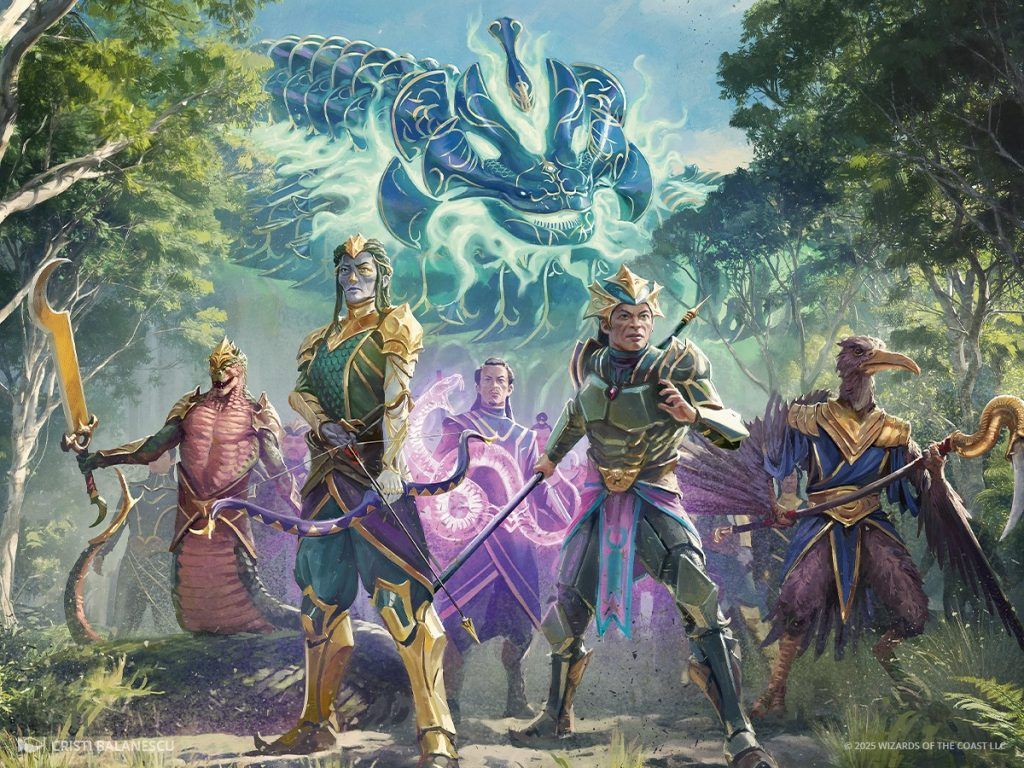
Sultai Arisen arrives as a graveyard deck led by Teval, the Balanced Scale, but the alternate commander hidden in the same box offers a much more direct way to turn that graveyard into a second hand. Kotis, Sibsig Champion allows you to cast a creature from your graveyard once during each of your turns, giving the precon a repeatable recursion engine that does not need a separate reanimation spell every time something dies or gets milled.
Kotis costs and begins as a 3/3. Once during each of your turns, you may cast a creature spell from your graveyard by exiling three other cards from your graveyard in addition to paying its normal costs. Whenever one or more creatures you control enter, if at least one of them entered from a graveyard or was cast from a graveyard, Kotis receives two +1/+1 counters.
That creates a very different deck-building challenge from conventional reanimator. You need enough cards entering the graveyard to provide both creatures worth casting and the three additional cards Kotis consumes every time you use his ability. The best Sultai Arisen upgrade therefore focuses on efficient self-mill, creatures that provide immediate value when repeatedly cast from the graveyard and payoffs for cards entering or leaving that graveyard throughout the game.
The Stock Deck Is Already Built for Kotis Better Than It Looks
Although Teval, the Balanced Scale is the face commander, Wizards filled Sultai Arisen with exactly the kind of graveyard infrastructure Kotis needs. Stitcher’s Supplier, Hedron Crab, Satyr Wayfinder, Skull Prophet, Millikin, Grisly Salvage and Forbidden Alchemy all help move cards from the library into the graveyard without asking the deck to abandon its normal development.
Several stock creatures become significantly better once Kotis takes over. Sakura-Tribe Elder can ramp early, sacrifice itself and eventually be cast from the graveyard through Kotis. Timeless Witness returns any card from your graveyard when it enters, while Shigeki, Jukai Visionary provides mana early and can later recover several nonlegendary cards. Gravecrawler even comes with its own built-in graveyard casting ability, giving the deck another creature that naturally moves between zones.
The stock payoff package is equally important. River Kelpie draws cards when permanents enter from graveyards and when spells are cast from graveyards. Teval’s Judgment rewards cards leaving your graveyard with cards, Treasure or Zombie Druid tokens, while Conduit of Worlds lets you continue extracting value from lands and other permanents that self-mill has placed there. Meren of Clan Nel Toth provides another recursion engine that does not compete directly with Kotis’s once-per-turn creature spell.
The foundation is therefore already excellent. The upgrade does not need to remove the graveyard theme and replace it with something new. It needs to make the graveyard deep enough to feed Kotis every turn without running out of useful cards.
Best Sultai Arisen Upgrades
Ripples of Undeath is one of the cleanest additions because it performs two jobs every turn. At the beginning of your first main phase, it mills three cards, then gives you the option of paying and 3 life to put one of those cards into your hand. That means the worst cards can remain in the graveyard as fuel for Kotis while the best card can become your normal draw for the turn.
Aftermath Analyst fits the deck even better than a conventional self-mill spell because it is itself a creature. When it enters, you mill three cards, and later it can sacrifice itself to return every land card from your graveyard to the battlefield tapped. If Analyst eventually reaches the graveyard again, Kotis can cast it another time. The more aggressively the deck mills, the more impressive its land-recursion ability becomes.
Kheru Goldkeeper rewards the other half of Kotis’s engine. Whenever one or more cards leave your graveyard during your turn, it creates a Treasure token. Kotis necessarily exiles three cards from the graveyard whenever you use his casting permission, and the creature spell itself also moves from the graveyard to the stack, so Goldkeeper naturally sees the deck doing what it already wants to do. Its renew ability can later exile Goldkeeper from the graveyard to put two +1/+1 counters and a flying counter on another creature, giving a large Kotis a legitimate way to become a commander-damage threat.
Six expands the graveyard beyond creatures. Whenever Six attacks, you mill three cards and can recover a land from among them. More importantly, nonland permanent cards in your graveyard have retrace during your turn, allowing you to discard lands to cast enchantments, artifacts and planeswalkers that Kotis cannot normally touch. Kotis handles creatures while Six provides access to many of the other permanents that self-mill sends to the graveyard.
Finally, Syr Konrad, the Grim turns all of this zone movement into damage. He triggers when creature cards are milled into the graveyard, when creatures die and when creature cards leave your graveyard. A creature milled by Stitcher’s Supplier can therefore damage every opponent on the way in, and casting that creature later through Kotis can trigger Konrad again when it leaves the graveyard.
The strongest additions share the same philosophy: they are useful while filling the graveyard, useful while emptying it, or preferably both.
What Should You Cut?
The biggest trap in a Kotis build is playing too many cards that consume the graveyard without producing enough in return. Kotis already asks you to exile three additional cards every time you cast a creature through his ability. Effects such as delve therefore compete for exactly the same resource.
Necropolis Fiend is the clearest example. Delve can make the creature inexpensive, but every card exiled to pay for it is one less card available to fuel future Kotis casts. Its activated ability also repeatedly exiles cards from the graveyard. That is perfectly reasonable in a generic graveyard deck, but Kotis is unusually hungry for the same material.
Treasure Cruise has a similar tension. Drawing three cards is powerful, but aggressively delving away six or seven cards can remove enough graveyard resources to shut down the commander’s ability for several turns. Sultai already has access to plenty of card advantage that does not consume its central resource.
Multani, Yavimaya’s Avatar can become enormous, but the upgraded deck is less interested in creatures that are simply large than creatures with useful enters-the-battlefield or sacrifice abilities. Casting something from the graveyard through Kotis should ideally generate immediate value even if an opponent removes it before combat.
Ob Nixilis, the Fallen is another powerful standalone card whose landfall damage belongs to a slightly different plan. The stock deck has land recursion, but a focused Kotis list gains more from creatures that interact directly with graveyard movement and can be profitably recast.
I would also trim Reassembling Skeleton. Returning itself from the graveyard is useful sacrifice fodder in the right deck, but Sultai Arisen is not trying to become a dedicated Aristocrats list. Kotis already provides repeatable access to much more impactful creatures, making a two-mana 1/1 increasingly difficult to justify.
A clean first round of changes would therefore be:
Out: Necropolis Fiend, Treasure Cruise, Multani, Yavimaya’s Avatar, Ob Nixilis, the Fallen, Reassembling Skeleton
In: Ripples of Undeath, Aftermath Analyst, Kheru Goldkeeper, Six, Syr Konrad, the Grim
Those swaps preserve the existing Sultai graveyard identity while making the flow of cards into and out of the graveyard much more productive.
Kotis Needs Four Cards in the Graveyard, Not One
Kotis looks like a commander that simply allows you to cast creatures from the graveyard, but his real cost is easy to underestimate. To cast one creature this way, the creature itself must already be in the graveyard and you must exile three other cards from that graveyard.
That means four cards need to be available before the first Kotis cast is even possible.
If you use the ability every turn, the graveyard disappears quickly. A single Satyr Wayfinder or Grisly Salvage is not enough to support the engine indefinitely, which is why repeatable self-mill becomes much more valuable than one-shot effects. Hedron Crab, Ripples of Undeath, Crawling Sensation and creatures you can repeatedly recur all help keep the graveyard supplied.
This is also why cards such as Life from the Loam remain so useful. Lands milled into the graveyard are rarely dead cards because Loam can recover them, but lands you do not need can instead become fuel for Kotis. The deck effectively gets to decide which graveyard resources still have future value and which three can safely be exiled.
The goal is not simply to have the largest graveyard possible. It is to maintain enough turnover that Kotis can continue spending cards without exhausting the engine.
Cast Creatures With ETB Value First
Once you can cast one creature from the graveyard every turn, the quality of those creatures matters more than their raw size. A giant body may eventually attack for significant damage, but a creature with an immediate enters-the-battlefield ability creates value even if an opponent removes it immediately afterward.
Timeless Witness is excellent because returning it through Kotis also returns another card from your graveyard to your hand. Sakura-Tribe Elder can repeatedly provide a land and place itself back into the graveyard. Noxious Gearhulk gives the deck removal attached to a creature body, while Junji, the Midnight Sky makes opponents reluctant to kill it because its death trigger generates another major swing.
Aftermath Analyst follows the same rule. Cast it from your graveyard, mill another three cards and then sacrifice it when enough lands have accumulated. The creature is not impressive because of its stats. It is impressive because every trip through the battlefield changes the rest of the game.
This makes sacrifice effects more useful than they initially appear. The deck does not need to become Aristocrats, but being able to deliberately return a valuable utility creature to the graveyard can set up another Kotis cast later. Woe Strider is still reasonable for exactly that reason even if you eventually cut it during a more aggressive rebuild.
The best Kotis creature is often not the biggest creature in the graveyard. It is the one whose text box you would happily pay for twice.
River Kelpie and Teval’s Judgment Are Core Engines
Two cards from the stock list deserve special attention because they effectively pay you for using your commander.
River Kelpie draws a card whenever it or another permanent enters the battlefield from a graveyard, and it also draws whenever a player casts a spell from a graveyard. Kotis casts creatures from the graveyard, so River Kelpie can reward that action directly. If the creature later enters from the graveyard through a different reanimation effect, Kelpie can reward that movement as well.
Its persist ability is particularly appropriate here. When River Kelpie dies without a -1/-1 counter, it returns to the battlefield with one, generating another graveyard-to-battlefield event while keeping the draw engine alive.
Teval’s Judgment approaches the engine from another direction. Whenever one or more cards leave your graveyard, it allows you to choose an option you have not chosen that turn: draw a card, create a Treasure or create a 2/2 Zombie Druid. Kotis naturally causes cards to leave the graveyard whenever his ability is used, meaning your normal recursion can begin paying for itself.
These are exactly the cards I would avoid cutting simply because they were designed for the face commander. Their text lines up beautifully with what Kotis actually does and helps transform his additional graveyard cost from a liability into another trigger.
Do Not Let Delve Eat the Entire Graveyard
Sultai Arisen contains several cards that were designed for a broad graveyard strategy, and delve is normally one of the strongest things you can do with a full graveyard. Kotis changes the calculation.
Tasigur, the Golden Fang, Necropolis Fiend and Treasure Cruise can all become dramatically cheaper by exiling cards from the graveyard. The problem is that Kotis is already effectively asking you to delve three cards every time you use his ability.
There is nothing wrong with keeping one or two especially efficient graveyard-consuming cards. Tasigur, the Golden Fang, for example, is still a creature that can become inexpensive and later mill more cards through his activated ability. The mistake is using delve aggressively simply because seven cards happen to be available.
Before exiling anything, ask what the next Kotis turn requires. If you leave only two irrelevant cards and one creature in the graveyard, the commander’s engine is suddenly offline.
The graveyard is not a trash pile in this deck. It is a mana-like resource with a limited balance, and every delve spell is spending from the same account as your commander.
Cards Leaving the Graveyard Can Become Their Own Engine
Kotis’s additional cost initially looks painful because you are permanently losing three cards every time you use his ability. Sultai has enough payoffs to turn that movement into an advantage.
Teval’s Judgment can transform a graveyard departure into a card, Treasure or creature token. Kheru Goldkeeper creates Treasure when cards leave your graveyard during your turn, while Syr Konrad, the Grim can damage every opponent when a creature card leaves your graveyard.
The interaction becomes particularly efficient because Kotis exiles three cards as part of casting another creature from the graveyard. One activation can therefore cause several different permanents to notice the same underlying action while the creature spell itself is still waiting to resolve.
This is where Sultai Arisen begins to feel less like a simple self-mill deck. You are no longer filling the graveyard just to retrieve cards later. You are generating value from cards going in, value from them coming out and another creature once the process is finished.
That circular resource flow is the real engine of the upgraded deck.
Kotis Can Become a Serious Combat Threat
The commander’s second ability is easy to read as incidental value. Whenever one or more creatures you control enter and at least one entered from a graveyard or was cast from a graveyard, Kotis, Sibsig Champion receives two +1/+1 counters.
Two counters every turn adds up quickly.
Kotis begins as a 3/3. After three successful graveyard creature turns, he can already be a 9/9 without playing a single dedicated +1/+1 counter card. That makes combat a legitimate secondary win condition even though the deck’s primary engine lives in the graveyard.
Wonder is particularly important in the stock list. As long as Wonder is in your graveyard and you control an Island, your creatures have flying. A Kotis that has accumulated eight or ten power becomes dramatically more threatening once chump blocking on the ground is no longer an option.
Kheru Goldkeeper provides another route through its renew ability, putting two +1/+1 counters and a flying counter on a creature. Those counters naturally complement the growth Kotis is already receiving rather than asking the deck to become a dedicated Voltron build.
I would not fill the list with Equipment and Auras just to chase 21 commander damage. The important point is that opponents cannot safely ignore Kotis while focusing exclusively on your graveyard engines. The commander eventually becomes a threat on his own.
The Mana Base Mostly Needs Untapped Sultai Fixing
Sultai Arisen already includes a solid selection of mana support. Command Tower, Exotic Orchard, Dreamroot Cascade, Hinterland Harbor, Llanowar Wastes, Sunken Hollow, Woodland Cemetery and Fetid Pools provide a reasonable three-color foundation. Farseek, Rampant Growth, Cultivate, Harrow, Sakura-Tribe Elder, Arcane Signet and Sol Ring already give the deck plenty of acceleration.
The main issue is speed. Kotis, Sibsig Champion costs exactly , so the deck benefits enormously from having all three colors available on turn three. Contaminated Aquifer, Haunted Mire, Temple of Malady, Terramorphic Expanse and Myriad Landscape can all make an otherwise good opening awkward when they arrive at the wrong moment.
I would not remove every tapped land at once. Several have useful land types or provide inexpensive color fixing, and the deck remains casual enough that the mana base does not need to resemble a tournament list. Start with the slowest lands whose utility you notice least and move gradually toward untapped Sultai sources according to budget.
Our Mana Base Upgrade Guide is useful here because Sultai Arisen needs something more important than expensive lands: it needs to cast Kotis early, begin filling the graveyard and still have enough mana left over to actually cast the creatures he gives you access to.
How the Upgraded Sultai Arisen Deck Wins
The early game should focus on developing mana and filling the graveyard without burning through it too quickly. Stitcher’s Supplier, Hedron Crab, Satyr Wayfinder and Ripples of Undeath can all begin stocking the graveyard while Farseek, Sakura-Tribe Elder and the mana rocks prepare your colors.
Once Kotis, Sibsig Champion is on the battlefield, the graveyard becomes an extension of your hand. A Sakura-Tribe Elder can be cast again for another land, Timeless Witness can recover another important card and Aftermath Analyst can mill more resources before returning a pile of lands. Every qualifying creature also adds two counters to Kotis, allowing the commander to become increasingly difficult to ignore.
The deck becomes much stronger once a payoff such as River Kelpie, Teval’s Judgment, Kheru Goldkeeper or Syr Konrad, the Grim joins the battlefield. Now the normal act of casting one creature from the graveyard can produce cards, Treasure, tokens or table-wide damage before considering what the creature itself does.
Wonder gives the growing battlefield a way over blockers, while Kotis eventually becomes a large attacker through his own +1/+1 counters. The deck does not have to choose between winning through graveyard value and winning through combat. The graveyard engine naturally builds the creatures and commander power necessary to do both.
If opponents wipe the battlefield, that is not necessarily the end of the plan. Many of your creatures are now exactly where Kotis wants them, and cards such as Living Death, Victimize, Meren of Clan Nel Toth and Conduit of Worlds give the deck several additional ways to rebuild.
That creates a satisfying Sultai progression. Early self-mill becomes graveyard fuel. Graveyard fuel becomes repeatable creature spells. Those creatures generate more cards, mana and recursion, while Kotis quietly grows into a serious combat threat alongside them.
PreconForge Verdict
Sultai Arisen already contains an unusually strong foundation for Kotis, Sibsig Champion. Stitcher’s Supplier, Hedron Crab, Satyr Wayfinder, Grisly Salvage, Sakura-Tribe Elder, Timeless Witness, River Kelpie, Teval’s Judgment, Meren of Clan Nel Toth, Victimize and Living Death mean most of the graveyard infrastructure is already sitting in the box.
The biggest mistake would be stripping away that self-mill package in an attempt to turn Kotis into something the card was never designed to be. Kotis does not steal cards from opponents, and this version of the commander does not need Equipment or Auras to function. He wants a graveyard full enough to become a second hand every single turn.
Ripples of Undeath keeps that graveyard stocked while improving card selection. Aftermath Analyst turns aggressive self-mill into a mana advantage, Kheru Goldkeeper turns cards leaving the graveyard into Treasure, Six expands recursion beyond creatures and Syr Konrad, the Grim makes the constant movement of creature cards hurt every opponent.
Most importantly, remember that Kotis needs more than one creature sitting in the graveyard.
Every creature you cast through him consumes three additional cards.
Build the deck so the graveyard fills faster than Kotis can spend it, prioritize creatures whose abilities are worth casting repeatedly, and Sultai Arisen becomes a genuine recycling engine where the same resources can produce value again and again until opponents simply cannot keep up.


