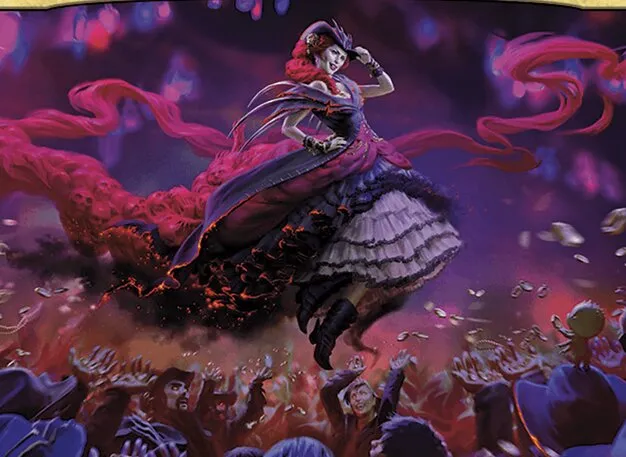
Most Wanted has one of the clearest engines among the Outlaws of Thunder Junction Commander decks. Olivia, Opulent Outlaw wants you to attack with Outlaws, turn successful combat into Treasure tokens and eventually convert those Treasures into permanent power across your entire battlefield.
That sounds straightforward, but there are two different decks hiding inside the precon. One is an Outlaw typal deck built around Assassins, Mercenaries, Pirates, Rogues and Warlocks. The other is a broader Mardu Treasure deck full of ways to create, sacrifice and profit from artifact tokens.
The strongest Olivia build connects those plans instead of choosing only one. Your creatures should be cheap enough to attack early, evasive enough to connect with multiple opponents and synergistic enough that the Treasure tokens they create become more than simple mana.
Once that engine is running, Olivia can turn a board of relatively modest Outlaws into a serious combat threat surprisingly quickly.
How Olivia’s Outlaw Engine Actually Works
Olivia, Opulent Outlaw costs for a 3/3 Vampire Assassin with flying and lifelink.
Whenever one or more Outlaws you control deal combat damage to a player, you create a Treasure token. In Magic, an Outlaw is any creature that is an Assassin, Mercenary, Pirate, Rogue or Warlock. A creature only needs one of those types to qualify.
The wording of Olivia’s combat trigger makes spreading your attacks especially valuable.
If three Outlaws all hit the same player during the same combat-damage step, Olivia creates only one Treasure. If your Outlaws connect with three different opponents, however, Olivia can trigger once for each of those players and create three Treasures.
That gives the deck a strong reason to use evasive creatures and divide attacks intelligently rather than sending the entire army at one opponent every turn.
The Treasure tokens then fuel Olivia’s second ability. For and two sacrificed Treasures, she puts two +1/+1 counters on each creature you control. The ability can only be activated as a sorcery, but in a developed board it represents an enormous amount of permanent power.
This creates a natural progression. Early Outlaws generate Treasures. Those Treasures help cast more creatures and spells. Once your mana is established, excess Treasures become +1/+1 counters and turn the same evasive creatures that built your economy into the threats that finish the game.
Most Wanted Already Has a Strong Outlaw Foundation
The stock deck contains several cards that are worth building around rather than replacing.
Vihaan, Goldwaker may be the most important. At the beginning of combat on your turn, your Treasures become 3/3 Construct Assassin creatures in addition to their other types until end of turn, and attacking Outlaws you control get +1/+1 until end of turn.
That interaction is exceptionally good with Olivia.
Treasure tokens animated by Vihaan become Assassins, which means they qualify as Outlaws and can generate more Treasures when they connect in combat. You can therefore turn the resource Olivia produced on one turn into attackers that help rebuild the same resource on the next.
The important decision is knowing when not to attack with every Treasure. Those tokens are still your mana and your fuel for Olivia’s counter ability, so converting all of them into combat pieces can expose you to a board wipe or leave you unable to cast interaction.
Mari, the Killing Quill gives the deck another excellent Outlaw payoff. She works particularly well when your Assassins, Mercenaries, Pirates, Rogues and Warlocks are trading in combat, adding a graveyard-based value engine to a strategy that already wants to attack.
Captain Lannery Storm supplies both haste and Treasure production, making her exactly the kind of creature Olivia likes. Changeling Outcast is even simpler but surprisingly effective: changeling makes it every creature type, including all five Outlaw types, and it cannot be blocked. That gives Olivia an inexpensive and highly reliable combat-damage trigger.
Queen Marchesa contributes card advantage through the monarch while bringing haste and deathtouch, and Breena, the Demagogue encourages the table to attack while potentially growing your creatures.
Then there is Academy Manufactor. Most Wanted is not primarily a Food or Clue deck, but any effect that produces one of those token types alongside Treasure can dramatically increase the number of artifacts you generate.
The result is already a solid core. What the deck needs most is more reliable early combat and better ways to capitalize on the Treasure engine.
The Best Most Wanted Upgrades
Grim Hireling is one of the cleanest additions you can make.
It is itself a Rogue, so it qualifies as an Outlaw. Whenever one or more creatures you control deal combat damage to a player, it creates two Treasure tokens. Like Olivia, that ability can reward you for connecting with different players, which means one successful combat can produce a large burst of Treasure.
It also gives those Treasures a second purpose. For , you can sacrifice X Treasures to give a creature -X/-X until end of turn. That turns your economy into removal when necessary instead of forcing every Treasure to be spent on mana or Olivia’s ability.
Hellspur Posse Boss addresses another weakness of the deck: getting new Outlaws into combat quickly. It is a Rogue itself, gives your other Outlaws haste and creates two Mercenary tokens when it enters.
Those Mercenaries are already Outlaws, so one card provides three relevant bodies while allowing many of your later creatures to attack immediately.
Kellogg, Dangerous Mind is another natural fit. As a Mercenary, he qualifies for Olivia’s trigger, and first strike plus haste makes him a useful attacker immediately. Every time Kellogg attacks, he creates a Treasure token, while five Treasures can eventually be sacrificed to take control of an opposing creature for as long as you control him.
He therefore participates in both halves of the deck without requiring any additional setup.
Laughing Jasper Flint pushes harder into the Outlaw side. At the beginning of your upkeep, he exiles cards from an opponent’s library based on the number of Outlaws you control and lets you cast those cards that turn.
A battlefield full of the creature types Olivia already wants can therefore become a substantial source of additional cards. Jasper also makes creatures you control but do not own into Mercenaries in addition to their other types, which creates interesting interactions with temporary theft effects already present in the precon.
Professional Face-Breaker deserves consideration even though it is not itself an Outlaw. Whenever one or more creatures you control deal combat damage to a player, it creates a Treasure, giving the deck another Olivia-like combat reward. It can then sacrifice Treasures to exile cards from the top of your library and let you play them that turn.
That kind of card is worth breaking typal purity for because it solves two real problems at once: Treasure generation and card advantage.
Evasion Matters More Than Simply Adding More Outlaws
Olivia does not reward you simply for controlling Outlaws. They have to connect.
That makes an inexpensive evasive Rogue potentially more valuable than a large Outlaw with no reliable way through blockers.
The stock Changeling Outcast demonstrates the principle perfectly. It is only a 1/1, but because it cannot be blocked it can reliably attack whichever opponent gives you the best chance to generate another Olivia trigger.
Mistmeadow Skulk serves a similar role in specific board states thanks to protection from mana value 3 or greater, although it is less universally reliable.
Equipment such as Trailblazer’s Boots is therefore more relevant here than it might be in a generic creature deck. In Commander, opponents commonly control nonbasic lands, so nonbasic landwalk can make an important Outlaw very difficult to block.
Rogue’s Passage provides another option from the mana base when you need one specific attacker to connect.
The aim is not to make every creature unblockable. You usually only need enough reliable attackers to spread damage across multiple opponents.
Once Olivia has produced the first few Treasures, her counter ability changes the combat equation. A board of 1/1s, 2/2s and 3/3s can become significantly larger after a single activation, and repeated activations quickly make even your utility creatures dangerous.
That is why I prefer improving connectivity before simply adding more expensive finishers.
Treasure Is a Resource, Not Just Ramp
The most interesting decisions in an Olivia deck often involve not spending your Treasures immediately.
A normal Treasure deck frequently treats the tokens as temporary mana. Most Wanted has more options.
Two Treasures plus can become two +1/+1 counters on every creature you control through Olivia. Grim Hireling can convert Treasure into removal. Professional Face-Breaker can exchange it for access to additional cards. Kellogg, Dangerous Mind can eventually turn five Treasures into control of an opposing creature.
The stock deck already contains several other payoffs.
Rain of Riches rewards spells cast with mana from Treasures by giving the first such spell each turn cascade. Deadly Dispute can turn an expendable creature or artifact into two cards while replacing part of the sacrificed resource with a Treasure.
Idol of Oblivion can draw cards on turns where you create tokens, something Olivia naturally wants to do anyway.
This means the best play is rarely “sacrifice every Treasure as soon as possible.”
Sometimes the correct move is to keep mana available. Sometimes you save two Treasures for Olivia. Sometimes you build toward a much larger Treasure payoff.
The deck becomes significantly stronger once those tokens are treated as a flexible resource rather than decorative mana rocks.
Vihaan Offers a Different Way to Finish the Game
Vihaan, Goldwaker is the alternate commander in Most Wanted, but under Olivia he functions as one of the deck’s strongest finishers.
At the beginning of combat, your Treasures become 3/3 Construct Assassins until end of turn. Because Assassins are Outlaws, the Treasure tokens themselves can benefit from Olivia’s broader game plan.
This creates an interesting feedback loop.
You attack with Outlaws and make Treasures. Vihaan turns those Treasures into Outlaws during a later combat. If they connect, Olivia can create replacement Treasures.
Meanwhile Vihaan gives your attacking Outlaws +1/+1, and Olivia can permanently grow the entire creature team through her activated ability.
You should still be careful about committing every Treasure to combat. A sweeper or unfavorable block can destroy artifact tokens that might otherwise have remained safely available as mana.
But when opponents‘ life totals are low, Vihaan can turn what looked like six or seven mana tokens into a lethal army without requiring another dedicated finisher.
That is one of the strongest reasons to keep Most Wanted centered on both Outlaws and Treasure, rather than stripping one half of the precon away.
Where to Make Room for the Upgrades
Some cards in Most Wanted are individually useful but fit Olivia less cleanly than the core Outlaw engine.
Hex is an easy place to look. Destroying six creatures for can be powerful, but it requires six legal creature targets to cast at all. That makes it dramatically less flexible than the efficient removal a Mardu deck can access.
Tenured Inkcaster also pulls the deck toward a different strategy. Its magecraft ability rewards casting or copying instants and sorceries, while Olivia wants a sufficiently high density of creatures capable of connecting in combat. Unless you deliberately move toward a spell-heavy build, that slot can do more for the primary plan.
Aetherborn Marauder is awkward for another reason. It can move +1/+1 counters from your other permanents onto itself as it enters. Olivia, however, works hard to distribute counters across your entire army. Consolidating them onto a single creature moves in the opposite direction from the commander’s best payoff.
Ogre Slumlord can create a substantial Rat army when creatures die, but it has little connection to Outlaws or Treasure. It remains perfectly playable in a more aristocrats-oriented version, but it becomes easier to replace when Olivia is the focus.
Mass Mutiny can create a spectacular turn in multiplayer, but five mana for temporary creature theft does not always advance the deck after combat. It becomes much more interesting if you add Laughing Jasper Flint, because creatures you control but do not own become Mercenaries and therefore Outlaws. Without that interaction or other theft synergies, it is a reasonable flex slot.
The aim is not to eliminate every card that lacks an Outlaw creature type. Removal, draw and protection still matter.
What you want to remove are cards that neither support the Treasure engine nor help the creatures that generate it connect.
Most Wanted’s Mana Base Is Better Than It Looks
Mardu mana can become expensive if you chase premium lands, but Most Wanted already has a surprisingly broad fixing package.
The stock deck includes Command Tower, Exotic Orchard, Blackcleave Cliffs, Battlefield Forge, Caves of Koilos, Sulfurous Springs, Clifftop Retreat, Dragonskull Summit, Isolated Chapel, Fetid Heath and Rugged Prairie.
That is a respectable foundation for a precon.
The obvious first replacement is Temple of the False God. Olivia needs three colors and costs four mana, while Temple cannot produce anything until you already control at least five lands. That is exactly the stage of the game where fixing is least difficult.
Path of Ancestry is more interesting here than in many precons because Olivia genuinely cares about several related creature types. It still enters tapped, but the scry can matter frequently enough in an Outlaw-heavy list to justify keeping it.
Rogue’s Passage also earns its utility slot because getting a key Outlaw through combat can directly become another Treasure.
The stock Orzhov Signet, Rakdos Signet, Arcane Signet and Sol Ring provide additional acceleration, while the Treasures produced by the deck help smooth awkward colors later.
That means I would not spend the first upgrade budget rebuilding all of the lands. Replace the worst tapped or unreliable sources gradually and spend the early budget on cards that improve the actual Outlaw engine.
For a larger rebuild, our Mana Base Upgrade Guide covers affordable Mardu fixing options without requiring an expensive fetch-and-shock mana base.
How the Upgraded Most Wanted Deck Wins
The strongest Olivia games begin with small creatures rather than giant threats.
Deploy an inexpensive Outlaw, establish your mana and then cast Olivia, Opulent Outlaw when you have enough creatures to begin spreading combat damage around the table.
Evasive attackers such as Changeling Outcast create reliable Treasure triggers. Cards such as Captain Lannery Storm, Grim Hireling and Kellogg, Dangerous Mind add even more Treasure production while participating in combat themselves.
From there, your battlefield begins to scale.
You can use some Treasures to accelerate new threats while keeping others for Olivia’s activated ability. Every activation adds two +1/+1 counters to the entire team, which means a board of individually modest Outlaws quickly stops being modest.
Hellspur Posse Boss lets newly played Outlaws attack sooner, while Mari, the Killing Quill and Laughing Jasper Flint give the deck additional value engines when combat alone is not enough.
Then Vihaan, Goldwaker gives you another axis entirely. A stockpile of Treasure tokens that opponents viewed as mana can suddenly become an army of attacking Assassins.
The deck therefore does not have to choose between economy and combat. The economy eventually becomes the combat.
PreconForge Verdict
Most Wanted already gives Olivia, Opulent Outlaw a strong foundation of evasive Outlaws, Treasure generation and cards that benefit from both.
Vihaan, Goldwaker, Mari, the Killing Quill, Captain Lannery Storm, Changeling Outcast, Queen Marchesa, Back in Town and Academy Manufactor all give the deck real reasons to preserve its original identity.
The upgrades should make that identity more efficient.
Grim Hireling dramatically increases Treasure production, Hellspur Posse Boss supplies Outlaws and haste, Kellogg, Dangerous Mind combines early aggression with another Treasure engine, and Laughing Jasper Flint rewards you for maintaining a high Outlaw count.
Most importantly, prioritize creatures that can actually deal combat damage. Olivia does not care how impressive your Outlaws look while sitting behind blockers.
Connect with several opponents, build the Treasure stockpile and resist the temptation to spend every token immediately. Once Olivia starts converting those Treasures into two +1/+1 counters across an entire board, or Vihaan turns the Treasures themselves into attackers, Most Wanted can move from incremental value to lethal combat very quickly.


