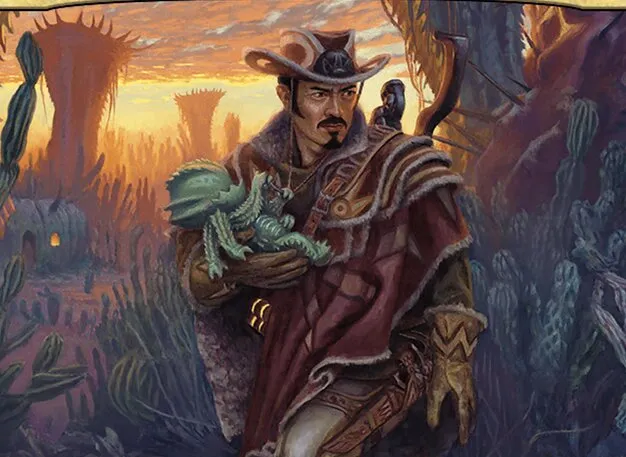
Desert Bloom takes one of Magic’s least glamorous resources, the land card, and turns it into almost everything the deck needs.
Yuma, Proud Protector rewards you for filling the graveyard with lands, sacrificing lands for value and, most importantly, putting Desert cards into the graveyard. Each Desert that gets there while Yuma is on the battlefield creates a 4/2 green Plant Warrior creature token with reach.
That gives the deck an unusual rhythm. Lands are not simply mana sources you play and forget about. A Desert can enter the battlefield, produce mana, be sacrificed for another effect, create a creature when it hits the graveyard and then return to the battlefield through one of the deck’s many recursion engines.
The stock precon already has most of the difficult infrastructure in place. The strongest upgrades make that land cycle more reliable, increase the number of useful Deserts and give you better ways to return an entire graveyard of lands at once.
Yuma Wants Lands in the Graveyard
Yuma, Proud Protector normally costs , but his cost is reduced by for each land card in your graveyard.
That means an eight-mana commander can realistically enter much earlier if you spend the opening turns deliberately putting lands into the graveyard.
His second ability continues that plan. Whenever Yuma enters the battlefield or attacks, you may sacrifice a land. If you do, you draw a card.
Sacrificing a normal land provides the card draw and helps reduce Yuma’s future commander tax if he is removed. Sacrificing a Desert while Yuma remains on the battlefield does even more, because his final ability sees the Desert enter your graveyard and creates a 4/2 Plant Warrior token.
That sequence is at the heart of the deck:
Desert goes to the graveyard → Yuma creates a Plant → the Desert becomes available for recursion.
Yuma’s last ability triggers whenever a Desert card is put into your graveyard from anywhere, not just from the battlefield. A Desert discarded from your hand or milled from your library can create the same 4/2 token as one you sacrificed.
There is one important limitation: Yuma must actually be on the battlefield when the Desert enters the graveyard. If Yuma and a Desert are put into your graveyard at the same time, his trigger will not happen.
That makes timing especially important when you are considering large self-mill effects or board wipes.
Desert Bloom Already Has the Right Core
The precon comes with a surprisingly complete land-recursion package.
Ramunap Excavator lets you play lands from your graveyard, which means a Desert sacrificed for value can immediately become a future land drop.
Ancient Greenwarden does the same while also doubling triggered abilities caused by lands entering the battlefield. That gives the card value beyond simple recursion, especially alongside your landfall payoffs.
World Shaper puts lands into your graveyard when it attacks and can return every land from your graveyard to the battlefield when it dies. That is exactly the kind of effect Yuma wants because the first half prepares your graveyard while the second half converts it back into a battlefield.
Titania, Protector of Argoth gives you another major reward for sacrificing lands. When a land you control is put into your graveyard from the battlefield, Titania creates a 5/3 Elemental token. Sacrificing a Desert with Titania and Yuma available can therefore generate multiple bodies from a single land.
Hazezon, Shaper of Sand may be one of the most important cards in the entire precon. He lets you play Desert lands from your graveyard and creates Sand Warrior tokens when Deserts enter under your control.
That means the same Desert can trigger Yuma when it goes to the graveyard and then contribute to Hazezon’s engine when it comes back.
Current Yuma lists continue to reflect the strength of this package. Hazezon appears in more than 90% of current Desert-focused Yuma decks, while Ramunap Excavator and Titania remain among the commander’s most common cards overall.
The Best Upgrades Improve Both Halves of the Land Cycle
One of the strongest additions is Aftermath Analyst.
When it enters, it mills three cards. More importantly, you can pay , sacrifice it and return all land cards from your graveyard to the battlefield tapped.
The first ability can put Deserts into your graveyard while Yuma is active, generating Plant Warriors. The second can then return those lands all at once.
That is almost a perfect description of what the deck wants to do, and current EDHREC data shows Aftermath Analyst in roughly 55% of Yuma decks.
Splendid Reclamation provides the same mass-recursion concept in a single spell. Returning every land from your graveyard simultaneously can transform a setup turn into an enormous burst of mana and landfall triggers. It remains one of the most popular additions in optimized Yuma lists.
Life from the Loam offers a more controlled engine. It returns up to three lands from your graveyard to your hand and can repeatedly dredge itself back, putting more cards into the graveyard in the process. In a deck with Deserts, cycling lands and lands that sacrifice themselves, that repeated recursion is extremely efficient.
Elvish Reclaimer is another excellent fit. Once you have three or more lands in your graveyard, it becomes a 3/4, but the important ability is paying , tapping it and sacrificing a land to search your library for any land and put it onto the battlefield tapped.
That single activation does several useful things at once. It puts a land into the graveyard, can trigger Yuma if the sacrificed land is a Desert and finds whichever utility land or Desert the game requires. Current Yuma data shows Elvish Reclaimer in roughly a quarter of builds, which is substantial for a non-stock upgrade.
Scapeshift Turns Lands Into a Real Engine
Scapeshift is one of the more explosive upgrades available to Yuma.
As an additional cost to cast it, you sacrifice any number of lands. Then you search your library for that many land cards and put them onto the battlefield tapped.
In many decks, this is primarily a landfall combo card. In Yuma, the sacrifice itself can be just as important.
If several of the lands you sacrifice are Deserts and Yuma is on the battlefield, each one going to the graveyard can create a 4/2 Plant Warrior. You then replace those lands with whatever utility lands or Deserts you need.
With Titania, Protector of Argoth present, sacrificing lands from the battlefield can create even more creature tokens. With landfall cards such as Scute Swarm or Omnath, Locus of Rage, the lands entering afterward generate a second wave of value.
That makes Scapeshift less of a narrow combo piece and more of a bridge between every major theme in the deck.
It also remains a common Yuma inclusion, appearing in roughly a quarter to a third of current lists depending on the build.
Worldsoul’s Rage Does More Than It First Appears
Worldsoul’s Rage is another useful upgrade because it combines interaction with graveyard recovery.
It lets you deal damage while returning land cards from your graveyard to the battlefield tapped. In Yuma, that means a card capable of affecting the board can also rebuild your mana after you have spent several turns sacrificing, cycling or milling lands.
That distinction matters.
The deck does not need every recursion spell to be a huge all-in effect such as Splendid Reclamation. Smaller cards that return several lands while also accomplishing another job help prevent your hand from filling with narrow setup pieces.
Current Yuma lists use Worldsoul’s Rage in roughly 30% of decks, and it remains particularly popular in lands-matter and optimized builds.
The broader principle is worth keeping in mind: the best upgrades either put lands into the graveyard efficiently, return them efficiently, or reward both actions.
Cards that only care about generic landfall can still be powerful, but the more focused Yuma becomes, the more important that graveyard loop is.
Do Not Replace the Deserts With Better-Looking Dual Lands
This deck is unusual because land quality cannot be judged solely by how efficiently the land produces mana.
Desert of the Fervent, Desert of the Indomitable and Desert of the True enter tapped, which would normally make them obvious upgrade targets.
Here, they are some of the most synergistic lands in the entire deck.
They are Deserts, so putting them into your graveyard triggers Yuma. They also have cycling, allowing you to discard them from your hand when you no longer need the land drop. With Yuma on the battlefield, cycling one can effectively replace the land with a card while also producing a 4/2 Plant Warrior.
That is excellent role compression.
Hashep Oasis, Shefet Dunes and Ramunap Ruins also deserve to stay because they are Deserts with relevant utility abilities.
Dunes of the Dead is particularly thematic. When it is put into your graveyard from the battlefield, it creates a 1/1 Sand Warrior token. If Yuma is also present, sacrificing it can therefore produce both that token and Yuma’s 4/2 Plant Warrior.
Cactus Preserve is another important stock Desert and remains one of Yuma’s highest-synergy cards today.
So while Desert Bloom’s mana base can absolutely be improved, cutting Deserts simply because they enter tapped can weaken the commander even if the deck becomes slightly faster on paper.
Add More Deserts Before Adding More Generic Lands
The best mana-base upgrades are often additional lands with the Desert subtype.
Sunscorched Desert is simple, but being a Desert matters more here than its modest enter-the-battlefield damage.
Endless Sands offers creature protection while still counting as a Desert.
Grasping Dunes can sacrifice itself, which naturally puts another Desert into your graveyard for Yuma.
Cradle of the Accursed provides another Desert with a self-sacrifice ability, creating a Zombie token while feeding the graveyard engine.
Current Yuma lists frequently use these lands precisely because the subtype itself is a resource. EDHREC’s current data shows Sunscorched Desert, Endless Sands, Grasping Dunes and Cradle of the Accursed among the commander’s recurring Desert upgrades.
Field of the Dead is another powerful option if your mana base naturally supports enough differently named lands. It is not a Desert itself, but a Yuma deck already tends to play a large number of differently named utility lands, making its condition easier to satisfy than in many Commander lists.
It is a premium upgrade rather than something the deck requires, but it gives the land engine another independent route to a wide battlefield.
The Deck Wants Lands to Die, Not Stay Dead
One of the easiest ways to misunderstand Yuma is to treat self-mill as the final goal.
Putting ten lands into the graveyard can make Yuma cheap and generate Plants if those cards are Deserts, but those lands are still one of your most valuable resources.
The strongest Yuma decks repeatedly move them between zones.
Ramunap Excavator and Hazezon, Shaper of Sand turn the graveyard into an extension of your hand.
World Shaper, Aftermath Analyst and Splendid Reclamation can bring back large groups of lands.
Ancient Greenwarden both enables land recursion and multiplies landfall triggers.
This gives you permission to use lands aggressively.
Cycling a Desert is not permanently losing a mana source if Ramunap Excavator can play it later. Sacrificing lands to Scapeshift becomes much less risky when Splendid Reclamation can return them. Milling a utility land becomes potential value rather than automatically being a miss.
That recursion is what separates Yuma from a deck that merely wants cards in the graveyard.
Where to Make Room for the Upgrades
The easiest cuts are cards that cost a lot of mana without strongly participating in the land-graveyard engine.
Genesis Hydra can certainly generate value, but it asks for a substantial mana investment and does not specifically reward Deserts, sacrificed lands or graveyard recursion.
Angel of the Ruins is more defensible because plainscycling gives it early utility while its enter-the-battlefield ability can exile artifacts or enchantments. If you are lowering the curve aggressively, though, seven mana is still a meaningful investment.
Nantuko Cultivator has some synergy because it can discard lands and replace them with cards while growing itself. The tension is that four mana for a creature whose main purpose is filtering lands can be slow compared with more efficient graveyard enablers. It is a reasonable flex slot rather than an automatic cut.
Perennial Behemoth provides land recursion through unearth and therefore fits the plan, but paying five mana for a 2/7 is not especially efficient when Ramunap Excavator already performs the core effect for less mana.
I would be much more reluctant to cut expensive cards such as Ancient Greenwarden, Titania, Protector of Argoth or Avenger of Zendikar. They cost more, but they also provide meaningful payoffs for the strategy you are actually building.
As always, mana value alone should not determine the cuts. The expensive card has to justify itself by advancing the land engine or ending the game.
Yuma Does Not Need Traditional Ramp in the Same Way
Desert Bloom contains conventional ramp such as Explore, Harrow, Springbloom Druid, Map the Frontier, Arcane Signet and Sol Ring.
The land-based pieces are particularly valuable.
Harrow sacrifices a land as part of its cost and replaces it with two basic lands that enter untapped. If the sacrificed land is a Desert while Yuma is on the battlefield, Harrow effectively becomes ramp, mana fixing and a Plant token in one spell.
Springbloom Druid offers a creature-based version of the same concept, exchanging one land for two basics.
Those cards are more synergistic than a generic three-mana rock because the act of sacrificing a land can contribute to Yuma, Titania and your graveyard recursion plan.
I would still keep efficient artifact ramp such as Sol Ring and Arcane Signet, particularly because Yuma’s printed mana value is high.
But as the deck improves, land-based ramp should generally receive priority whenever the rates are comparable.
How the Upgraded Desert Bloom Deck Wins
The early game is about setting up the graveyard without sacrificing your ability to develop mana.
Cycle a Desert you do not need. Use Satyr Wayfinder, Winding Way or similar effects to place lands into the graveyard. Develop a recursion piece such as Ramunap Excavator.
Once enough lands are in the graveyard, Yuma becomes much cheaper than his printed eight mana.
From there, every useful Desert becomes a potential creature.
Sacrifice one through Yuma and draw a card. Get a 4/2 Plant. Replay the Desert with Ramunap Excavator or Hazezon. Sacrifice it again later.
Titania, Protector of Argoth can add another 5/3 Elemental whenever one of your lands goes from the battlefield to the graveyard. Hazezon, Shaper of Sand produces another army when Deserts enter the battlefield. Scute Swarm, Nesting Dragon, Omnath, Locus of Rage and Avenger of Zendikar reward the return trip.
Then mass-recursion cards turn the engine into a finishing sequence.
A Splendid Reclamation after filling the graveyard can return a large number of lands at once. World Shaper and Aftermath Analyst can create similar turns.
The result is a deck that can build an army from something opponents normally cannot prevent you from doing forever: playing, sacrificing and replaying lands.
PreconForge Verdict
Desert Bloom already gives Yuma, Proud Protector most of the cards required for a coherent land-graveyard engine.
Hazezon, Shaper of Sand, Ramunap Excavator, Ancient Greenwarden, World Shaper, Titania, Protector of Argoth, Oracle of Mul Daya, Scute Swarm and Avenger of Zendikar are all already part of the stock list.
The strongest upgrades make the land cycle more explosive and more repeatable.
Aftermath Analyst gives the deck both self-mill and mass land recursion. Splendid Reclamation can rebuild the entire mana base in one spell. Life from the Loam creates a repeatable graveyard engine, while Elvish Reclaimer turns a sacrificed land into whichever Desert or utility land you need.
Scapeshift gives a more powerful version of the same idea, simultaneously sacrificing lands and replacing them with better ones.
The most important upgrade principle, though, is not a single card: do not optimize the Deserts out of the Desert deck.
Some of the lands enter tapped. Some look weaker than modern dual lands. But every Desert that moves into your graveyard while Yuma is watching represents another 4/2 Plant Warrior, another recursion target and another piece of the engine.
Once you start treating the graveyard as a second land zone rather than a place where your lands disappear, Desert Bloom becomes dramatically stronger.


