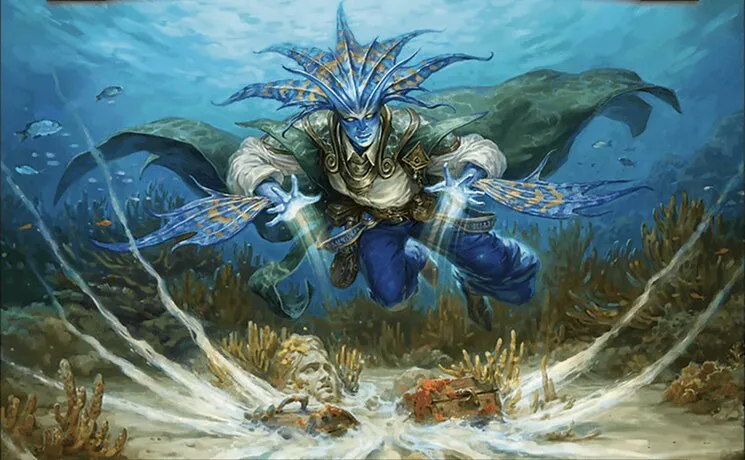
Deep Clue Sea is a Commander precon that already understands its own engine unusually well. Morska, Undersea Sleuth generates a steady supply of Clues, rewards you for drawing extra cards and can grow from an unassuming 2/3 into a serious combat threat without asking you to play dedicated +1/+1 counter cards.
The challenge is that the stock deck contains several overlapping ideas. There is a Clue package, a broader token package, artifact payoffs, card-draw engines and a handful of individually powerful Bant creatures that do not necessarily push Morska’s core plan forward.
The strongest upgrade path is therefore not about replacing the deck’s identity. It is about tightening it around a simple sequence: make Clues efficiently, turn those Clues into cards and resources, and make every token or extra draw do more than one job.
Morska Is Both a Clue Engine and a Growing Threat
Morska, Undersea Sleuth costs for a 2/3 Vedalken Fish Detective. She gives you no maximum hand size, investigates at the beginning of your upkeep and gets two +1/+1 counters whenever you draw your second card each turn.
That wording is important.
Investigating creates a Clue artifact token with “, Sacrifice this artifact: Draw a card.” Morska therefore gives you one Clue every upkeep without requiring another card or mana investment at the point of creation. You still need to pay when you eventually sacrifice that Clue to draw, but you can save it until the timing is useful.
Morska’s final ability also says “each turn,” not “your turn.” That means she can get two +1/+1 counters on an opponent’s turn if you manage to draw your second card during that turn.
This opens up a much more interesting play pattern than simply cracking one Clue during your own main phase.
Your normal draw step gives you the first card on your turn, so drawing once more during that turn triggers Morska. On an opponent’s turn, however, you normally need two draws because you do not receive a regular draw step. Clues give you control over when those draws happen, while other repeatable draw engines can help you trigger Morska around the entire table.
You do not need to build the entire deck around maximizing those counters. The important point is that cards you already wanted for card advantage can also turn your commander into a legitimate source of combat damage.
Deep Clue Sea Already Has an Excellent Clue Core
One of the reasons this precon responds so well to selective upgrades is the quality of its existing engine.
Academy Manufactor is arguably the most important card in the stock list. If you would create a Clue, Food or Treasure token, Manufactor creates one of each instead. Morska’s upkeep investigate can therefore become three different artifacts rather than a single Clue.
That dramatically changes the economics of the deck. Treasures help pay to crack Clues, Food gives you another resource when life matters, and all three tokens increase your artifact count for cards that care about artifacts or tokens.
Erdwal Illuminator provides a different form of multiplication. The first time you investigate each turn, you investigate an additional time. Because Morska naturally investigates during your upkeep, Illuminator can start doubling that steady source immediately.
Tireless Tracker produces Clues through ordinary land drops and grows whenever you sacrifice one. It therefore participates in both halves of the strategy: generating the resource and converting its use into pressure.
Those three cards remain among Morska’s highest-synergy inclusions in current Commander deck data. Academy Manufactor appears in roughly 82% of Morska decks, Tireless Tracker in 78% and Erdwal Illuminator in 75%.
The stock list also includes Adrix and Nev, Twincasters, which can double token creation more broadly, and Bennie Bracks, Zoologist, whose card-draw ability rewards you for creating tokens during the turn.
Tangletrove Kelp, Detective of the Month, Lonis, Cryptozoologist and Ethereal Investigator add further ways for Clues and Detectives to matter.
This is why the finished Morska deck should still feel recognizably like Deep Clue Sea. A large part of the real engine is already sitting in the box.
The Best Upgrades Make Clues Cheaper and More Valuable
Morska can produce plenty of Clues, but producing them is only half the equation. Paying for every card you want to draw can consume an enormous amount of mana.
That makes reducing the cost of using Clues one of the best ways to improve the deck.
Forensic Gadgeteer is particularly attractive because it reduces the activation costs of artifact abilities you control while also creating a Clue when it enters. In practice, turning a Clue activation from into makes a pile of five or six Clues substantially easier to convert into cards.
Tamiyo’s Journal approaches the problem differently. It creates a Clue every upkeep, but its real ceiling is the ability to sacrifice three Clues to search your library for any card and put it into your hand. A deck that naturally accumulates Clues can therefore turn excess evidence into exactly the card it needs.
Current optimized Morska lists reflect the strength of Journal, where it appears among the commander’s highest-synergy cards.
Lonis, Genetics Expert is another direction worth considering if you want to push harder into Clue production and creature-based value. The important question with any addition should be whether it improves the rate at which you create, exploit or benefit from artifact tokens.
There are also premium token multipliers such as Doubling Season or Anointed Procession, but I would not treat expensive doublers as mandatory. Deep Clue Sea already has Adrix and Nev, Twincasters, and the deck often improves more by making its Clues cheaper to use than by generating an even larger pile it cannot afford to crack.
That balance matters. Ten Clues are impressive, but if you never have enough spare mana to turn them into cards, much of their value remains theoretical.
Artifact Payoffs Give the Clues a Second Job
Clues are already card advantage, but the strongest Morska decks make them valuable before they are sacrificed.
Kappa Cannoneer is already in the precon and is a perfect example. Its affinity for artifacts makes a battlefield full of Clues help cast it cheaply, and subsequent artifacts entering the battlefield can continue making it more threatening.
Nettlecyst, another stock card, turns your growing collection of artifacts and enchantments into raw power. This gives the deck a second combat threat without requiring Morska to carry the entire burden herself.
Inspiring Statuary lets your nonartifact spells use artifacts as a source of improvise. Suddenly an unused Clue is not merely a future card; it can help pay for the next spell you cast.
And Mechanized Production gives the deck one of its more distinctive alternate win conditions. Enchanting a Clue allows Production to create more copies, and its upkeep trigger can win the game if you control eight or more artifacts with the same name.
That line should not become the only reason to play the deck, but it gives opponents a reason to respect a battlefield that otherwise looks like a harmless collection of investigation tokens.
If you want to add another payoff, prioritize cards that work with artifacts or tokens generally, rather than cards that only function when everything has gone perfectly. Morska is at her best when each permanent contributes to several overlapping engines.
Drawing on Opponents‘ Turns Can Make Morska Much Larger
Because Morska triggers whenever you draw your second card each turn, there is meaningful upside in finding ways to draw outside your own turn.
The stock deck already has several tools that can contribute to this. Clues themselves are the most obvious because they can be sacrificed at instant speed whenever you have priority.
Suppose another player casts something and you respond by cracking two Clues. The second card you draw that turn triggers Morska and gives her two +1/+1 counters.
Doing that on every opponent’s turn can make Morska grow remarkably quickly, although paying four mana per opponent just to crack two Clues is rarely efficient by itself.
The better approach is to combine Clues with other sources of card draw.
Shimmer Dragon, already included in Deep Clue Sea, can turn untapped artifacts into cards without sacrificing them once you have enough artifacts to enable its hexproof ability. Teferi’s Ageless Insight can dramatically increase the number of cards generated by non-draw-step effects. Bennie Bracks, Zoologist can reward turns in which you create tokens.
The goal is not to trigger Morska on all four turns at any cost. Spending eight or twelve mana solely to add counters is usually inefficient.
Instead, treat the counters as a bonus for drawing cards at times that were already useful. If your engine naturally lets you draw during an opponent’s turn, Morska quietly becomes a much faster clock.
Which Cards Make the Most Sense to Cut?
The easiest cuts are expensive cards that are powerful in isolation but do not contribute enough to the Clue, artifact or card-draw engines.
Hornet Queen is one of the clearest examples. Seven mana for a defensive flying board is useful in many green decks, but Deep Clue Sea has more synergistic ways to generate tokens and stabilize the battlefield.
Koma, Cosmos Serpent is enormously powerful, but it also costs seven mana and belongs more naturally in a generic value or sea-creature strategy. A tighter Morska list can use that slot for a cheaper engine that begins contributing several turns earlier.
Esix, Fractal Bloom is more interesting and should not be dismissed automatically. Turning the first token creation of a turn into copies of a powerful creature can be explosive. The tension is that Morska specifically wants artifact tokens to remain available for many of her other synergies.
If your version of the deck leans heavily into general token copying, Esix can absolutely stay. If the goal is a focused Clue-and-artifact build, it becomes a reasonable cut.
Magnifying Glass is another card I would consider replacing. It provides mana, but paying four mana and tapping it merely to investigate is expensive compared with the rate available from the rest of the deck.
I would be much more reluctant to cut Junk Winder. Its affinity for tokens can make it much cheaper than its printed mana cost suggests, and creating tokens lets you tap opposing nonland permanents. In a deck that can create several Clues, Food, Treasures or creature tokens, that can become a genuine control engine.
The key distinction is therefore not simply mana value. Expensive cards can stay when the deck naturally discounts them or when they strongly amplify the primary plan.
The Mana Base Is Functional but Slower Than Morska Wants
Deep Clue Sea is Bant, so reliable access to all three colors matters. Morska herself requires , which makes early color fixing particularly important.
The stock deck gives you a reasonable base with Command Tower, Exotic Orchard, Canopy Vista, Prairie Stream, Irrigated Farmland, Scattered Groves, Skycloud Expanse, Spire of Industry and Sungrass Prairie.
It also contains all three relevant Signets or Talismans across much of the Bant color combination, including Azorius Signet, Simic Signet, Talisman of Curiosity, Talisman of Progress and Talisman of Unity.
The weakest land is Temple of the False God. Morska wants three different colors early, while Temple produces no mana at all until you already control four other lands. That is an easy trade for another colored source.
The three bounce lands Azorius Chancery, Selesnya Sanctuary and Simic Growth Chamber can generate long-game value, but drawing several of them makes early sequencing slow. You do not need to remove all three, but replacing some of the tapped lands improves the chances of casting Morska on time.
Path of Ancestry is also less compelling here than in a genuine typal deck. Morska may be a Detective, but Deep Clue Sea does not rely heavily enough on a single creature type for the tribal upside to define the land slot.
Meanwhile Spire of Industry is better here than it might look because maintaining an artifact on the battlefield is rarely difficult in a Clue deck.
If you want to go further, our Mana Base Upgrade Guide covers affordable Bant fixing without requiring fetch lands or other premium options.
How the Upgraded Deep Clue Sea Deck Wins
The upgraded deck should begin quietly.
Early turns are about fixing mana and establishing one or two engines. Morska arrives, starts investigating during your upkeep and gradually builds a stockpile of Clues. Cards such as Erdwal Illuminator, Academy Manufactor and Tireless Tracker then make every investigation or land drop more productive.
From that point, the deck gains several ways to convert resources into pressure.
You can crack Clues and keep your hand full. Morska becomes larger as you draw additional cards. Nettlecyst turns artifact count into combat power. Kappa Cannoneer becomes a resilient artifact payoff. Junk Winder can manipulate opposing boards as tokens enter, while Mechanized Production gives the deck an alternate route to victory.
Academy Manufactor is often the card that ties the entire battlefield together. Every investigation can become a Clue, Food and Treasure. The Treasure helps fund your spells or Clue activations, the Clue keeps cards flowing and the additional artifacts strengthen everything that cares about artifact count.
That is the ideal version of Morska: the deck is not making tokens simply because tokens are fun to accumulate. Every token is a resource with several possible uses.
The strongest turns come when you can choose between those uses rather than being forced into one. A Clue can become a card, improvise a spell through Inspiring Statuary, increase Nettlecyst‚s power, contribute toward Mechanized Production, or simply sit on the battlefield until a better opportunity appears.
PreconForge Verdict
Deep Clue Sea needs refinement more than reconstruction.
The original precon already contains many of the cards that define Morska, Undersea Sleuth: Academy Manufactor, Tireless Tracker, Erdwal Illuminator, Adrix and Nev, Twincasters, Bennie Bracks, Zoologist, Kappa Cannoneer, Mechanized Production and Inspiring Statuary all give the deck legitimate ways to convert token production into advantage.
The first upgrades should make that engine easier to use. Forensic Gadgeteer reduces the cost of artifact activations, while Tamiyo’s Journal gives excess Clues another powerful purpose. Additional efficient Clue producers or artifact payoffs can follow depending on whether you prefer card advantage, combat or an artifact-heavy finish.
Then trim the expensive cards that contribute least to that engine and improve the slowest parts of the Bant mana base.
Morska does not need dozens of dedicated +1/+1 counter cards to become dangerous. Make Clues, make those Clues more efficient, draw cards when it is useful and let the commander grow naturally while the rest of the artifact engine takes over the game.


