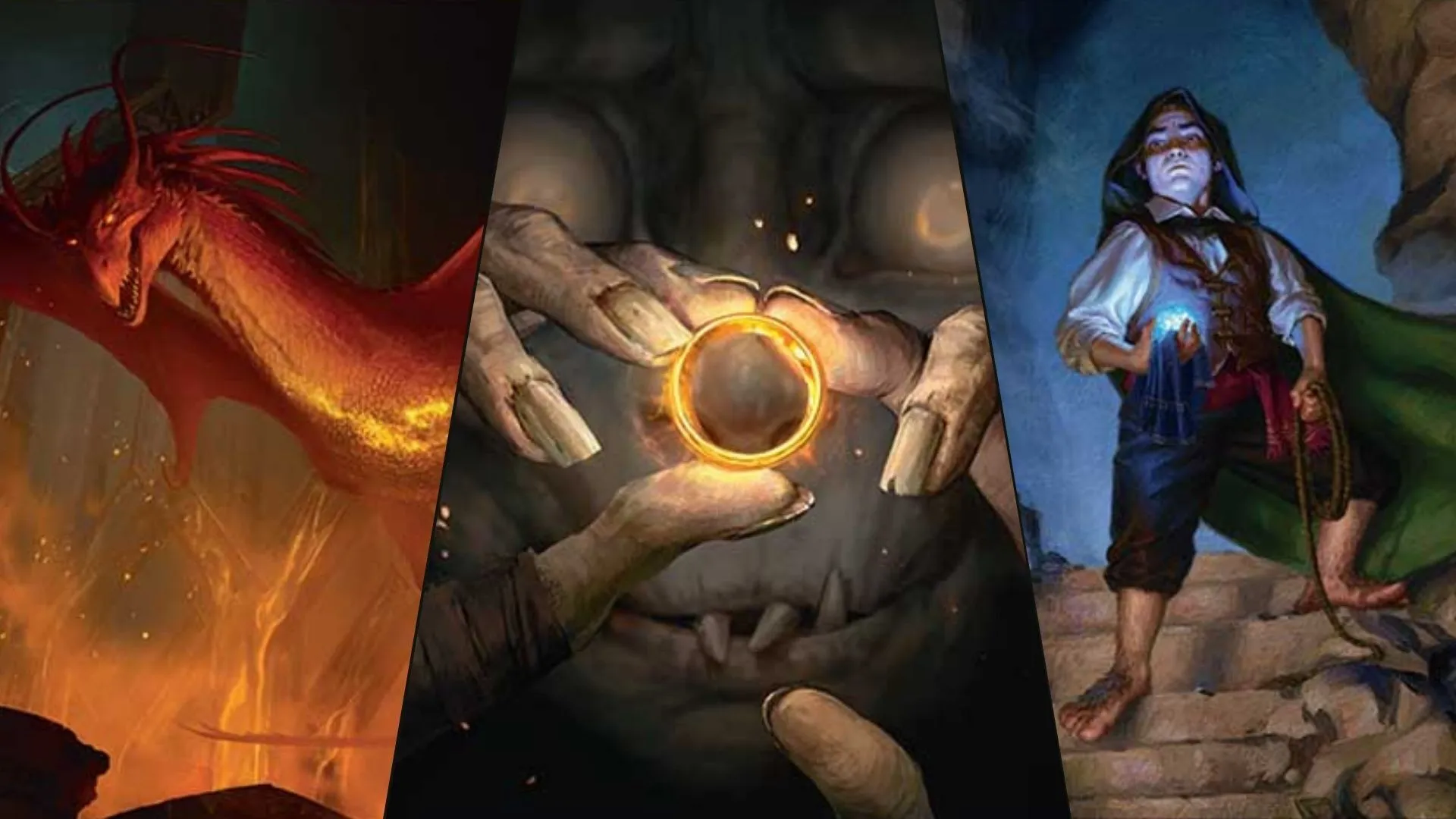
Magic: The Gathering | The Hobbit is built around a surprisingly clear idea: the cards are supposed to feel like an adventure unfolding on the table.
That shows up in almost every major mechanic. Some reward you for assembling a board full of artifacts, legends and Sagas. Others let characters literally go on an Adventure before arriving on the battlefield. Treasure plays a major role, Equipment becomes more dangerous over time, and even the set’s token mechanics are tied directly to the story’s armies and companions.
The result is a set that feels mechanically connected to Tolkien’s story without simply repeating everything from The Lord of the Rings: Tales of Middle-earth.
The most important new mechanics are Storied, Recruit and Hone, while Adventure and Amass return in roles that fit The Hobbit naturally.
Storied Is the Mechanic That Holds the Set Together
Storied is probably the mechanic that best explains what The Hobbit is trying to do.
A permanent with storied checks whether you control at least three permanents among artifacts, legendary permanents and Sagas. Once you satisfy that condition while controlling a storied permanent, you gain what the rules call an enduring story.
The key detail is that an enduring story is permanent.
If one of your artifacts is destroyed later, you do not lose it. If your legendary creature dies, you do not lose it. Even if the permanent with storied leaves the battlefield, the story has already been established and stays with you for the rest of the game.
That gives the mechanic a very different feel from ordinary threshold-style abilities. You are not trying to preserve three specific permanents forever. You are trying to reach a narrative milestone once.
Cards such as Thorin Oakenshield can then reward you for having crossed that threshold.
Treasure tokens make this especially easy because each Treasure counts as an artifact permanent. Sagas also count, and legendary permanents naturally appear throughout the set. A legendary artifact still counts as only one permanent, not two, but the broader idea is simple: The Hobbit rewards decks that gradually build a board full of important objects, places and characters.
That is also why Storied feels so natural in Commander. Commander decks already tend to contain legendary permanents and artifacts, so the mechanic often asks you to do something you were going to do anyway.
Recruit, Treasure and Hone Build the Adventure Around Your Creatures
Recruit is much more straightforward, but it still fits the theme well.
Whenever you recruit, you draw a card and then discard a card. If the discarded card is nonland, you also create a 1/1 white Human Soldier creature token.
So Recruit is not just card filtering. It also turns spare nonland cards into additional board presence.
That makes the decision slightly more interesting than an ordinary loot effect. Discarding a land may improve your hand, but it does not create a Soldier. Discarding a nonland card can develop your battlefield at the same time, and in graveyard-focused decks the discard may even be an advantage.
Treasure is not technically a new mechanic, but it is everywhere in the set’s identity. That is hardly surprising in a story built around reclaiming a dragon’s hoard.
Treasure tokens help cast expensive spells, support artifact strategies and contribute directly toward Storied. They are one of the clearest examples of different mechanics working together rather than existing in isolation.
Hone counters fill a similar role for Equipment.
Each hone counter on an Equipment gives the equipped creature +1/+0. The counters stay on the Equipment itself, so if that Equipment moves to another creature, the new creature receives the bonus.
A card such as Sting, Bilbo’s Sword can therefore grow into a more dangerous weapon over the course of a game rather than merely providing a temporary boost to one bearer.
That makes Hone especially relevant to Equipment-heavy Commander decks, where permanent improvement to the Equipment matters more than a one-turn combat trick.
Adventure and Amass Return for Very Different Reasons
Adventure returns because few mechanics in Magic fit The Hobbit as perfectly.
An Adventure card gives you two stages of play. You can cast the instant or sorcery Adventure first, and if it resolves, the card goes into exile. From there, you can later cast the permanent portion.
That means one card can represent both the journey and the character who eventually arrives.
Bilbo, Luckwearer is a good example of how naturally the mechanic fits the source material.
There is one rules detail worth remembering: after casting the Adventure, you do not get to cast that Adventure again from exile. You may cast the permanent portion.
Outside the stack, the card is also treated according to its permanent characteristics. So if Bilbo is a creature card, a tutor searching for a creature can find him even though an Adventure spell is printed on the same card.
Amass returns for a completely different reason.
The mechanic represents the Goblin and Orc forces that oppose Bilbo’s company. If you amass Goblins 4 and you do not control an Army, you create a 0/0 Goblin Army token and put four +1/+1 counters on it.
If you already control an Army, the new counters normally go onto an existing Army instead.
That means Amass is about building one growing military force rather than creating a new token every time. Different Amass types can even combine on the same Army, so one token can end up carrying multiple creature types.
For Commander players, Amass is most interesting in decks that already care about tokens, +1/+1 counters, Goblins, Orcs or Army creatures.
The Hobbit Feels Different From Tales of Middle-earth
The Hobbit is not just a smaller remix of The Lord of the Rings: Tales of Middle-earth.
Amass creates a direct mechanical connection between the two sets, but the rest of The Hobbit’s identity is different.
Storied rewards the act of building a board that looks like a collection of important story elements. Recruit turns card selection into the process of gathering companions. Hone lets famous weapons become more powerful over time. Adventure lets characters literally travel through part of their story before becoming permanents.
Sagas and Treasure then tie everything together.
That gives the set a much more episodic feeling, which suits The Hobbit better than simply reusing the mechanics of the War of the Ring.
For Commander, this also means the cards are likely to spread into several existing archetypes rather than forming one isolated „Hobbit deck.“ Treasure cards can go into artifact strategies. Adventure cards provide flexible value. Recruit fits graveyard and token decks. Storied naturally rewards legendary-heavy lists.
The mechanics are flavorful, but they are also broad enough to matter outside dedicated Tolkien builds.
PreconForge Verdict
The Hobbit succeeds mechanically because its keywords reinforce the shape of the story rather than simply decorating familiar Magic effects with Middle-earth names.
Storied is the standout because it creates a permanent narrative milestone during the game. Recruit, Treasure and Hone build out the journey around your creatures, while Adventure and Amass return in roles that feel natural rather than forced.
For new players, Storied is the mechanic most worth understanding carefully because once you gain an enduring story, you keep it for the rest of the game.
For Commander players, Adventure and Treasure are probably the easiest mechanics to reuse across existing decks, while Recruit and Hone will shine more in strategies already built around graveyards, tokens or Equipment.
And if you are preparing specifically for Draft or Sealed, our MTG The Hobbit Draft & Sealed Guide is the better next step because it focuses on which mechanics and color pairs actually matter in Limited.


