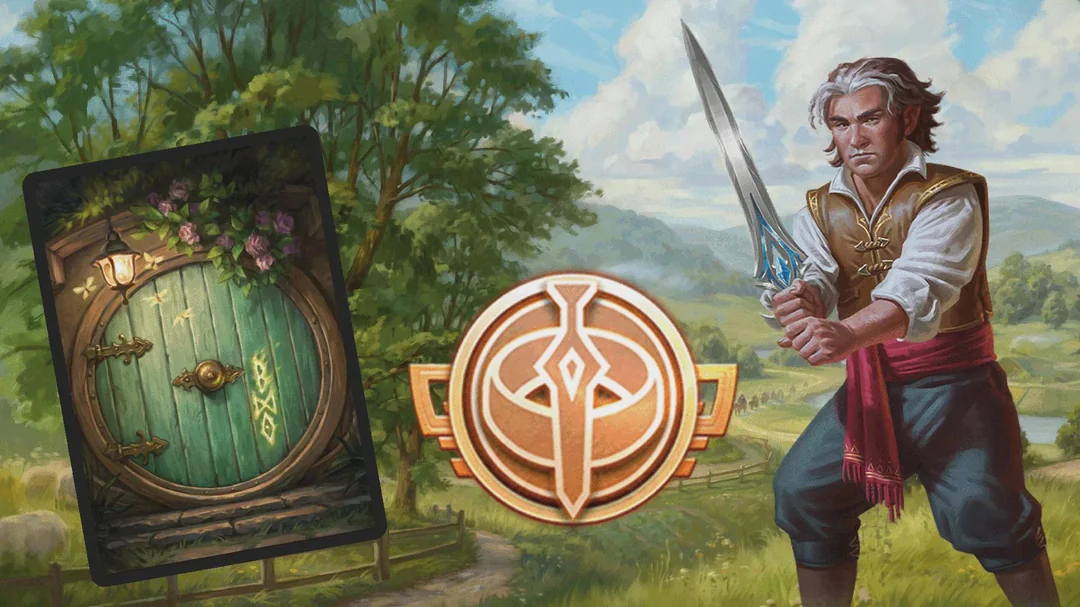
Magic: The Gathering | The Hobbit (HOB) is now live on MTG Arena, bringing Bilbo’s journey to Draft, Sealed and Constructed play. The set launched digitally on August 11, 2026, with its own Set Mastery track, Mastery Pass and a full schedule of Limited events.
Whether you are entering your next Premier Draft or deciding where to spend Rare and Mythic Wildcards, the most important thing is knowing what the set actually supports. The Hobbit Limited environment is built around only five official two-color archetypes, while Constructed players should be much more selective before committing valuable Wildcards.
The Hobbit Draft Archetypes on MTG Arena
Unlike many Magic sets, The Hobbit Limited environment is centered around five supported two-color archetypes rather than all ten color pairs. Each pair has a clear mechanical identity, which makes reading signals especially important during a Draft.
White-Blue Humans revolves around drawing a second card each turn and using Recruit to generate additional value and creature tokens. It tends to play a patient value game before turning a developed board into pressure.
Black-Red Goblins combines Amass with sacrifice synergies. The deck builds an Army, uses it as a resource and rewards you for creatures dying or being sacrificed at the right moment.
Black-Green Wolves is the set’s Ferocious strategy. It wants creatures with power 4 or greater on the battlefield so that its payoff cards operate at full strength.
Red-White Dwarves leans into Storied, artifacts and legendary permanents. Cards such as Thorin Oakenshield reward you for establishing an enduring story and then maintaining an aggressive board.
Green-Blue Elves is the Landfall archetype and generally plays a more controlling game, using repeated land drops and larger threats to take over longer games. Wizards specifically identifies these five pairs as the set’s intended Limited archetypes.
That does not mean you can never draft another color combination, but the gold cards and strongest mechanical support are concentrated in these five lanes. If an unsupported pair appears open, you still need a good reason to move away from the set’s natural synergies.
If you want a deeper breakdown of card evaluation, mana curves and how these archetypes perform in 40-card decks, our MTG The Hobbit Draft & Sealed Guide goes much further into the Limited environment.
How to Approach Hobbit Drafts on Arena
The biggest mistake is forcing an archetype too early.
A strong Red-White card in your opening pack does not mean Dwarves will remain open. Pay attention to which commons and uncommons continue reaching you, especially the multicolor signpost cards that indicate whether another player is competing for the same strategy.
Mana curve still matters as much as synergy. The official Prerelease guide recommends a conventional Limited structure with roughly 17 lands, while Adventure cards can give some spells additional flexibility at different points on the curve.
That is especially relevant on Arena because it is easy to become distracted by the set’s mechanics and end up with too many expensive payoff cards. A deck full of powerful four- and five-mana spells can still lose before those cards matter if it does nothing during the first few turns.
Removal and interaction should not be sacrificed purely for theme either. The best Hobbit Draft decks usually combine their archetype’s engine with enough early plays and answers to survive until those synergies begin generating real advantage.
Best Wildcard Crafts: Craft Decks, Not Individual Cards
Rare and Mythic Wildcards remain some of the most valuable resources on MTG Arena, so there are very few cards I would describe as universally safe crafts.
The Hobbit is Standard legal, and HOB cards are also legal in Pioneer and Modern on tabletop. On Arena, individual cards may also find homes in formats such as Brawl, Historic and Timeless depending on the card and format rules.
That does not mean you should immediately craft four copies of every headline rare.
Cards such as The Arkenstone, Smaug the Magnificent and Sting, Bilbo’s Sword may be worth crafting when they complete a deck you actually intend to play, but the better rule is simple: craft the deck, not the card.
If a Standard list requires three copies of The Arkenstone, craft those copies because you already know what they are for. If you only think a Mythic looks powerful and hope to find a home for it later, keeping the Wildcard is usually the safer decision.
Brawl is less demanding because it is singleton. Spending one Wildcard on a card you know will immediately slot into a commander deck is much easier to justify than spending four Rare or Mythic Wildcards on an uncertain Standard playset.
The Hobbit is still relatively new on Arena, so constructed decks will continue to evolve. There is very little downside to waiting until you know exactly what you want to build.
Making the Most of The Hobbit on Arena
The Hobbit received a dedicated Arena event schedule covering Premier Draft, Traditional Draft, Pick-Two Draft, Quick Draft and Sealed play throughout its release period. Wizards also launched a separate Set Mastery track where normal play earns packs and Mastery Orbs, while the paid Mastery Pass adds further digital rewards.
For Limited players, Draft and Sealed remain the best ways to learn the five archetypes while building a collection at the same time. Constructed players can afford to be more patient and let the decks they actually want to play determine where their Wildcards go.
The simplest plan is also the most efficient: learn the five supported Draft archetypes, avoid forcing colors too early, and only spend Rare or Mythic Wildcards when they complete a real deck rather than an imagined future one.
If you are building one of those decks from scratch, our Mana Curve & Ultimate Deck Analyzer can help you check the curve before committing more Wildcards.


