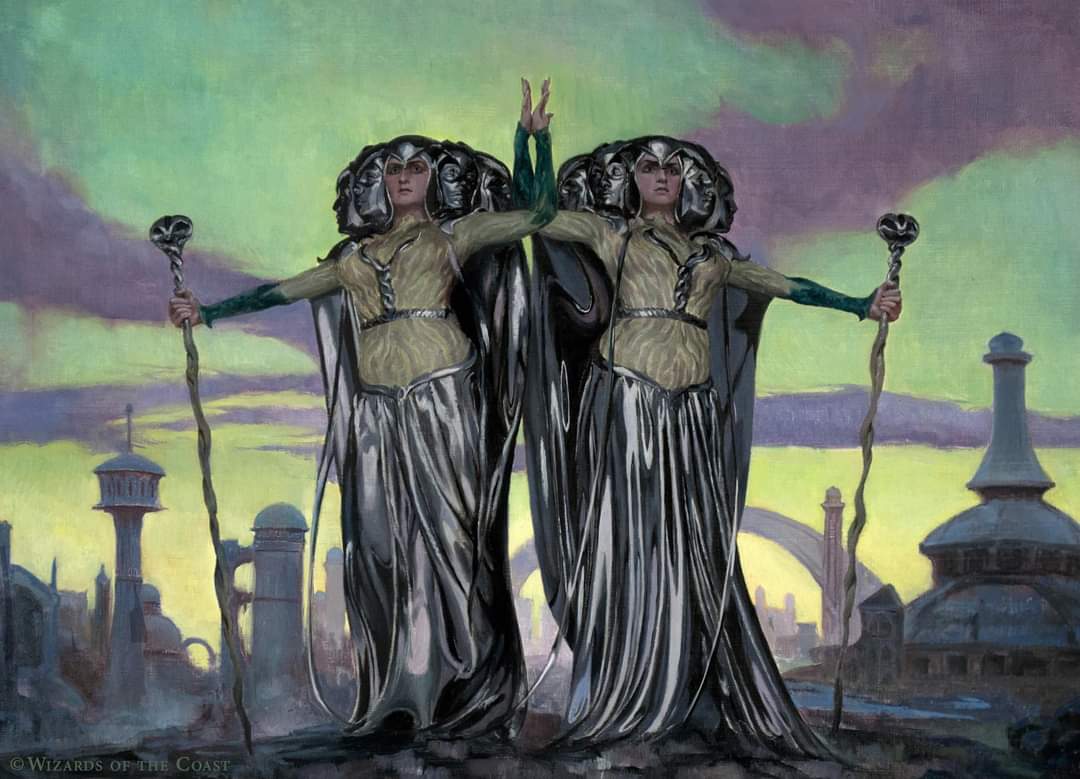
Tricky Terrain is one of those Commander precons that becomes much stranger once you stop treating it like a normal Simic lands deck.
At first glance, Omo, Queen of Vesuva looks like another commander that rewards you for playing unusual lands. In reality, the most interesting part of Omo is how completely an everything counter rewrites what a permanent is allowed to be.
Whenever Omo enters the battlefield or attacks, you can put an everything counter on up to one target land and up to one target creature. A land with one of those counters becomes every land type in addition to its other types, while a nonland creature with an everything counter becomes every creature type. Wizards‘ own release notes specifically clarify that this includes all land types, not merely basic land types.
That is the real engine of the deck.
An everything-countered land can be a Locus, Gate, Desert, Forest and every Urza land type at the same time. An everything-countered creature can simultaneously be an Elf, Merfolk, Wizard, Illusion, Treefolk and much more.
The original Tricky Terrain precon already gives Omo an excellent foundation. The goal of this upgrade is therefore not to tear the deck apart. It is to remove the generic pieces that do not exploit Omo and replace them with cards that reward those constantly changing land and creature types.
What Tricky Terrain Already Does Well
One reason this precon is relatively easy to upgrade is that Wizards already included many of the lands you would otherwise have to buy separately.
The official list contains Urza’s Mine, Urza’s Power Plant and Urza’s Tower, alongside Cloudpost and Glimmerpost. You also get Dark Depths, Thespian’s Stage, Vesuva, Basilisk Gate and Planar Nexus directly in the box.
That is a remarkably interesting land package for a preconstructed deck.
The interaction with Omo is stronger than simply giving your lands cute extra labels. Because an everything-countered land has every land type, it can satisfy cards that care about Locuses, Gates or Urza lands.
Cloudpost, for example, produces more mana based on the number of Locuses you control. Put an everything counter on an ordinary land and you have created another Locus.
The Urza lands benefit for a similar reason. Once one of your lands has every relevant Urza land type, it becomes much easier for Urza’s Tower, Urza’s Mine and Urza’s Power Plant to see the land types they need.
That is the side of Tricky Terrain worth strengthening.
The First Cards I Would Cut
The deck contains several cards that are perfectly reasonable in Commander but do not do enough for Omo specifically.
Fog Bank is the easiest cut. It can protect your life total, but it neither develops the land engine nor rewards your everything counters. In a deck with such a specific commander, spending a card slot on a purely defensive two-drop is difficult to justify.
Hydra Broodmaster is another candidate. The deck can certainly generate enough mana to make a huge Hydra and create a pile of tokens, but that is generic Simic power rather than Omo synergy. If you are investing six mana into a creature, I would rather have one that multiplies your land or creature-type engine.
Floriferous Vinewall helps find lands, but the precon already contains much more precise tools such as Sylvan Scrying, Expedition Map, Hour of Promise and Ulvenwald Hydra. If the deck needs a particular utility land rather than just any land, precision matters.
I would also consider trimming Harmonize and Urban Evolution. Neither card is terrible, but Omo has access to stronger draw engines that can become part of the land strategy rather than existing as generic value spells.
The land cuts require more care. Desert of the Indomitable and Desert of the Mindful are reasonable places to look if you are trying to make the mana base faster, because both always enter tapped. Unlike the creature cuts, though, I would not automatically remove every tapped land from Tricky Terrain. Omo is a lands deck, and some slower utility lands can justify their tempo cost.
Add More Ways to Exploit Creature Types
The original deck does a much better job exploiting Omo’s land ability than its creature ability. That is where several of the best upgrades come from.
Roaming Throne is one of my favorite additions.
When it enters, choose a creature type that matters to your board. Omo herself is already a Shapeshifter, and creatures with everything counters become every creature type, which makes Roaming Throne surprisingly easy to exploit. More importantly, doubling a relevant triggered ability can turn Omo’s type-changing engine into a genuine value engine instead of a novelty.
Another excellent option is Hakbal of the Surging Soul. Creatures carrying everything counters are Merfolk, so Hakbal can reward them alongside any natural Merfolk you happen to control. That gives the creature half of Omo’s text a much more meaningful payoff.
Lord of the Unreal works from another angle. Everything-countered creatures are also Illusions, allowing the Lord to protect them with hexproof while increasing their power. It is narrow in a normal deck, but Omo is exactly the kind of commander capable of turning narrow typal cards into flexible support pieces.
One of the most entertaining options is Timber Protector. Creatures with everything counters count as Treefolk, while lands with everything counters count as Forests. Timber Protector can therefore protect far more of your board than it would in an ordinary Treefolk deck.
These cards are much more interesting than trying to splash five-color tribal lords. They stay within Omo’s blue-green color identity while still exploiting the fact that everything-countered creatures belong to every tribe.
Wirewood Symbiote Gives Omo a Clever Utility Engine
Wirewood Symbiote is a particularly elegant inclusion because an everything-countered creature is an Elf.
That means the Symbiote can return one of those creatures to your hand as part of its ability while untapping another creature. The obvious use is protecting an important creature from removal, but the untap can also support cards such as Magus of the Candelabra.
There is a cost here: once the creature returns to your hand, the everything counter disappears with it. You will need Omo to place another counter later.
That is not necessarily a problem.
If the creature you saved has a useful enter-the-battlefield ability, replaying it may actually be beneficial. This is exactly the kind of interaction I want from an Omo upgrade: not simply a powerful Commander staple, but a card whose value changes because Omo changes creature types.
Upgrade the Land Engine Before Adding More Big Creatures
The easiest mistake with Tricky Terrain is seeing how much mana it can make and immediately filling the deck with expensive finishers.
The stock list already contains Apex Devastator, Avenger of Zendikar, Hydroid Krasis, Rampaging Baloths and Terastodon. You are not short of things to do with ten mana.
The better upgrade is making the unusual land engine more consistent.
Crop Rotation is excellent because it converts almost any land into the exact utility land you need at instant speed. That could mean finding Cloudpost, completing a particular land interaction or grabbing Thespian’s Stage when the board makes it relevant.
Just do not describe it as automatically producing a surprise Marit Lage.
The precon already contains both Dark Depths and Thespian’s Stage, and Stage is the important half of that familiar interaction because it can copy Dark Depths after entering the battlefield without inheriting its ice counters. Crop Rotation helps you find pieces, but it does not remove the mana and sequencing required to execute the combo.
Elvish Reclaimer fills a similar role more slowly. It can repeatedly turn expendable lands into the specialty lands your board currently needs, which is much more valuable in Tricky Terrain than another generic ramp creature.
Field of the Dead is another strong premium upgrade. Commander naturally plays many differently named lands, and Tricky Terrain goes even further with its huge collection of utility lands. Once Field is active, simply continuing to play lands gives you another route to winning without forcing the entire deck to depend on Omo surviving.
Gates Are Useful, but Do Not Overbuild Around Them
The original article was right that Gates are interesting with Omo, but I would not turn the deck into a full Gate deck unless that is specifically the direction you want to take.
Basilisk Gate is already in the precon, and an everything-countered land counts as a Gate, making its activated ability easier to scale.
Baldur’s Gate can also become impressive because the number of Gates you control matters to its mana production. Omo creates additional Gates simply by putting everything counters on lands.
Gond Gate is more of a dedicated Gate-package card. If you start adding enough named Gates, helping them enter untapped becomes meaningful. If you only have a few, the slot may be better spent on a land that advances the Locus, Urza or utility-land plan instead.
That distinction matters.
Omo gives you access to several overlapping land-type strategies, but trying to maximize every one of them simultaneously can make the deck less consistent rather than more powerful.
Pick the parts that matter most to you.
Locus Is the Cleanest Omo Payoff
If I were upgrading Tricky Terrain without completely changing its identity, Locus would be one of my highest priorities.
The deck already gives you Cloudpost, Glimmerpost, Trenchpost and Planar Nexus.
Omo then allows ordinary lands to become additional Locuses.
That is an extremely natural synergy because you do not need ten different cards working together. You simply need Omo, a land with an everything counter and one of the cards that rewards the Locus type.
Cloudpost is the obvious centerpiece. Every additional Locus increases its output, which means Omo can effectively turn a harmless land into part of a rapidly scaling mana engine.
This is also where Magus of the Candelabra becomes much more interesting. Untapping a land that already produces several mana is fundamentally different from untapping a basic Forest.
Rather than cutting Magus as generic ramp, I would keep it if you are leaning into Cloudpost and other high-output lands.
The Urza Lands Need Omo More Than You Might Think
Tricky Terrain also includes the complete Tron package: Urza’s Mine, Urza’s Power Plant and Urza’s Tower.
In a normal singleton Commander deck, naturally assembling all three is unreliable.
Omo changes the equation because everything-countered lands gain the relevant land types. You no longer need to think about the three Urza lands as a miniature Modern deck hiding inside your 100 cards. They are pieces of a wider type-based mana engine.
That means I would keep them.
The mistake would be spending too many additional slots trying to assemble natural Tron when Omo herself already helps solve that problem.
Cards such as Sylvan Scrying and Expedition Map are valuable because they can find whichever specialty land matters in the current game, not merely because they complete one specific three-land combination.
Protect Omo Before Adding Another Payoff
The upgraded deck increasingly depends on having Omo available.
Without her, Cloudpost is just counting the natural Locuses you control. Tribal cards stop seeing random creatures as Merfolk, Elves or Illusions. Gates stop multiplying through everything counters.
That makes protection more valuable than another flashy seven-mana spell.
Heroic Intervention is one of the cleaner options in Simic because it can protect a large portion of your board at once. That matters in a deck where your important engine includes both creatures and unusual lands.
Tamiyo’s Safekeeping is a much cheaper alternative for protecting one critical permanent.
This is also why I would be cautious about cutting all of the stock interaction just to chase synergy. Arcane Denial, Beast Within and Pongify are not exciting Omo cards, but decks still need to interact with opponents.
An upgraded deck that produces twenty mana and dies to the first opposing combo is not actually upgraded.
A Practical First Upgrade Package
If you do not want to rebuild half the precon immediately, I would start with a small group of changes rather than purchasing fifteen cards at once.
If you are still working out the overall structure of your 99, our How to Build a Commander Deck guide explains how to balance ramp, card draw, interaction, lands and win conditions before you start making individual upgrades.
My first additions would be Roaming Throne, Wirewood Symbiote, Crop Rotation, Elvish Reclaimer and Heroic Intervention.
For those slots, I would begin by removing Fog Bank, Hydra Broodmaster, Floriferous Vinewall, Harmonize and one of the slower flex cards based on your preferred direction.
That small package already changes how the deck plays.
You gain another way to amplify creature-type interactions, more reliable access to key lands, additional commander protection and fewer cards that simply provide generic midrange value.
From there, you can decide whether you want to push harder toward Locus mana, Gates, creature types or landfall.
Premium Upgrades Worth Considering
If budget is less important, Field of the Dead is one of the most natural upgrades because Tricky Terrain already plays so many differently named lands.
Ancient Greenwarden also fits beautifully if you want to lean further into landfall. It lets you play lands from your graveyard and doubles triggered abilities caused by lands entering the battlefield under your control.
Aesi, Tyrant of Gyre Strait provides both an additional land drop and card draw whenever a land enters under your control, giving the deck a much stronger long-game engine.
Nyxbloom Ancient is less subtle, but Tricky Terrain is one of the decks where tripling mana from already powerful lands can become spectacular very quickly.
I would still resist the temptation to replace every cheap synergy card with an expensive staple.
The best Tricky Terrain upgrades are the cards that become unusually powerful because Omo is your commander, not merely cards that happen to be strong in green and blue.
Do Not Add Five-Color Tribal Cards
This deserves a separate warning because the interaction looks so tempting.
Omo can make your creatures Slivers, Scarecrows and every other creature type, but that does not change the Commander color-identity rules.
Cards such as The First Sliver, Sliver Overlord and Reaper King may appear to have perfect mechanical synergy with everything counters, but their color identities do not fit inside an Omo Commander deck.
Omo is Simic.
Your 99 therefore needs to remain within blue, green and colorless card identities.
The better approach is to look for blue-green or colorless tribal payoffs such as Roaming Throne, Hakbal of the Surging Soul, Lord of the Unreal or Timber Protector.
You still get to exploit Omo’s ridiculous creature typing without accidentally building an illegal deck.
Is Tricky Terrain Worth Upgrading?
Yes, especially if you enjoy Commander decks that reward sequencing and rules knowledge rather than simply casting the largest creature available.
The stock Tricky Terrain list is already unusual because Wizards included most of the land infrastructure the commander wants. The complete Urza package, Locus cards, Dark Depths, Thespian’s Stage, Vesuva, Gates and several land tutors are already in the official deck.
That means your upgrade budget can go toward making Omo matter more, rather than rebuilding the mana base from scratch.
The strongest version of the deck is not simply Simic goodstuff with a strange commander at the top. It is a deck where one everything counter changes how five different cards on the battlefield suddenly interact.
Lean into Locus mana. Use creature-type payoffs that are actually legal in Simic. Add more ways to find your specialty lands, protect Omo and trim generic six-mana threats that do not need your commander at all.
Do that, and Tricky Terrain stops feeling like a collection of clever land cards and starts feeling like one coherent machine.


