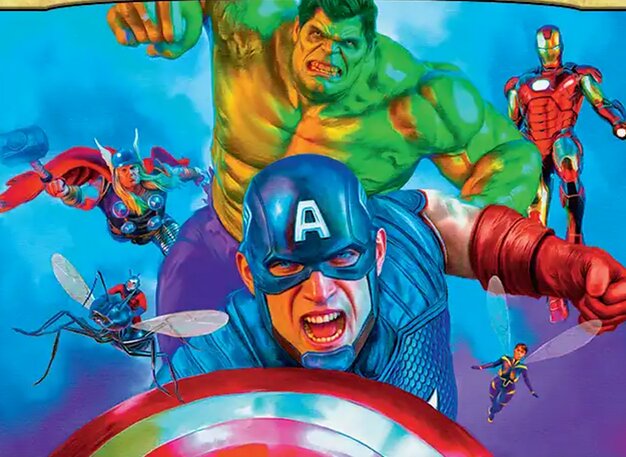
The Avengers Assemble Commander deck from Magic: The Gathering | Marvel Super Heroes delivers exactly what its name promises: put a team of Heroes onto the battlefield and overwhelm the table before opponents have time to stabilize. Its Jeskai color identity gives the deck access to excellent interaction and card advantage, but the real reason to play it is Captain America, Team Leader.
Captain America rewards you every time another Hero enters under your control. That Hero gains vigilance and haste until end of turn, then receives a +1/+1 counter while Captain America gets a +1/+1 counter of his own. Instead of asking you to build around Equipment or complicated combo pieces, he turns something you already want to do into your primary engine: keep assembling Avengers.
That creates a surprisingly aggressive Commander deck. Your Heroes do not have to wait a turn before contributing to combat, vigilance lets them attack without completely exposing you on the crackback, and every new recruit permanently increases both itself and Captain America. Left unanswered for several turns, Captain America can become a serious combat threat while the rest of the board continues growing around him.
The stock precon already provides an excellent starting point with cards such as Iron Man, Armored Avenger, Director Nick Fury, Captain Marvel, Apex Avenger, Scarlet Witch, Chaotic Avenger, She-Hulk, Wallbreaker and War Machine, Avenging Arsenal. It also contains tribal support including Herald’s Horn, Door of Destinies, Metallic Mimic and Kindred Discovery.
That means Avengers Assemble does not need to be rebuilt from scratch. The best upgrade plan is to make the Hero engine faster and more consistent, increase the value of every creature entering the battlefield and remove some of the cards that are powerful in isolation but do not contribute enough to Captain America’s game plan.
If you are still choosing between the four Marvel precons, our Marvel Commander Deck Value Guide compares Avengers Assemble with Wakanda Forever, The Fantastic Four and Doom Prevails before you start buying upgrades.
Check the current Avengers Assemble Commander deck price on TCGplayer.
How Captain America Actually Wants to Win
The strongest part of Captain America, Team Leader is that his ability provides both immediate tempo and permanent scaling. A Hero entering the battlefield does not simply trigger a temporary combat bonus. It arrives larger than normal, can attack immediately and makes Captain America permanently larger at the same time.
That changes how you should evaluate creatures in the deck. A Hero that might look merely efficient in another Commander list becomes significantly more dangerous here because Captain America removes the usual summoning-sickness delay. You can deploy a threat during your first main phase and immediately send it into combat with vigilance, while still having it available as a blocker afterward.
The ideal game therefore involves casting Captain America early and following him with a steady stream of Heroes rather than emptying your hand all at once. The longer Captain survives, the more value you accumulate from every creature you deploy. Cards that produce additional Heroes, duplicate his triggered ability or turn other creatures into Heroes become especially attractive because they increase the number of meaningful triggers without forcing the deck away from its original theme.
There is another important consequence: Captain America does not need Equipment to function. Avengers Assemble contains a small amount of Equipment and artifact support because it fits the Marvel theme, but you should not spend your upgrade budget trying to transform this version of Captain America into an Equipment commander. The cleaner path is to make the Avengers themselves stronger.
The Best Cards to Cut
I would begin by removing cards that consume a lot of mana without advancing the Hero engine enough. Unlike the original version of this guide, I would not cut Hawkeye, Avenging Archer or War Machine, Avenging Arsenal simply because they are not Equipment payoffs. Both are Heroes, which means they naturally work with Captain America’s trigger and preserve the central identity of the deck.
West Coast Expansion is a more reasonable place to look when lowering the curve. Large, dramatic effects can be excellent when the game goes long, but Captain America performs best when you are adding Heroes consistently rather than saving an entire turn’s resources for one expensive play. It is the kind of slot I am comfortable converting into a cheaper engine piece.
Methods of the Mighty is another flexible slot rather than a mandatory cut. The card belongs thematically and can produce useful combat turns, but if the goal is to make the deck more consistent, permanent engines generally outperform one-shot effects over a long Commander game.
I would also examine some of the more generic tribal cards once you begin upgrading. Door of Destinies can make the team enormous, but four mana for a permanent that does nothing until you continue casting creatures can occasionally feel slow. I would not remove it in a budget build, but it becomes a possible cut if you are adding more powerful ways to multiply Captain America’s triggers.
One card I would not cut is Exotic Orchard. In three-color Commander it is usually perfectly reasonable fixing, especially in multiplayer. Replacing functional mana sources should come later than fixing the actual engine of the deck.
The Best Upgrades to Buy First
If I were upgrading Avengers Assemble with Captain America remaining in the command zone, Roaming Throne would be very high on my list. When it enters, you choose a creature type, and choosing Hero gives the deck exactly the kind of effect it wants. Captain America’s triggered ability can trigger an additional time, which means subsequent Heroes can pick up additional counters while Captain himself grows significantly faster. The Throne also benefits from the creature-type infrastructure already present in the deck, making it much more than a generic Commander staple.
Maskwood Nexus attacks the problem from a different direction by giving every creature you control every creature type. Suddenly, utility creatures that would normally miss Captain America’s trigger become Heroes too. That substantially widens the card pool you can play without sacrificing synergy and makes future creature draws much more reliable.
For the counter side of the strategy, The Ozolith is particularly useful because Captain America tends to accumulate a surprising number of +1/+1 counters over the course of a game. Once opponents realize how quickly he is growing, removal becomes inevitable. The Ozolith gives you a way to preserve the investment you have made rather than starting completely from zero each time Captain America returns from the command zone.
Resourceful Defense serves a similar purpose while fitting naturally into a deck where counters are spread across multiple Avengers. Moving counters away from a creature that is about to disappear makes spot removal less punishing, and the ability to redistribute your resources can create much stronger combat steps than opponents expect.
Finally, Cathars‘ Crusade is expensive enough that I would not automatically put it into every version, but the ceiling here is enormous. Captain America already rewards creatures entering. Cathars‘ Crusade turns those same arrivals into counters across your entire army, so each new Hero can make the existing Avengers larger while Captain America’s own ability continues doing its job. It is exactly the type of card that can turn a normal-looking board into lethal damage very quickly.
The important point is that these upgrades reinforce what Captain America already does. We are not replacing Marvel cards merely to fill the list with Commander staples. The Avengers remain the stars of the deck while the new support pieces make each Hero more impactful.
Budget and Premium Upgrade Paths
A budget Avengers Assemble upgrade should begin with consistency rather than raw power. The stock deck already has an unusually deep collection of Heroes, so you do not need to replace half of them. Instead, concentrate on getting Captain America onto the battlefield reliably and keeping enough cards flowing that you can continue deploying Heroes turn after turn.
That makes cards already present in the deck, particularly Kindred Discovery, extremely valuable. Naming Hero turns your creature-heavy game plan into a source of cards and helps prevent the classic tribal-deck problem where you build an impressive battlefield and then run out of things to do. Herald’s Horn similarly deserves to stay because it can reduce the cost of your Heroes while generating additional card advantage over a longer game.
Metallic Mimic is another stock card I would keep. Choosing Hero means new Avengers arrive with an additional +1/+1 counter, stacking naturally with the counter they already receive from Captain America. It is inexpensive to cast and contributes immediately to the exact plan we are trying to improve.
Once you have more budget available, the focus should move toward multiplying those effects and protecting the resulting board. Roaming Throne is more appealing to me here than an expensive generic threat because it makes the cards already in your deck better. Teferi’s Protection becomes increasingly valuable as well because Avengers Assemble naturally encourages you to commit several creatures to the battlefield, making sweepers one of the easiest ways for opponents to undo several turns of development.
If you want to lean harder into +1/+1 counters, The Ozolith and Resourceful Defense make removal less painful, while Cathars‘ Crusade provides the higher-ceiling option. I would add these pieces gradually rather than turning the deck into a generic counters list. Captain America still needs a healthy density of actual Heroes to keep his primary engine functioning.
That balance is important. A powerful support enchantment does nothing if your hand contains no Avengers to trigger it.
Keep the Best Parts of the Original Precon
One of the easiest mistakes when upgrading a precon is replacing so many thematic cards that the finished deck barely resembles the product you bought. Avengers Assemble does not need that treatment.
Iron Man, Armored Avenger is exactly the kind of Hero you want to keep. Director Nick Fury helps solve the card-flow problem that creature-heavy decks frequently encounter, and Captain Marvel, Apex Avenger gives the deck another substantial threat. Cards such as Scarlet Witch, Chaotic Avenger, Black Widow, Agile Avenger, Ant-Man, Elusive Avenger and Quicksilver, Speedster are not merely flavor pieces when Captain America cares specifically about Heroes entering.
The deck also comes with excellent Commander fundamentals. Swords to Plowshares, Arcane Denial, Austere Command and Dismantling Wave give you interaction without requiring a major upgrade budget, while Sol Ring, Arcane Signet and the three Talismans help Captain America arrive on schedule.
Rather than replacing those cards, use your first upgrades to remove the weakest links surrounding them. This keeps the cost of improving the deck manageable and preserves the reason you bought an Avengers deck in the first place.
Improving the Jeskai Mana Base
Captain America costs , so having access to all three colors early matters more here than it would for a commander with a mostly generic mana cost. Fortunately, Avengers Assemble already gives you a respectable foundation with Command Tower, Spectator Seating, Glacial Fortress, Sulfur Falls, Clifftop Retreat, Prairie Stream, Irrigated Farmland, Exotic Orchard and several lands designed to support creature types.
That means I would not make premium lands the first purchase.
If you eventually want to optimize the mana base, Flooded Strand, Scalding Tarn and Arid Mesa give you much better access to the colors you need when paired with suitable typed dual lands. Those upgrades improve consistency, but they do not fundamentally change how Avengers Assemble plays, so I would prioritize the Hero engine first.
Our Ultimate Landbase Upgrade Guide covers the progression from precon mana bases to stronger Commander fixing without assuming that every player wants to spend heavily on fetchlands.
Captain America or Director Nick Fury?
Avengers Assemble also includes Director Nick Fury as its featured alternative commander, and switching commanders changes what you should prioritize.
Captain America is the more aggressive option. He wants Heroes to enter repeatedly, immediately sends them into combat with haste and vigilance, and gradually builds a battlefield covered in +1/+1 counters. The deck feels like the Avengers actually assembling one by one and joining the fight as soon as they arrive.
Nick Fury pushes the shell more heavily toward sustained Hero value and card advantage. That can be appealing if your Commander games regularly go long, but it is a different upgrade direction.
For this version of the deck, I would stay with Captain America, Team Leader and embrace the aggressive identity. It distinguishes Avengers Assemble from slower Jeskai value decks and makes the huge concentration of Marvel Heroes in the original precon an asset rather than something that needs replacing.
If you are comparing the deck against the other Marvel Commander products before buying, our Marvel Commander Deck Value Guide is the better place to make that decision.
Final Verdict
Avengers Assemble is much stronger when you build around what Captain America, Team Leader actually asks you to do: play Heroes and keep playing them.
Every new Avenger entering after Captain America represents immediate pressure. It receives haste and vigilance, gets permanently larger and adds another +1/+1 counter to Captain America. As those triggers accumulate, the deck can move from an ordinary creature board to a dangerous attacking force much faster than opponents expect.
That also means the upgrade path does not need to be complicated. Keep the strongest Avengers and the excellent tribal infrastructure already included in the precon. Trim some of the slower standalone effects, add a few cards such as Roaming Throne, Maskwood Nexus, The Ozolith and Resourceful Defense, then invest in board protection before spending heavily on premium lands.
Most importantly, resist the temptation to turn the deck into something it is not. This version of Captain America is not an Equipment commander. The reason to play him is that he makes every new Hero feel like reinforcements arriving in the middle of battle.
If you already own Avengers Assemble, buying a handful of targeted singles is enough to make that engine faster and more resilient. If you are still looking for the sealed deck, compare its current price before deciding how much of your budget to reserve for upgrades.
Check the current Avengers Assemble Commander deck price on TCGplayer.
Build around the Heroes, protect the team once it is assembled and let Captain America do what his card was designed to do: make every new Avenger matter immediately.


