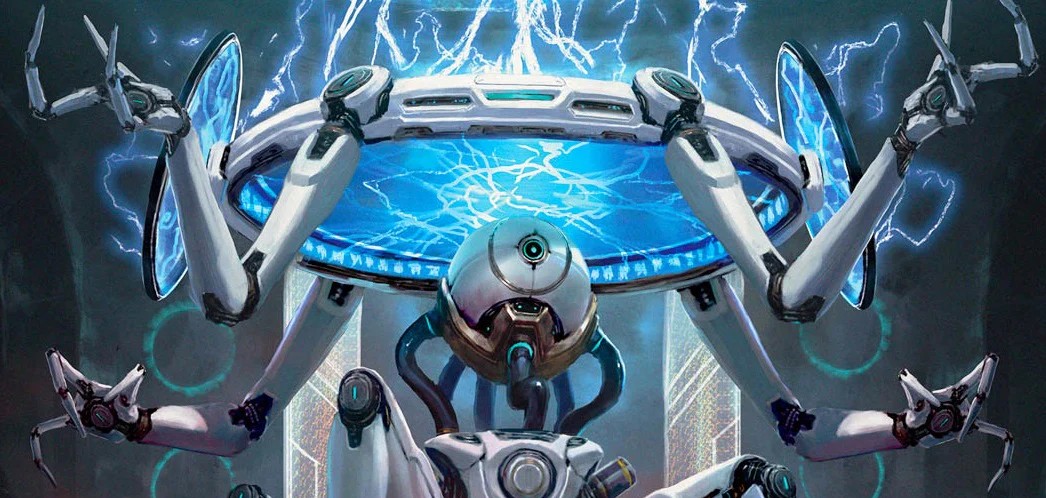
Counter Intelligence is one of those precons that looks complicated at first because it cares about several different kinds of counters, but the underlying plan is actually very coherent. The deck wants artifacts with charge counters, artifact creatures with +1/+1 counters, and repeatable proliferate effects that increase all of those resources at the same time.
At the center of that plan is Inspirit, Flagship Vessel. Once it has at least one charge counter, Inspirit begins placing either a +1/+1 counter or two charge counters on another artifact at the beginning of combat on your turn. At eight charge counters, it becomes a 5/5 flyer and gives your other artifacts hexproof and indestructible.
That final ability is the real payoff. Once Inspirit is fully stationed, much of the deck becomes extremely difficult to remove, and several of the stock board wipes become much more one-sided than they initially appear.
The best upgrade plan therefore is not to abandon the precon’s counter theme. It is to make the charge-counter engine faster, improve how often you can proliferate, and add more ways to untap or reuse the artifacts that actually spend those counters.
The Stock Deck Already Has the Right Core
The strongest part of Counter Intelligence is that the precon already contains many of the cards an upgraded Inspirit deck would want.
Kilo, Apogee Mind is probably the most important. Kilo has haste and proliferates whenever it becomes tapped, which means stationing Inspirit with Kilo does two jobs at once. Kilo contributes its power toward station and then immediately proliferates, adding another counter to every permanent you choose that already has one.
That interaction alone explains why the deck can scale so quickly.
Coretapper is another excellent stock card because it adds charge counters directly to artifacts, while Deepglow Skate can double the counters already sitting on your permanents. Tekuthal, Inquiry Dominus makes every proliferate effect significantly stronger, and Thrummingbird, Experimental Augury, Tezzeret’s Gambit and Karn’s Bastion give the deck several additional ways to keep counters growing.
The actual charge-counter payoffs are also better than they first appear. Insight Engine can become a serious draw engine once its counter total grows, Lux Cannon turns charge counters into permanent removal, and Titan Forge converts them into 9/9 Golems. Darksteel Reactor even provides an alternate win condition if the deck can accelerate it to twenty counters.
Then there is Lux Artillery, which rewards the deck for accumulating counters across artifacts and creatures and can begin dealing 10 damage to every opponent at the end step once the board reaches thirty total counters. The upgraded deck does not need to choose between “charge counters” and “+1/+1 counters.” Proliferate allows both plans to grow together.
Best Counter Intelligence Upgrades
One of the best additions is Clock of Omens. It lets you tap two untapped artifacts to untap another artifact, which is exactly what a deck full of activated artifact engines wants. Lux Cannon, Insight Engine and other tap abilities become much easier to use repeatedly, and tapping Kilo, Apogee Mind as one of the two artifacts also triggers another proliferate.
That gives Clock of Omens several layers of synergy without needing to introduce a completely separate combo package.
Unwinding Clock attacks the same problem from a different angle. Untapping your artifacts during every other player’s untap step means mana artifacts become reusable, tap abilities become much more threatening and counter engines can potentially activate several times around the table instead of only once per turn cycle.
Contagion Engine is expensive, but Counter Intelligence is one of the decks where its activated ability is genuinely worth the mana. Proliferating twice at once can advance Inspirit toward eight charge counters, increase Darksteel Reactor, reload Lux Cannon, grow +1/+1 counters and improve several other permanents simultaneously. One activation can represent far more than two counters of value.
Goblin Engineer is another excellent addition because the deck is heavily artifact-based and will inevitably lose important pieces to removal. Being able to exchange a small artifact in play for something stronger in the graveyard gives the deck resilience without relying entirely on mass recursion such as Wake the Past.
Foundry Inspector is much simpler, but that does not make it less useful. Counter Intelligence wants to cast several artifacts in the same game and already contains cards such as Jhoira, Weatherlight Captain, Thought Monitor and Uthros Research Craft that reward sustained artifact development. Reducing the cost of almost every artifact spell makes the entire deck smoother.
A more aggressive option is Arcbound Ravager. Sacrificing artifacts to grow Ravager gives the deck a way to convert temporary or expendable artifacts into permanent +1/+1 counters, and modular can move those counters elsewhere when Ravager dies. In a deck where proliferate is already increasing creature counters, Ravager gives those effects another useful target.
Conveniently, Wizards themselves later included Goblin Engineer, Foundry Inspector and Arcbound Ravager in an official Commander Reinforcements drop specifically designed for Counter Intelligence, which lines up very well with the direction the deck naturally wants to take.
What Should You Cut?
The stock list is fairly cohesive, so I would avoid cutting cards merely because they look slow in isolation. A card such as Titan Forge may be inefficient in a normal Commander deck, but here proliferate and direct charge-counter placement can reduce the amount of mana it actually asks you to spend.
The easier cuts are cards that contribute less to the central artifact-counter engine.
Gavel of the Righteous does care about charge counters, but the payoff is narrow. It spends several turns growing one equipped creature and eventually provides double strike, while the rest of the deck is trying to turn counters into cards, mana, protection and repeatable removal. It is functional, but not essential.
Etched Oracle is another card I would be comfortable trimming. Sunburst technically works with the deck, but Counter Intelligence is Jeskai and naturally has access to only three colors of mana. You can proliferate the Oracle later, but that is a lot of effort for a relatively modest body and delayed draw effect.
Pull from Tomorrow is good generic card draw, but the upgraded deck already has more synergistic engines. Insight Engine, Jhoira, Weatherlight Captain, Thought Monitor, Uthros Research Craft and other artifact-based draw effects reward you for doing what the deck already wants to do.
Mindless Automaton has some counter synergy, but the rate is fairly slow compared with the stronger artifact engines available. It can draw cards by removing +1/+1 counters, yet those counters often become more valuable when kept on threats or multiplied through proliferate.
The fifth cut can be more table-dependent. Soul-Guide Lantern is useful graveyard interaction and I would absolutely keep it in graveyard-heavy metas, but if your games rarely demand dedicated graveyard hate, it is an easy slot to convert into another engine piece. If your table does use graveyards heavily, keep Lantern and cut a weaker generic card instead.
A clean first round of changes would therefore look like this:
Out: Gavel of the Righteous, Etched Oracle, Pull from Tomorrow, Mindless Automaton, Soul-Guide Lantern
In: Clock of Omens, Unwinding Clock, Contagion Engine, Goblin Engineer, Foundry Inspector
If you want to push the artifact-creature side harder after those changes, Arcbound Ravager is one of the next cards I would test.
Do Not Cut the Cards That Look Slow but Scale With Proliferate
One of the easiest mistakes with Counter Intelligence is removing old charge-counter artifacts because they look inefficient by modern Commander standards.
Lux Cannon is the clearest example. Normally it takes several tap activations before it can destroy a permanent. Here, every proliferate effect can accelerate it without requiring another turn cycle. With Unwinding Clock or Clock of Omens, it can become a repeatable removal engine rather than a novelty artifact.
Insight Engine deserves similar patience. Its first activation is modest, but each charge counter increases future card draw. Inspirit can put two charge counters directly onto it every combat, and proliferate keeps scaling the engine without requiring repeated investment.
Darksteel Reactor is slow in a vacuum, but this is not a vacuum. Inspirit, Kilo, Coretapper, Deepglow Skate and the deck’s proliferate package all compress the twenty-counter requirement dramatically. Even when Reactor never reaches twenty, it forces opponents to respect a permanent that can eventually win without combat.
Long-Range Sensor is also more useful than it appears. It gains a charge counter whenever you attack a player, and two counters can be converted into discover 4. Inspirit can accelerate it directly with two additional charge counters at combat, effectively turning the Sensor into a recurring source of free spells.
Finally, Uthros Research Craft is one of the stock cards I would build around rather than replace. Once it reaches three charge counters, every artifact spell draws a card and adds another charge counter to the Spacecraft. That makes the deck’s normal development feed a second growing engine at the same time.
The precon already has multiple artifacts capable of taking over a long game. The upgrade should make those engines activate more often, not replace them with unrelated goodstuff.
The Mana Base Is Functional, but the Tapped Lands Add Up
Counter Intelligence has a respectable Jeskai mana base out of the box. Command Tower, Exotic Orchard, Adarkar Wastes, Battlefield Forge, Shivan Reef, Cascade Bluffs, Rugged Prairie, Glacial Fortress, Clifftop Retreat, Sulfur Falls and Spire of Industry already give the deck a solid foundation.
The slower portion is easier to identify. Temple of Enlightenment, Temple of Epiphany, Temple of Triumph, Mystic Monastery, the artifact bridges and cycling lands all enter tapped.
The artifact lands deserve more consideration than a normal tapped land because cards such as Thought Monitor, Organic Extinction, Spire of Industry and other artifact synergies actually care about their type. I would therefore avoid blindly replacing every tapped artifact land.
Instead, start with the slow lands that provide the least synergy and gradually replace them with untapped Jeskai sources that fit your budget.
This is also one of the rare precons where artifact lands can be strategically valuable enough to justify a small tempo cost, so the correct mana upgrade is not simply “remove everything tapped.”
Our Mana Base Upgrade Guide is useful here because Counter Intelligence is a good example of why lands should be evaluated by what the deck actually needs rather than by a universal rule.
How the Upgraded Counter Intelligence Deck Wins
The upgraded deck usually starts by establishing one or two artifacts that care about counters rather than rushing immediately toward combat. Everflowing Chalice, Astral Cornucopia, Insight Engine or Lux Cannon all become more dangerous as the game progresses.
Then Inspirit and the proliferate package begin connecting those pieces.
Kilo, Apogee Mind can station Inspirit while proliferating at the same time. Coretapper accelerates individual artifacts. Tekuthal, Inquiry Dominus doubles proliferate. Deepglow Skate can suddenly turn a modest collection of counters into a threatening board.
Once Inspirit, Flagship Vessel reaches eight charge counters, the game becomes much harder for opponents. Your other artifacts gain hexproof and indestructible, protecting much of the engine from both targeted removal and destruction-based sweepers. Inspirit itself also becomes a flying creature, giving the deck a legitimate combat threat.
That protection creates particularly strong interactions with stock cards such as Fumigate and Chain Reaction. Once the artifact creatures are protected by Inspirit’s eight-counter ability, those sweepers can become heavily asymmetrical depending on the board.
From there, the deck has several ways to finish.
Darksteel Reactor can simply reach twenty counters. Lux Artillery can repeatedly burn every opponent once your battlefield contains enough counters. Cyberdrive Awakener can transform a collection of harmless artifacts into a sudden flying army, while Depthshaker Titan provides another way to convert artifact infrastructure into combat pressure.
The important part is that all of these finishers grow out of the same engine.
You are not playing three unrelated win conditions. You are accumulating counters until the resource engine itself becomes lethal.
PreconForge Verdict
Counter Intelligence is already one of the more focused artifact precons in recent memory. Kilo, Apogee Mind, Coretapper, Deepglow Skate, Tekuthal, Inquiry Dominus, Insight Engine, Lux Cannon, Darksteel Reactor and Lux Artillery give the stock deck a real counter engine rather than a loose collection of artifacts.
That is why the best upgrades should concentrate on speed and repetition.
Clock of Omens gives your tap abilities another life. Unwinding Clock lets the artifact board operate throughout the turn cycle. Contagion Engine dramatically increases the value of proliferate, while Goblin Engineer and Foundry Inspector make the entire artifact package more resilient and efficient.
The result is still recognizably Counter Intelligence. Inspirit remains the centerpiece, Kilo remains one of the best cards in the deck and the original charge-counter payoffs still matter.
They simply start reaching their dangerous numbers much faster.


