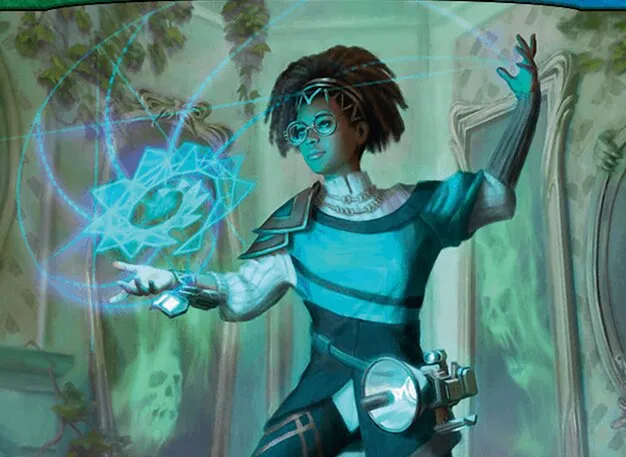
Jump Scare! is one of the more unusual Simic Commander precons because it takes two familiar ideas, landfall and face-down creatures, and forces them to work together. Zimone, Mystery Unraveler is the reason the combination works. Your first landfall trigger each turn manifests dread, while later landfall triggers can turn one of your permanents face up. That means a normal land drop can create a mysterious 2/2 creature and the next land entering can reveal that creature as something dramatically larger.
This creates a very different play pattern from an ordinary lands deck. You are not trying to maximize landfall simply because landfall is powerful. You want reliable sequences where the first land creates a face-down permanent and the second one unlocks it. The best upgrades therefore improve both sides of the engine: additional land drops, lands that can create multiple triggers, better face-down payoffs and creatures that are genuinely exciting to reveal without paying their full mana costs.
The stock precon already has an excellent foundation for this plan. Aesi, Tyrant of Gyre Strait, Tatyova, Benthic Druid, Ashaya, Soul of the Wild, Yedora, Grave Gardener, Trail of Mystery, Whisperwood Elemental, Scroll of Fate, Scute Swarm and Sakura-Tribe Elder all already support one or both halves of Zimone’s game plan. The goal of upgrading Jump Scare! is not to replace that identity with generic Simic value, but to make the existing engine happen more consistently.
How Zimone Turns Land Drops Into Hidden Threats
Zimone, Mystery Unraveler rewards the first and subsequent landfall triggers of each turn differently. The first time a land enters the battlefield under your control during a turn, you manifest dread. You look at the top two cards of your library, put one onto the battlefield face down as a 2/2 creature and put the other into your graveyard. If the face-down card is a creature, it can normally be turned face up by paying its mana cost, but Zimone gives you a much more attractive alternative.
When another land enters under your control during that same turn, Zimone can turn a permanent you control face up. That is where the deck becomes dangerous. A card that was hiding as an anonymous 2/2 can suddenly become a six-, eight- or even eleven-mana creature without you paying its normal casting cost.
The important implication is that two landfall triggers in the same turn are dramatically better than one. Your normal land drop handles the first half of the sequence, so the deck should prioritize ways to produce another land afterward. This is why Growth Spiral, Sakura-Tribe Elder, fetch-style lands and additional-land effects are more important here than they would be in a generic value deck.
Evolving Wilds is a perfect example. Playing it creates one landfall trigger and manifests dread. Sacrificing it then finds a basic land and creates another trigger, which can immediately reveal the permanent you just manifested. Terramorphic Expanse works the same way, and Fabled Passage is a natural upgrade if you want another version of the effect.
The Best Upgrades Strengthen Both Landfall and Face-Down Synergies
One of the strongest additions is Threats Around Every Corner because it lives directly at the intersection of Zimone’s two themes. Rather than functioning as another generic landfall payoff, it contributes to the face-down side of the deck while helping the land engine continue moving. That kind of overlap is exactly what makes an upgrade valuable here: one card supports several parts of the strategy instead of occupying a slot for only one narrow purpose.
Paranormal Analyst is attractive for the same reason. Face-down creatures are already necessary for Zimone, so cards that make those permanents generate additional value help prevent them from becoming passive 2/2 bodies while you wait for another land. The stronger version of Jump Scare! should reward you both when permanents enter face down and when they are eventually revealed.
Hauntwoods Shrieker also deserves a place because it gives the deck another way to interact with hidden permanents without relying completely on the commander. That redundancy matters. If every manifested permanent only becomes exciting while Zimone is on the battlefield, repeated commander removal can leave you with several small creatures and no meaningful way to use them. The stock deck already reduces that weakness through Trail of Mystery, Whisperwood Elemental, Primordial Mist and Scroll of Fate, so adding another strong face-down payoff makes the entire deck more resilient.
Secret Plans is another inexpensive option that fits naturally. Giving your face-down creatures extra toughness makes them better blockers, while drawing a card whenever one of your permanents is turned face up rewards the exact sequence Zimone already wants to perform. The result is a deck where every successful reveal can become more than simply a creature changing size.
Zimone Is One of the Rare Commanders That Can Justify Giant Creatures
Most Commander decks become more consistent when they lower their mana curve. Jump Scare! is a partial exception because Zimone can bypass the normal mana cost of the creature hiding underneath a manifested permanent.
That is why a card like Worldspine Wurm makes much more sense here than it would in a conventional Simic list. Paying eleven mana for it naturally is extremely ambitious, but manifesting it as a 2/2 and turning it face up through Zimone gives you the full creature without paying that cost. Hydra Omnivore, Multani, Yavimaya’s Avatar and other large threats can benefit from the same idea, although they are not equally strong.
The best reveal targets should ideally do more than simply have enormous stats. If you are dedicating a slot to an expensive creature, it should either affect the battlefield immediately, be difficult to answer or threaten to end the game quickly once revealed. That is where Abhorrent Oculus becomes especially interesting. It is a worthwhile permanent to cheat into play while also reinforcing the manifest dread plan afterward, making it more cohesive than a random large creature.
This is also why I would not automatically remove Worldspine Wurm simply because it has an absurd mana value. Zimone is one of the few commanders where that mana value can become largely irrelevant. The real question is how many giant reveal targets the deck can afford before opening hands become awkward. A handful is exciting; filling the deck with them makes the strategy too dependent on having Zimone and multiple landfall triggers available.
Extra Land Drops Matter More Than Generic Ramp
The stock deck already includes several cards that make repeated landfall triggers much easier. Aesi, Tyrant of Gyre Strait is particularly strong because it gives you an additional land play and draws a card whenever a land enters under your control. Your first land can manifest dread, the additional land can reveal the permanent and both can generate cards through Aesi. Tatyova, Benthic Druid provides another excellent landfall payoff, while Augur of Autumn helps keep lands flowing from the top of your library.
This is also where instant-speed land placement becomes powerful. Zimone cares about the first landfall trigger each turn, not just during your own turn. If you can put a land onto the battlefield during an opponent’s turn, you can manifest dread again. If you somehow generate another landfall trigger during that same turn, you can reveal another permanent as well.
Walking Atlas and Sakura-Tribe Scout are useful because they can put lands from your hand onto the battlefield at instant speed. Burgeoning is even more explosive in the right hand, potentially letting you place a land onto the battlefield whenever an opponent plays one. That can create Zimone triggers during several different turns around the table, although it requires enough lands in hand to keep the effect useful.
The stock Growth Spiral remains excellent because it combines card draw with another land entering at instant speed. Sakura-Tribe Elder is similarly valuable because you control when to sacrifice it. These cards are better for Zimone than a generic mana rock because they advance your mana while also interacting directly with the commander’s trigger.
The Existing Face-Down Core Is Worth Preserving
Trail of Mystery may be one of the most important cards in the entire precon. Whenever a face-down creature enters under your control, it can search your library for a basic land and put it into your hand. That helps guarantee future landfall triggers, which then give you the opportunity to reveal the creature that triggered Trail in the first place. When a permanent is turned face up, Trail can also temporarily increase its power and toughness, making the reveal relevant in combat as well as for value.
Yedora, Grave Gardener creates another unusual interaction. Whenever another nontoken creature you control dies, Yedora returns it to the battlefield face down as a Forest land. That means a dead creature can immediately become another landfall trigger and remain on the battlefield as a resource instead of disappearing into the graveyard. In a normal deck that is already interesting; in Zimone, it connects death, face-down permanents and landfall in a way very few cards can.
Ashaya, Soul of the Wild deserves similar respect. Giving your nontoken creatures the Forest land type can create additional landfall interactions simply by casting creatures, while also making Ashaya enormous as the battlefield develops. Scute Swarm gives the deck another independent win condition, turning every extra land into more bodies even when the manifest engine is disrupted.
This is the part of the precon I would protect most carefully during upgrades. It is very easy to look at blue and green’s huge pool of Commander staples and gradually turn Jump Scare! into generic Simic lands. That deck might be powerful, but it would lose much of what makes Zimone interesting. The best build keeps landfall and face-down permanents tied together.
What to Cut Without Weakening the Deck’s Identity
The easiest cuts come from cards that cost a lot of mana without doing enough for either half of the strategy. Body of Knowledge can become large and draw cards after taking damage, but it depends heavily on already having a strong hand and offers little immediate value when it is revealed. It is not terrible, but it competes with more exciting high-end creatures.
Hydra Omnivore is another reasonable flex slot. If it connects, it can deal a huge amount of damage across the table, but it has no evasion and does nothing when it enters. If you want to reduce the number of expensive reveal targets, it is one of the easier creatures to replace. Thunderfoot Baloth is more useful as a finisher because it can give the rest of your creatures +2/+2 and trample while your commander is in play, so whether it stays depends on how creature-heavy you want the finished list to be.
Some of the ramp can also be tightened. Explosive Vegetation works, but four mana for two tapped basic lands is slower than many modern options, and Zimone benefits especially from effects that can create landfall triggers at more flexible times. Greater Tanuki offers some versatility through channel, but both halves are relatively expensive compared with more efficient ways to find lands.
I would avoid cutting Trail of Mystery, Whisperwood Elemental, Scroll of Fate or Yedora, Grave Gardener. They may not look as generically powerful as a premium Simic staple, but they are some of the cards that allow Jump Scare! to keep functioning as a genuine face-down deck rather than just another landfall shell.
The Mana Base Should Create Triggers, Not Just Produce Colors
Jump Scare! already has a functional Simic mana base through cards such as Command Tower, Flooded Grove, Hinterland Harbor, Yavimaya Coast, Vineglimmer Snarl, Tangled Islet and Temple of Mystery. Because the deck is only two colors, you do not need to spend heavily to make the mana reliable.
More importantly, some of the slower lands have genuine mechanical value. Evolving Wilds and Terramorphic Expanse are not simply budget fixing here; each can produce two separate landfall triggers. Myriad Landscape is slow but can generate multiple triggers later in the game, while Drownyard Temple can return itself from the graveyard to the battlefield and create another landfall event.
The first land I would remove is Temple of the False God. Zimone costs only three mana and wants blue and green available early, while Temple cannot produce any mana until you already control at least five lands. It offers no special landfall interaction to compensate for that weakness.
Quandrix Campus and Thornwood Falls are more conventional slow lands and can gradually become faster Simic duals. Simic Growth Chamber is more interesting because returning a land to your hand gives you something to replay on a later turn. It still costs tempo, but the drawback can occasionally become useful in a deck that actively wants repeated land drops.
If you want to rebuild the mana base further, our Mana Base Upgrade Guide is the natural next step. With Zimone, however, I would not optimize purely for untapped lands. A land that creates two landfall triggers or can return itself from the graveyard may be worth far more than a slightly faster dual.
How the Upgraded Jump Scare! Deck Comes Together
A good game usually starts with ordinary ramp and setup rather than giant threats. Develop your mana, establish something such as Trail of Mystery, and cast Zimone when you can begin generating value immediately. Once she is active, your land drops start functioning like spells.
The ideal turn begins with a land entering and manifesting dread. Then Growth Spiral, Sakura-Tribe Elder, a fetch-style land or an extra land play creates the second trigger and turns the mystery permanent face up. Sometimes that creature will be a modest utility card. Sometimes it will be one of the largest threats in the deck.
As the battlefield develops, your support cards start multiplying the value of every step. Secret Plans can turn reveals into cards. Trail of Mystery ensures face-down creatures help supply future land drops. Aesi, Tyrant of Gyre Strait and Tatyova, Benthic Druid refill your hand while the lands continue entering, and Scute Swarm creates an army almost incidentally.
At that point, the deck becomes difficult to attack from a single angle. Removing Zimone slows the reveal engine, but your landfall cards continue producing value. Removing the landfall payoffs still leaves face-down creatures and large threats. Clearing the creature board may activate unusual recursion through Yedora, Grave Gardener. The best upgrades reinforce this overlap rather than forcing the deck to depend on one fragile commander interaction.
PreconForge Verdict
Jump Scare! already contains most of the ingredients needed for a strong Zimone, Mystery Unraveler deck. The stock list has excellent landfall support through Aesi, Tyrant of Gyre Strait, Tatyova, Benthic Druid, Ashaya, Soul of the Wild and Scute Swarm, while Trail of Mystery, Whisperwood Elemental, Scroll of Fate and Yedora, Grave Gardener preserve the face-down identity that separates Zimone from an ordinary Simic lands deck.
The best upgrades make those two halves overlap more often. Threats Around Every Corner, Paranormal Analyst, Hauntwoods Shrieker and Secret Plans make hidden permanents more valuable, while cards such as Fabled Passage, Walking Atlas and Sakura-Tribe Scout help produce the additional landfall triggers needed to reveal them.
The deck also has room for several oversized creatures that would look unreasonable almost anywhere else. Zimone can make their mana costs largely irrelevant, so cards such as Worldspine Wurm become legitimate rewards for assembling the landfall sequence rather than clumsy cards you are expected to hard-cast.
The central principle is what makes the deck work: the first land creates the mystery and the next land reveals it. Build around making that sequence reliable, keep enough face-down support that the deck does not collapse without Zimone, and Jump Scare! becomes a much more distinctive Commander deck than another collection of generic Simic landfall staples.


