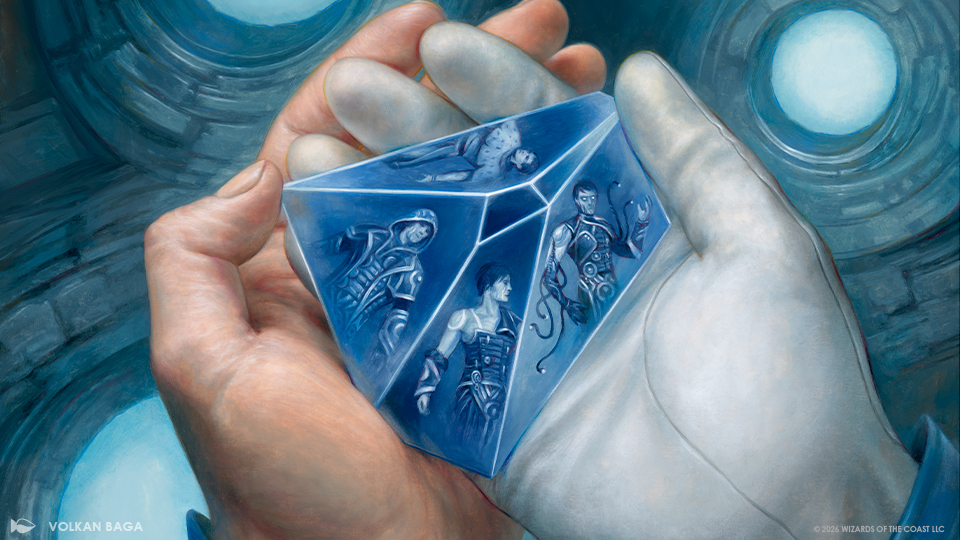
Alchemy is going out exactly the way you would expect: with cards that could only exist on MTG Arena.
Alchemy: Reality Fracture arrives today, October 13, with 31 new digital-only cards, giving Jace’s fractured Echoverse one final dose of spellbooks, conjuring, perpetual effects, seek and other mechanics that would be difficult or impossible to reproduce cleanly on paper.
It is also a strangely important release. Wizards has confirmed that this is the last planned Alchemy expansion, with the dedicated Alchemy format itself disappearing from MTG Arena on February 2, 2027.
That makes crafting these cards more complicated than usual. Spending four Mythic Wildcards on a card simply because it dominates Alchemy for the next few months is difficult to justify when the format already has an expiration date.
Fortunately, the cards do not disappear with it. Digital-only Alchemy cards will remain available in formats including Historic, Timeless, Brawl and Competitive Brawl, which means the best crafts are the ones capable of surviving beyond February.
After looking through all 31 cards, these are the ones I would put at the top of the list.
The 10 Best Alchemy: Reality Fracture Cards to Craft
| Rank | Card | Best Home | Craft Priority |
|---|---|---|---|
| 1 | Potential Horizon | Historic, Timeless, Brawl | Very High |
| 2 | Asymmetry Sage | Historic Prowess/Wizards | Very High |
| 3 | Valgavoth, the Lifeline | Brawl, Lifegain | High |
| 4 | Quintorius, Fate Splitter | Brawl, Superfriends | High |
| 5 | Searing Soloist | Burn, Prowess | High |
| 6 | Killian, Spotlight Chaser | Brawl, Burn | High |
| 7 | Prophet of the Planeswalker | Superfriends | Medium-High |
| 8 | Remnants of Beleren | Jace, Superfriends | Medium-High |
| 9 | The Bloodbile Swarm | Sacrifice, Brawl | Medium |
| 10 | Enter the Eternities | Combo, Brawl | Speculative |
This is not simply a ranking of which cards have the most spectacular text. Craft priority also takes future usefulness into account. With Alchemy itself disappearing in February, a card that has a realistic home in Historic or Brawl is considerably easier to recommend than one that only makes sense inside the final Alchemy metagame.
1. Potential Horizon Could Be the Most Important Card in the Set
If I had to choose one Alchemy: Reality Fracture card most likely to matter long after Alchemy disappears, it would be Potential Horizon.
The land comes with a wonderfully strange Arena-specific balancing mechanism. If you were the starting player, it enters tapped. If you were not the starting player, that drawback disappears.
From there, you can tap and sacrifice it to search your library for any land with a basic land type and put that land directly onto the battlefield.
That is a huge range of possible targets.
The obvious comparison is a fetch land, although Potential Horizon behaves differently enough that it should not simply be described as another Polluted Delta. What matters is that going second can turn it into extremely efficient color fixing at effectively no mana cost beyond sacrificing the land itself.
Going first is substantially worse because the land enters tapped, which creates one of the strangest play/draw disparities Arena has ever attached to a mana base.
Even so, lands are usually among the safest Wildcards to spend when they can fit into multiple decks. Potential Horizon is not tied to one creature type, commander or combo, and that alone makes it the first card I would watch in Historic and Timeless.
Craft verdict: I would still avoid blindly crafting four on minute one, but this has the highest long-term constructed ceiling in the set.
2. Asymmetry Sage Gives Historic Prowess Its Missing Weapon
Asymmetry Sage does not look nearly as outrageous as some of the Mythics in this release, but competitive cards rarely need the longest text box.
It has flying and Magecraft, and whenever you cast or copy an instant or sorcery, one of your creatures gets base power 3 until end of turn.
Historic players should immediately recognize what Wizards is doing.
The old rebalanced version of Symmetry Sage was a major part of aggressive Wizards and spell-based strategies because turning tiny creatures into three-power attackers created absurdly efficient starts. When Arena reverted tabletop cards to their printed versions, those decks lost that version of the effect.
Asymmetry Sage effectively gives the archetype a new digital-only way to do it.
The flying body is also relevant. Even when you do not have another creature worth targeting, the Sage can apply pressure itself while every cheap cantrip and burn spell continues to trigger Magecraft.
This is exactly the kind of card I like spending Wildcards on: cheap, focused and already surrounded by an existing archetype that knows what to do with it.
Craft verdict: Historic Prowess and Wizards players should put this near the top of their list.
3. Valgavoth, the Lifeline Is an Absurd Brawl Engine
Reality Fracture turned several familiar characters inside out, and Valgavoth, the Lifeline may be the strangest transformation of all.
Instead of feeding on fear, this Valgavoth rewards lifegain.
Whenever you gain life, creature cards in your hand and graveyard perpetually receive +1/+1. Once you have gained life during the turn, you can also cast creature spells from your graveyard, with those returned creatures entering with finality counters.
That is an enormous amount of value from one permanent.
The perpetual buff matters because the creatures stay larger even as they move between zones. The graveyard ability then converts what would normally be dead resources into another hand, provided you can trigger lifegain first.
For Brawl, that creates an entire strategy almost by itself. Cheap lifegain suddenly improves future draws, graveyard creatures become recastable and every long game gives Valgavoth more opportunities to accumulate value.
The color restriction keeps the card from simply absorbing every good lifegain card on Arena, but the engine is strong enough that I would happily build around it.
Craft verdict: One of the safest single-copy crafts for Brawl players.
4. Quintorius, Fate Splitter Makes Planeswalkers Much Scarier
Superfriends receives several new toys in this release, but Quintorius, Fate Splitter is the card I would start with.
During the turn Quintorius enters, you can activate loyalty abilities of your planeswalkers twice rather than once.
That is already dangerous.
Quintorius then has his own loyalty abilities, including a zero ability that proliferates and gains life, a minus-one that seeks another non-Quintorius planeswalker and a minus-three capable of building a creature board.
The minus-one is particularly important. A Superfriends card that requires you to already have several planeswalkers risks becoming a win-more piece. Quintorius helps solve that problem by finding another planeswalker himself.
And because he can activate loyalty abilities twice on the turn he enters, the immediate value can become substantial before an opponent gets a clean opportunity to attack him.
Reality Fracture already pushed planeswalkers hard. Alchemy is now giving the archetype tools that intentionally break one of their fundamental rules.
Craft verdict: Excellent for Superfriends and a very tempting Brawl commander, but less universal than the top three cards.
5. Searing Soloist Makes Every Burn Spell Hurt More
Searing Soloist has exactly the kind of text aggressive players should pay attention to.
When it enters, it conjures Aria of Flame onto the battlefield. More importantly, whenever a red source you control would deal damage to a permanent or player, it deals one additional damage instead.
Adding one damage does not sound dramatic until a deck starts doing it repeatedly.
A burn spell that normally deals three now deals four. Small pings become meaningful. Effects that trigger multiple times can scale rapidly, and Aria of Flame introduces another source of damage that can benefit from the same environment.
The obvious weakness is that Searing Soloist costs more than the hyper-efficient threats normally found in aggressive spell decks. It is therefore unlikely to simply replace every cheap Prowess creature.
Instead, I see it as a way for burn-oriented lists to gain a much more powerful top end.
Pair it with the new Killian, Spotlight Chaser and suddenly every point of noncombat damage can start generating another resource while dealing more damage than it should.
Craft verdict: High ceiling in burn strategies. I would test two copies before committing to a full playset.
6. Killian, Spotlight Chaser Can Turn Burn Into Card Advantage
Killian, Spotlight Chaser may be the most obviously build-around legendary creature in the release.
Whenever a source you control deals noncombat damage to an opponent, Killian seeks a card with mana value equal to the damage dealt. You then discard that card at the beginning of the next end step if it remains unused.
That gives burn decks something they traditionally struggle to obtain: momentum after spending their spells.
Deal two damage, find a two-drop. Deal three, find something that costs three. Increase that damage with Searing Soloist and the range of cards Killian can seek changes with it.
There is real deck-building tension here because seek only becomes predictable when your deck is constructed around it. Filling every mana value with random cards makes Killian inconsistent, while carefully limiting the eligible cards can turn each amount of damage into something much closer to a tutor.
That is where I expect the most interesting builds to emerge.
In Brawl, he becomes even more attractive because the command zone guarantees access to the engine. In Constructed, the question will be whether the surrounding shell can afford a value creature instead of simply dealing more damage.
Craft verdict: Excellent Brawl craft and one of the cards I most want to experiment with during the first week.
7. Prophet of the Planeswalker Breaks Loyalty Math
Prophet of the Planeswalker is exactly the kind of innocent-looking Alchemy card that can become much more powerful than expected.
When it enters the battlefield, you can behold a planeswalker. If you do, that planeswalker perpetually gains an effect that causes its loyalty abilities to cost an additional +1 to activate.
The wording is important.
A normal +1 effectively becomes +2. A zero ability becomes +1. Even a loyalty ability that normally removes counters becomes less expensive because the additional +1 modifies the cost.
And because the change is perpetual, it remains attached to that card rather than disappearing at the end of the turn.
That can fundamentally alter planeswalkers balanced around reaching their strongest abilities at a particular speed.
Combined with Quintorius, Fate Splitter, Reality Fracture’s existing planeswalkers and cards such as Change the Narrative, Alchemy suddenly has the pieces for a much more dedicated Superfriends engine.
Whether that becomes the best deck in the format is another question. But if you already enjoy planeswalkers, Prophet is exactly the support card you want to own.
Craft verdict: Do not craft it generically. Craft it when you are actually building Superfriends.
8. Remnants of Beleren Is Peak Alchemy
If there is one card that summarizes the entire Alchemy experiment, it might be Remnants of Beleren.
The artifact can empower Jace, but it also changes what happens when you do. Instead of only interacting with the special Jace token mechanics from Reality Fracture, you can put those loyalty counters on a Jace you already control.
Then, for and a tap, it lets you draft from the Beleren Spellbook.
And the spellbook is exactly what the name suggests: Jaces.
It contains fifteen different versions, ranging from Jace Beleren and Jace Reawakened to Jace, the Mind Sculptor, Jace, the Perfected Mind and The Theorist, Jace Beleren.
That gives the card both consistency and chaos. You know you are receiving a Jace, but you do not know exactly which version will be offered.
The fact that several of those planeswalkers were never designed to share the same environment is precisely why the effect can only exist comfortably on Arena.
Craft verdict: Strong in dedicated Jace or Superfriends decks, but far too narrow to spend Wildcards on without a plan.
9. The Bloodbile Swarm Could Create Its Own Sacrifice Deck
The Bloodbile Swarm is one of the most mechanically dense cards in the set.
It turns other creatures into Blood artifacts in addition to their other types and gives them a way to sacrifice themselves, discard a card and draw another card. When a player sacrifices a nontoken creature or discards a creature card, the Swarm exiles that creature and perpetually gives it prismatic, allowing it to be cast until the end of your next turn.
The result is a sacrifice engine that does not merely consume resources.
It recycles them.
Creatures can be turned into cards, disappear into exile and then come back with their color requirements effectively opened up. That makes the Swarm both a sacrifice payoff and a strange source of card advantage.
The ward cost asking for a Blood artifact sacrifice is another interesting wrinkle because the Swarm itself turns surrounding creatures into exactly the permanent type needed to protect it.
This is not a card I would jam into every black-red deck. It demands a strategy built around creatures dying, being discarded and being cast again.
Give it that strategy, though, and the ceiling looks enormous.
Craft verdict: A build-around rather than a staple, but one of the best build-arounds in the release.
10. Enter the Eternities Is the Card I Want to Break
Enter the Eternities is probably not the safest Wildcard investment in this top ten.
It may be the most interesting.
The spell exiles one of your creatures, lets you draft a +1, a -2 and a -8 loyalty ability, then creates a legendary planeswalker token carrying those abilities. Its starting loyalty is equal to the power of the creature you exiled.
That means a creature with unusually high power relative to its mana cost can suddenly become a planeswalker that starts much closer to its ultimate than a normal design ever would.
And because the abilities themselves are drafted, the client can build a planeswalker that did not exist before you cast the spell.
This is Alchemy doing something paper Magic realistically cannot.
Whether it is competitively good will depend heavily on the ability pool and how consistently decks can provide cheap creatures with enough power to exploit the starting loyalty.
I would therefore resist crafting four copies simply because the card looks spectacular.
But somebody is going to spend the opening week trying to break it, and I want to know what happens when they succeed.
Craft verdict: Wait for data unless brewing is the reason you play Arena.
The Cards Just Outside the Top 10
Several cards narrowly missed the ranking.
Change the Narrative reduces the cost of your planeswalker spells and repeatedly conjures random planeswalkers with prismatic, making it an obvious Superfriends payoff. The effect is powerful, but four-mana value engines need time to operate, and random planeswalkers are much less reliable than simply seeking the pieces your deck was designed to use.
Flourishing Forces is far more straightforward. It creates a 2/2 Cadet and produces another token for every three life you have gained during the game. In dedicated lifegain strategies that count is cumulative, giving the spell an impressive ceiling later in a match.
Bend Mortal Limits deserves attention from graveyard decks because it can inspect a hand, remove a creature or planeswalker and create a duplicate in your own graveyard. Paradox Kraken offers another unusual graveyard engine, while Boisterous Clique combines flash pressure with hand disruption.
Etali, Primal Garden is also exactly the kind of card Brawl players will enjoy. It gets cheaper as you cast cards that were not in your starting deck and can conjure random Dinosaurs when it enters or attacks. The power is real, but being restricted to green makes it less exciting as a commander than it initially appears.
And then there is Oko, Lord of the Fae, a planeswalker that protects your other planeswalkers, blanks problematic creatures or artifacts and can eventually produce an emblem that conjures free random planeswalkers every upkeep. It is a fun payoff, particularly inside an established Superfriends deck, but I would rather craft the cards that make that archetype function before crafting its luxury finisher.
Which Cards Should You Craft First?
The answer changes dramatically depending on what you play.
If Historic or Timeless is your priority, I would begin with Potential Horizon and watch Asymmetry Sage very closely. These are the two cards in the set that most obviously slot into broader constructed ecosystems rather than requiring Alchemy-specific decks.
For Brawl, Valgavoth, the Lifeline, Killian, Spotlight Chaser and Quintorius, Fate Splitter immediately give you new commanders or centerpiece cards that only require a single Wildcard each.
Superfriends players have an entire package to explore with Quintorius, Fate Splitter, Prophet of the Planeswalker, Remnants of Beleren, Change the Narrative and Oko, Lord of the Fae.
And if you primarily play Alchemy itself, I would be much more conservative with Wildcards than during a normal release.
Remember: Alchemy Is Leaving MTG Arena
This is the strange part of recommending crafts for Alchemy: Reality Fracture.
The set arrives today, but its namesake format is already living on borrowed time.
Alchemy Play, Ranked Alchemy and the other dedicated Alchemy queues are scheduled to leave Arena on February 2, 2027, alongside the next rotation.
That does not mean your cards disappear.
The digital-only cards remain part of MTG Arena and can continue to be legal in formats such as Historic, Timeless, Brawl and Competitive Brawl. Wizards has also retained the ability to rebalance or ban digital cards in those formats if necessary.
That is why I would strongly favor multi-format cards when spending Rare and Mythic Wildcards today.
A playset that is only excellent in an Alchemy deck has less than four months in its intended format. A card that becomes a Historic staple or a favorite Brawl commander can potentially remain useful for years.
How Do You Get Alchemy: Reality Fracture Cards?
The 31 new cards become available through MTG Arena with the October 13 release and can also be crafted directly using Wildcards.
Alchemy: Reality Fracture receives its own Limited events as part of the sendoff. Premier Draft runs from October 13 through November 3, while additional Alchemy events follow later in the week.
That gives players another option before spending large amounts of Wildcards immediately.
If you already enjoy Limited, drafting the set first can help build a collection while simultaneously showing you which cards actually perform rather than merely looking impressive in a card gallery.
Waiting a few days is especially sensible for Mythics.
Launch-day crafting guides are useful for identifying cards with the strongest fundamentals, but they cannot replace thousands of real matches.
Alchemy Saved Its Weirdest Ideas for Last
There is something fitting about the final Alchemy set containing Enter the Eternities.
Alchemy began as Arena’s opportunity to do things that tabletop Magic could not easily reproduce, and its final release embraces that idea completely.
Cards permanently change other cards. Libraries generate new objects. Spells seek specific characteristics. Remnants of Beleren carries an entire collection of Jaces inside its spellbook. Enter the Eternities can turn a creature into a newly generated planeswalker. Potential Horizon can literally behave differently depending on who went first.
Not everyone ever wanted Magic to work this way, and the retirement of the Alchemy format makes it clear that the experiment did not become a permanent pillar beside Standard and Historic.
But if this really is the final dedicated Alchemy expansion, Wizards did not send it out quietly.
For Wildcards, my rule is simple: craft for the format you expect to play after February, not only for the next four months.
That puts Potential Horizon and Asymmetry Sage at the top of my list, with the strongest Brawl legends immediately behind them.
The rest?
Give Arena players a few days.
Alchemy may be ending, but with cards this strange, there is still time for one final deck to break reality.


