Reality Fracture does more than turn familiar Magic characters into alternate versions of themselves. The set introduces a completely new planeswalker-based mechanic, brings back one of Secrets of Strixhaven’s stranger designs and adds a new reusable mana token that plays very differently from Treasure.
The headline mechanic is Empower Jace, but it is not the only thing players should understand before Prerelease. Prepare returns, Heartwood tokens create new ramp patterns, and Flashback once again gives spells a second life from the graveyard. Echoed Pairs are also everywhere in the set, although they are a visual and booster concept rather than a true gameplay mechanic.
If you are opening Reality Fracture for the first time, these are the interactions that matter most.
Empower Jace Is the Core Reality Fracture Mechanic
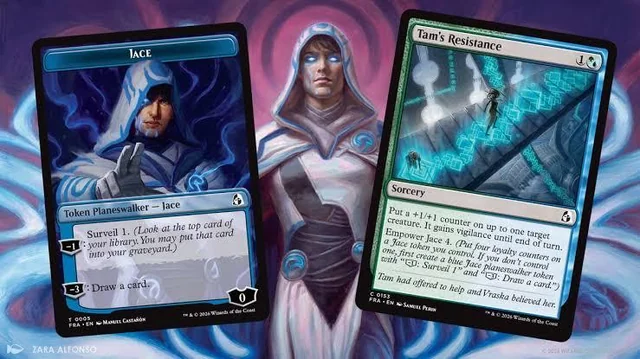
Empower Jace is Reality Fracture’s signature keyword action. Whenever a card tells you to Empower Jace N, you put N loyalty counters on a Jace planeswalker token you control. If you do not already control a Jace planeswalker token, the mechanic creates one first and then adds the counters.
The default Jace token starts with 0 loyalty and has two abilities: −1 to surveil 1 and −3 to draw a card. That means a card with Empower Jace 2 creates a Jace with two loyalty if you did not already have one, while a later Empower Jace 3 effect would bring that same token up to five.
This creates a very different type of resource engine from normal Limited mechanics. Jace is not just a token you create once. He can continue growing throughout the game, and every future Empower effect effectively becomes both a loyalty boost and access to whatever abilities your version of Jace currently has.
There is one important restriction: Empower Jace only works with Jace planeswalker tokens. It cannot simply add loyalty counters to a normal nontoken Jace card such as Jace, Multiverse Architect. If you already control a Jace token, the mechanic uses that token rather than creating another one.
The standard Jace token is also not legendary. That means it is possible to control multiple Jace tokens if another effect creates or copies them, although Empower Jace itself will not normally generate extras while you already control one.
Because planeswalkers do not suffer from summoning sickness, a Jace created during your main phase can usually activate a loyalty ability immediately. If an effect gives you five loyalty, for example, you could create the token and then use −3 to draw a card during the same turn.
What does not change is the normal planeswalker rule: each planeswalker still gets only one loyalty activation per turn unless another card specifically says otherwise.
Reality Fracture also includes cards that grant new loyalty abilities to your planeswalkers, which is where the mechanic becomes much more interesting. Way of the Pyromancer, for example, can give your planeswalkers another way to spend or generate loyalty. The Jace token therefore acts less like a fixed planeswalker and more like a platform that other cards can continue modifying.
There is also one interaction worth remembering in Limited. If a spell has a target and also says Empower Jace, losing all legal targets can stop the entire spell from resolving. In that case, you do not get the Empower Jace effect either. That gives opponents another reason to remove the targeted creature in response.
Our Reality Fracture Draft & Sealed Guide goes deeper into where Empower Jace matters most across the ten Limited archetypes.
Heartwood Tokens Are Reusable Mana, Not Treasure
Reality Fracture’s other major new game object is the Heartwood token.
A Heartwood token is a red and green artifact with the Heartwood subtype that can tap to add either red or green mana. The important distinction from Treasure is that it does not sacrifice itself when used.
Once you make a Heartwood, it behaves much more like a small mana rock. Tap it this turn, untap it next turn and continue using it as long as it stays on the battlefield.
That makes Heartwood especially important in the red-green Konstrari strategy, where cards such as Aerid Konstrari help build toward larger spells without forcing the deck to rely entirely on traditional mana creatures.
Heartwood also counts as an artifact, which matters because several Reality Fracture cards care about how many artifacts you control or when artifacts enter the battlefield. The token is therefore both acceleration and a synergy piece.
One visual detail may cause confusion at first: some Heartwood tokens look close to traditional colorless artifacts. Rules-wise, however, they are red and green. The frame does not override the actual characteristics of the token.
Prepare Turns Creatures Into Stored Spells
Prepare returns from Secrets of Strixhaven and is probably the Reality Fracture mechanic most likely to confuse players during their first games.
Preparation cards contain a normal creature and a separate spell displayed on the same physical card. Unlike Adventure, however, you are not choosing which half of the card to cast from your hand.
When a creature becomes prepared, the game creates a copy of its Prepare spell in exile. As long as that permanent remains prepared on the battlefield, its controller may cast that spell copy by paying its normal costs.
Take Diviner of Victory. The physical card remains a creature on the battlefield, while its Prepare spell exists separately as a copy in exile. Once you cast that spell, the creature becomes unprepared.
This distinction matters in other zones. A Preparation card in your graveyard is still a creature card. It does not suddenly count as an instant or sorcery just because a spell is printed on part of the card. Creature recursion can find it, while effects that specifically look for an instant or sorcery card normally cannot.
The creature also has to remain on the battlefield for you to keep access to its stored spell. If an opponent removes your prepared creature before you cast the spell, the copy in exile ceases to exist. That creates a real tactical decision: sometimes you will need to fire off the Prepare spell earlier than planned rather than risk losing it completely.
A creature cannot simply keep stacking additional Prepare spells while it is already prepared. You first need to use the existing spell or otherwise have the creature become unprepared before it can store another one.
Bloodline Recollector is a good example. Its ability can prepare it again when enough creatures have died, giving you access to Ancestral Craving, but being prepared already does not mean you keep accumulating extra copies indefinitely.
There is another interaction that matters surprisingly often in Commander: if another player gains control of your prepared creature, they become the player allowed to cast its associated Prepare spell. Control of the permanent matters more than ownership of the card.
Flashback Is Familiar, but It Works Very Differently From Prepare
Flashback returns in Reality Fracture and is much more straightforward.
A card with Flashback can be cast from your graveyard by paying its flashback cost. Afterward, it is exiled instead of returning to the graveyard.
Bestial Incursion, for example, can be cast normally and then used again later from the graveyard for its flashback cost.
The normal timing rules still apply. A sorcery with Flashback is still a sorcery, so you generally need to cast it during your main phase when the stack is empty. Flashback changes where the spell may be cast from, not when.
It is worth separating Flashback from Prepare because the two mechanics can look similar during gameplay. Flashback casts the actual instant or sorcery card from the graveyard. Prepare creates a spell copy in exile while the physical card remains a creature on the battlefield.
That means graveyard recursion, exile interactions and cards that care about spell copies can all distinguish between the two mechanics.
Echoed Pairs Are a Set Feature, Not a Keyword
Echoed Pairs are one of the most visible parts of Reality Fracture, but mechanically they are much simpler than they look.
They are not a keyword, ability or rules mechanic.
Each Echoed Pair consists of two related cards showing different versions of characters across the Multiverse and Jace’s Echoverse. In some cases, the connection is obvious from the characters. In others, the relationship becomes clearer through the artwork and story.
The two cards are still completely independent Magic cards. Playing one does not automatically summon the other, and there is no universal rule that rewards you for controlling both unless an individual card explicitly says so.
Reality Fracture contains 66 uncommon, 14 rare and 6 mythic rare individual Echoed Pairs cards, and Wizards built them directly into the booster structure. Play Boosters and Collector Boosters both contain dedicated Echoed Pairs slots, which is why players will see them far more often than a normal showcase treatment.
The Borderless Echoed Pairs versions take the concept further by using artwork designed to connect across both cards. That changes how the cards look, not how they function.
If you are trying to understand the difference between Echoed Pairs, Shattered Mirror cards, Japan Showcase cards and the other premium treatments, our Reality Fracture Collector Booster Guide breaks down each version and its official pull rates.
Which Reality Fracture Mechanics Matter Most in Limited?
For Prerelease and Draft, Empower Jace is the mechanic I would learn first.
It creates a persistent source of card selection and eventually card advantage, while several cards become considerably better once a Jace token is already established. Green-blue is the most obvious archetype built around Jace, but the mechanic appears widely enough that you will encounter it outside that pair too.
Prepare is more about card economy. A prepared creature can potentially represent both a battlefield body and access to another spell, but only if you keep the permanent alive long enough to use it. That makes removal timing especially important.
Heartwood belongs primarily to red-green ramp, where permanent extra mana helps the Konstrari deck reach its larger threats earlier.
Flashback is the easiest of the four to evaluate. If the first half of the spell is already playable, getting another cast from the graveyard is normally excellent value.
None of these mechanics changes the fundamentals of Limited. You still need a curve, creatures, removal and enough mana. They simply determine which cards become better once those basics are in place.
What Changes in Commander?
Commander gives these mechanics considerably more room to develop.
Heartwood tokens are not just ramp when the deck also cares about artifacts. Prepare becomes much more interesting if your deck can repeatedly reuse, blink or protect the creatures carrying those spells. Empower Jace can grow from a Limited card-selection engine into a full planeswalker package built around continuously adding loyalty and new abilities.
The biggest difference is time.
A Draft game may end before you can assemble several layers of synergy around one Jace token. Commander gives you enough turns and enough cards to build an entire engine around it.
That is why some Reality Fracture cards look merely solid in Limited but much more dangerous in EDH.
We have already covered those individually in our Best Reality Fracture Cards for Commander and Best Reality Fracture Commanders guides.
The Rules Worth Remembering
You do not need to memorize every Reality Fracture Release Note before sitting down at Prerelease.
The important ideas are simple.
Empower Jace creates a Jace token only when you do not already control one, and it cannot put loyalty onto a normal nontoken Jace. The token can normally use a loyalty ability immediately, but still only once per turn.
Heartwood tokens are reusable red-green artifact mana sources rather than disposable Treasures.
Prepare keeps the creature on the battlefield and creates a spell copy in exile. If the creature disappears before you cast that spell, you lose access to it.
Flashback instead casts the actual card from the graveyard and exiles it afterward.
And Echoed Pairs are not a gameplay mechanic at all. They are the visual and structural representation of Reality Fracture’s two competing realities.
Once those differences are clear, the set becomes much easier to follow.
Reality Fracture Makes Its Story Part of the Game
The strongest part of Reality Fracture’s design is that its mechanics reinforce the setting without every card needing paragraphs of new rules text.
Empower Jace turns the central character into a resource that grows as the game progresses. Heartwood represents Konstrari magic as physical stored power. Prepare lets Hexhaven’s students carry spells with them. Flashback gives the set another way to revisit what has already happened.
Echoed Pairs then connect the entire theme visually, putting familiar characters beside versions of themselves that could only exist in another reality.
For new players, Empower Jace and Prepare are the two interactions worth understanding before your first game.
For experienced players, the more interesting questions come later: how far can you push the Jace token, how often can you reuse Prepare, and which of these mechanics will escape Reality Fracture and become Commander engines long after the set rotates from Standard?
If you are still learning the fundamentals behind planeswalkers, the stack or casting cards from different zones, our How to Play Magic: The Gathering guide covers the core rules before you step into the Echoverse.
Reality Fracture may be about two universes colliding.
Fortunately, learning its mechanics is much simpler than surviving them.


