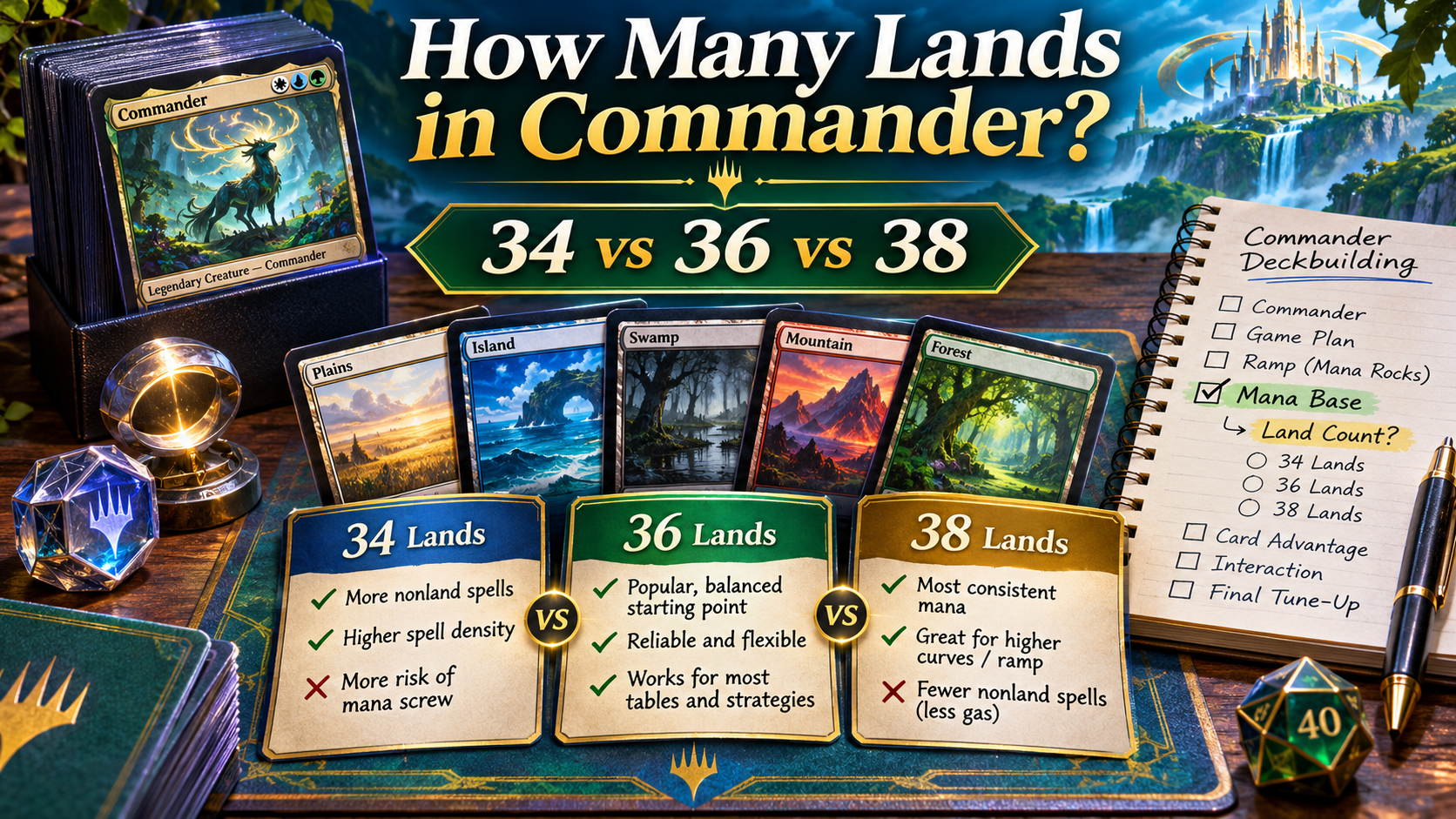
How many lands should you play in Commander? For most casual EDH decks, 36–38 lands is the ideal starting range, with 37 lands as a reliable default. Faster decks with low mana curves and efficient ramp can often function with 34–35, while landfall and expensive strategies may benefit from 39–40 or more.
The right number depends on how much mana your deck needs, how consistently it draws cards, and whether your ramp actually helps you make early plays. Cutting lands creates more room for exciting spells, but missing land drops can delay your entire game plan.
Let’s compare 34, 36, and 38 lands using real probabilities, practical deckbuilding advice, and examples from actual Commander precons.
How Many Lands Should You Run in Commander?
A typical Commander deck contains 100 cards, including your commander. For a normal single-commander deck, that leaves 99 cards in your library.
Most balanced decks should start with approximately 37 lands, but different strategies benefit from different counts.
| Land Count | Best For | Recommendation |
|---|---|---|
| 32–34 | Low-curve, highly optimized decks | Requires excellent ramp and card selection |
| 35–36 | Faster casual decks | Good with reliable acceleration |
| 37–38 | Most casual and midrange decks | Safest general starting range |
| 39–40 | Landfall and expensive commanders | Supports repeated land drops |
| 41+ | Specialized lands-matter strategies | Only when extra lands advance your game plan |
Your average mana value is one of the most important factors. A deck with mostly two- and three-mana spells can operate on fewer lands than one full of expensive Dragons or Eldrazi.
However, even low-curve decks need enough initial mana to cast their ramp spells and card-draw engines.
34 vs. 36 vs. 38 Lands: What Does the Math Say?
Four lands might not seem like a meaningful difference in a 100-card deck, but the probabilities tell a different story.
In multiplayer Commander, you normally begin with seven cards and draw on your first turn. By your fourth turn’s draw step, you’ve seen eleven cards without additional draw effects.
Using the hypergeometric distribution, we can calculate how frequently those cards contain enough lands.
| Land Count | Opening Hand With 3+ Lands | At Least 4 Lands Seen by Turn 4 |
|---|---|---|
| 34 | 45.3% | 56.3% |
| 36 | 50.1% | 62.1% |
| 37 | 52.5% | 64.9% |
| 38 | 54.8% | 67.6% |
| 40 | 59.4% | 72.6% |
Calculations assume a 99-card library, seven opening cards, four natural draws, and no mulligans, ramp, or additional card selection. Seeing four lands does not guarantee making every land drop on time.
The difference between 34 and 38 lands is approximately 11.3 percentage points when looking at whether you’ve seen four lands by turn four.
These figures don’t measure win rates, and good mulligan decisions can improve your consistency. They do show why removing several lands should be a conscious deckbuilding decision.
Is 34 Lands Enough in Commander?
Thirty-four lands can work, but it’s best suited to decks specifically designed around a lower mana count.
A fast artifact deck with a two- or three-mana commander, cheap spells, and efficient acceleration may rarely need more than four or five mana to execute its strategy.
Cards such as Sol Ring, Arcane Signet, and Mind Stone help these decks develop without relying entirely on natural land drops.
However, mana rocks are not perfect replacements for lands. Most require mana to cast, and artifact removal can disrupt your development.
Consider 34 lands when:
- Your average mana value is low.
- Most of your ramp costs one or two mana.
- You have consistent card draw or selection.
- Your commander and core strategy function on relatively little mana.
A six-mana Dragon commander with several expensive finishers usually doesn’t meet those conditions. Cutting its land count aggressively can leave powerful cards stranded in your hand.
For most casual builds, 34 lands is something to test after optimizing the deck, not where to begin.
Is 36 Lands the Best Balance?
Thirty-six lands is a strong middle ground for Commander decks with reliable acceleration and a reasonably efficient mana curve.
It gives you two more nonland slots than a 38-land build. Those slots could become additional interaction, card draw, or useful ramp spells.
A balanced 36-land Commander deck might use the following structure:
| Category | Cards |
|---|---|
| Commander | 1 |
| Lands | 36 |
| Ramp | 11 |
| Card draw | 10 |
| Targeted interaction | 10 |
| Board wipes | 3 |
| Protection and recursion | 4 |
| Other strategy cards | 25 |
| Total | 100 |
This is an illustrative framework, not a required deckbuilding formula. Some cards naturally fill several roles.
Thirty-six lands works particularly well when your deck can consistently cast an early ramp spell and continue drawing cards throughout the game.
For example, a two-land opening hand with Nature’s Lore may develop smoothly. A one-land hand with the same spell is considerably riskier.
If your deck regularly misses its third or fourth land drop, consider adding a land before adding more expensive spells.
Why 38 Lands Is Often Better for Casual Decks
Thirty-eight lands offers a little more consistency, which is especially useful for midrange strategies and expensive commanders.
Commander games frequently involve recasting your commander, holding mana for interaction, and activating abilities alongside your normal spells. Those requirements can make additional land drops valuable well beyond turn four.
A 38-land deck is particularly attractive when you run several five- and six-mana threats, your commander costs five or more mana, or your card-draw engine needs time to become established.
The obvious drawback is drawing too many lands later.
However, that problem can often be mitigated with card draw, cycling lands, utility lands, or mana sinks. Cutting lands isn’t always the best solution.
Our recommendation: If you’re building a new casual deck with an expensive commander, start at 38 lands. Reduce the count only after testing shows you can afford to.
What Do Actual Commander Precons Play?
Preconstructed Commander decks provide useful examples of how land counts change with strategy.
Our Commander Precon Database includes the original decklists for the following decks:
| Commander Precon | Lands | Strategy |
|---|---|---|
| Reign of Dragons | 38 | Expensive Dragons and ramp |
| Calling All Angels | 38 | Angel creatures and lifegain |
| Limit Break | 37 | Equipment and creature combat |
| Landing Party | 40 | Landfall and differently named lands |
Reign of Dragons uses 38 lands to support expensive creatures led by Lathliss, Dragon Queen. Its mana acceleration and cost-reduction effects help cast those Dragons, but the land count still plays an important role.
Landing Party takes a different approach. Its 40 lands support landfall and the strange new worlds mechanic, which rewards differently named lands. Cards such as Exploration and Ancient Greenwarden reinforce that land-focused strategy.
Neither count is automatically better. Each supports what its deck is designed to accomplish.
How Do Ramp and Mana Curve Affect Land Count?
Land count should never be evaluated independently of your ramp package.
For a typical casual Commander deck, 36–38 lands alongside approximately 10–12 dedicated ramp sources is a reasonable starting combination. However, the cost and reliability of those ramp cards matter more than simply reaching a target number.
Cheap acceleration helps you develop early. Expensive ramp spells may provide more mana later but do little to fix an awkward opening hand.
Your mana curve also matters. A deck with an average mana value of 2.5 will generally need less mana development than one averaging 4.0, assuming both have comparable card draw and acceleration.
If you want to optimize this balance, read our How Much Ramp Do You Need in Commander? and Commander Mana Curve Guide.
Land Quality Matters, Too
Playing 38 lands doesn’t guarantee consistent mana if those lands produce the wrong colors or frequently enter tapped.
A three-color deck needs enough colored sources to cast its early spells reliably. Command Tower and Exotic Orchard are useful fixing options, while utility lands require more careful evaluation.
For example, Temple of the False God doesn’t produce mana until you control at least five lands. Counting it as an ordinary early mana source can make opening hands appear better than they actually are.
Modal double-faced cards also deserve attention. Bala Ged Recovery can function as either a spell or a tapped land, offering useful flexibility. However, a deck with several tapped spell-lands may develop more slowly than one containing the same number of conventional untapped lands.
If your deck draws enough lands but struggles to cast spells on time, improve the mana base before changing the total count.
Our Budget Commander Mana Base Upgrade Guide covers inexpensive ways to improve your fixing.
How to Find Your Ideal Land Count
The best way to refine your land count is to test how consistently your deck plays its first few turns.
Start with 37 lands in a balanced build, draw sample opening hands, and play through the first five turns. Track whether you can cast your early spells and whether you regularly miss important land drops.
Pay attention to the difference between being short on lands and having the wrong colors. Those problems require different solutions.
Our Opening Hand Simulator can help you test your mana consistency before playing real games.
After testing, adjust one or two land slots at a time. Large changes make it harder to determine what actually improved your deck.
Final Verdict: How Many Lands Should You Play?
For most Commander players, 37 lands is the best starting point, with adjustments based on the deck’s strategy.
Thirty-four lands can work for optimized, low-curve decks. Thirty-six offers a good balance for efficient builds with reliable ramp. Thirty-eight provides greater consistency for casual midrange and expensive commanders, while landfall strategies may want 40 or more.
The goal isn’t to squeeze the maximum number of exciting spells into your deck. It’s to cast those spells consistently.
Start with a reliable mana base, test your opening hands, and adjust based on how your deck actually performs.
A Commander deck with enough lands gets to play Magic. A deck without them just gets to watch.
For a complete overview of deck construction, read our How to Build a Commander Deck guide.


