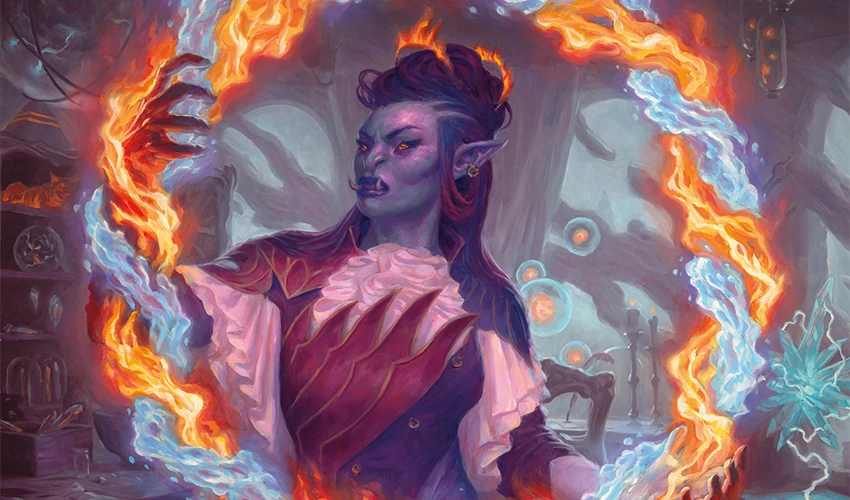
Prismari Artistry arrives as an Izzet spellslinger deck led by Rootha, Mastering the Moment, but this is not the usual Commander strategy built around chaining as many one-mana cantrips as possible. Rootha wants something much more appropriate for Prismari: cast one spectacular spell before combat and turn its mana value into a massive flying Elemental.
Rootha costs , and at the beginning of combat on your turn, if you have cast an instant or sorcery that turn, she creates an X/X blue and red Elemental creature token with flying and haste. X is the greatest mana value among instant and sorcery spells you have cast that turn.
That creates a very different deck-building incentive from most Izzet commanders. The amount of mana you actually spend is less important than the printed mana value of the spell. Cost reduction, delve and other ways to cast expensive cards efficiently therefore become extremely valuable.
The best Prismari Artistry upgrade focuses on casting high-mana-value spells efficiently, turning those spells into immediate combat pressure and keeping enough cards and mana flowing to do it again next turn.
The Stock Deck Is Already Built Around Going Big
Prismari Artistry has a surprisingly strong foundation straight out of the box. Wizards included several recognizable spellslinger staples alongside expensive cards that naturally support Rootha. Goldspan Dragon, Faerie Mastermind, Archmage Emeritus, Storm-Kiln Artist, Veyran, Voice of Duality and Manaform Hellkite are all present in the official list.
Storm-Kiln Artist is particularly useful because every instant or sorcery you cast produces Treasure, helping a deck full of expensive spells continue playing through the turn. Archmage Emeritus solves the opposite problem by making sure repeatedly casting those spells does not empty your hand.
Goldspan Dragon combines pressure with acceleration, while Manaform Hellkite follows almost the same philosophy as Rootha. Casting a noncreature spell creates another temporary flying threat based on the amount of mana spent, allowing one large spell to suddenly put a considerable amount of evasive power onto the battlefield.
The precon also understands that expensive spells need ways to become affordable. Dig Through Time and Treasure Cruise use delve, Volcanic Salvo can have its casting cost dramatically reduced by your creatures, and cards such as Big Score, Mana Geyser and Rousing Refrain help generate the mana needed for explosive turns.
That means Prismari Artistry does not need to be rebuilt into an entirely different spellslinger deck. The strongest upgrade path simply makes the precon better at doing what Rootha already rewards.
Best Prismari Artistry Upgrades
Temporal Trespass is almost tailor-made for Rootha. Its mana value is eleven, but delve allows cards in your graveyard to pay for most of its cost. Rootha does not care how much mana was actually spent, so casting Temporal Trespass can create an 11/11 flying Elemental with haste before giving you another turn.
That combination is exactly what the upgraded deck should look for: an enormous printed mana value paired with a realistic way to cast the spell. The extra turn also gives you another untap, another draw and another opportunity to trigger Rootha immediately.
Full Throttle approaches the problem from the opposite direction. It costs six mana and creates two additional combat phases after the main phase in which you cast it. Casting it before combat establishes six as Rootha’s minimum token size for the turn, then gives that hasty Elemental several opportunities to attack.
There is an additional interaction that makes Full Throttle particularly interesting here. Rootha triggers at the beginning of combat, and Full Throttle creates additional combat phases. As long as you cast the required instant or sorcery earlier that turn, Rootha can trigger at the beginning of those combats as well. One six-mana sorcery can therefore create far more battlefield pressure than its text initially suggests.
Call Forth the Tempest is another excellent example of Prismari excess actually becoming good deck construction. Eight mana looks intimidating, but the spell has cascade twice and deals damage to each creature your opponents control based on the total mana value of other spells you have cast that turn.
The cascade spells are cast rather than simply copied, which means they contribute to the turn’s spellcasting engine while triggering cards such as Storm-Kiln Artist and Archmage Emeritus. The original Call Forth the Tempest then leaves Rootha with an eight-mana spell to measure when combat begins.
Mizzix’s Mastery gives the deck a powerful second life once the graveyard has accumulated enough spells. Its normal mode can replay one important instant or sorcery, while overload can turn an entire graveyard into one explosive sequence of spells.
That is especially dangerous with the engines already inside the precon. Storm-Kiln Artist can create a pile of Treasure, Archmage Emeritus can refill your hand and Veyran, Voice of Duality can increase the value of appropriate triggered abilities. It is not automatically an infinite-mana combo, but it can produce the kind of overwhelming turn that lets Prismari Artistry take control of a game.
Finally, Thousand-Year Storm remains one of the strongest ways to lean harder into the spellslinger half of the deck. Copies created by Thousand-Year Storm are not themselves cast, so they do not increase the mana value Rootha checks or count as additional spells you cast. That does not make the enchantment any less threatening.
Once several instants and sorceries are chained together, copying the later spells can turn ordinary card draw, removal or Treasure generation into enormous value. Prismari Artistry already contains enough spell-based support that Thousand-Year Storm can become a genuine late-game engine without requiring the entire deck to be rebuilt around it.
What Should You Cut?
The stock deck contains several creatures and utility lands that make sense in a broad Prismari spellslinger list but become less appealing once the upgrade is focused tightly around Rootha, Mastering the Moment. Every creature that does not help cast spells, reward you for casting them or provide an unusually strong payoff has to compete with another instant or sorcery that could make Rootha’s next Elemental larger.
Mirrorwing Dragon is one of the easiest examples. Its ability becomes powerful when a deck repeatedly targets its own creatures with instants and sorceries, but Prismari Artistry is much more interested in large standalone spells, removal and resource generation. Five mana for a creature that does not directly help Rootha’s plan is difficult to justify.
Renegade Bull can generate value, but the upgraded deck has more reliable ways to turn expensive spells into advantage. A creature needs to contribute immediately or make future spells considerably easier to cast, and this is one of the slots that can be converted into a more focused payoff.
Rootha, Mercurial Artist has obvious thematic appeal, but paying mana and returning her to your hand in order to copy an instant or sorcery is cumbersome when the new Rootha already asks you to spend significant resources casting large spells. She is playable, but no longer essential.
The final easy cuts come from the mana base. Study Hall always enters tapped and offers relatively little to this particular commander, while Prismari Campus asks the same tempo cost for an expensive late-game scry ability.
A clean first round of changes would therefore be:
Out: Mirrorwing Dragon, Renegade Bull, Rootha, Mercurial Artist, Study Hall, Prismari Campus
In: Temporal Trespass, Full Throttle, Call Forth the Tempest, Mizzix’s Mastery, Thousand-Year Storm
That first package does not change the identity of the deck. It simply increases the number of cards capable of turning one successful main phase into a threatening combat step.
Rootha Rewards Mana Value, Not Mana Spent
This is the interaction that should shape almost every future upgrade to Prismari Artistry.
Rootha checks the greatest mana value among instant and sorcery spells you have cast during the turn. Mana value comes from the spell’s mana cost, not from the amount of mana you actually paid after cost reductions, alternative costs or similar effects.
That is why Volcanic Salvo is so interesting despite already being included in the precon. It has a mana value of twelve, but its cost is reduced based on the total power of creatures you control. A developed battlefield can make the spell dramatically cheaper without reducing the size of the Elemental Rootha creates.
Delve operates on the same principle. Dig Through Time still has mana value eight even when cards from your graveyard allow you to cast it for only a fraction of that amount. Treasure Cruise remains an eight-mana spell for Rootha’s purposes, and Temporal Trespass remains eleven.
The upgraded deck therefore does not need to fill every slot with seven- and eight-mana spells that genuinely cost seven or eight mana. That would make the deck painfully slow.
Instead, look for expensive spells that cheat on their own price.
This allows Prismari Artistry to maintain a reasonable curve while still producing enormous Elemental tokens.
Extra Combats Turn One Elemental Into a Real Win Condition
Rootha’s tokens have haste for a reason. They are designed to become damage immediately rather than asking you to protect a large creature for an entire trip around the table.
That makes additional combat phases particularly valuable.
Full Throttle is the clearest example because one card both satisfies Rootha’s spell requirement and creates two more combat phases. If Rootha remains on the battlefield, each beginning of combat gives her another opportunity to create an Elemental based on the spells already cast that turn.
The stock deck already contains several ways to multiply combat pressure without relying entirely on Rootha. Manaform Hellkite produces more temporary attackers, Rionya, Fire Dancer can generate hasty creature copies, and Brudiclad, Telchor Engineer can transform a battlefield of miscellaneous tokens into copies of the most threatening token available.
Surge to Victory also becomes much more interesting once the deck consistently produces evasive attackers. Exiling the correct expensive spell can dramatically increase your board’s power while letting successful combat damage cast copies of that spell.
You do not need to transform Prismari Artistry into a dedicated extra-combat deck. A few carefully chosen effects are enough because Rootha already gives those combat phases something meaningful to do.
The Mana Base Mostly Needs Small Improvements
Prismari Artistry is only two colors, and the stock deck already includes several strong Izzet lands. Command Tower, Cascade Bluffs, Shivan Reef, Sulfur Falls, Exotic Orchard and Fabled Passage provide a perfectly reasonable foundation.
The deck also starts with Sol Ring, Arcane Signet, Fellwar Stone and Talisman of Creativity. Combined with Storm-Kiln Artist, Big Score, Mana Geyser and Goldspan Dragon, Prismari Artistry already has more acceleration than many preconstructed decks.
The easiest upgrades are therefore the lands that consistently cost tempo. Prismari Campus, Study Hall, Molten Tributary and other slower lands can gradually become untapped blue-red sources according to budget.
Temple of the False God is also worth watching. The deck wants large amounts of mana later, which makes the land attractive in theory, but it does absolutely nothing before you control enough other lands. Prismari Artistry already has several reliable mana engines, so consistency may be more valuable than the possibility of one additional mana later.
I would not rebuild the entire mana base immediately. Start with the lands that most often prevent you from casting Rootha or a setup piece on curve, then improve from there.
Our Mana Base Upgrade Guide is useful here because Prismari Artistry does not need a premium collection of lands. It mainly needs to avoid losing momentum before its expensive spells become relevant.
How the Upgraded Prismari Artistry Deck Wins
The early turns should be spent developing mana and establishing one of the deck’s engines. Storm-Kiln Artist, Archmage Emeritus, Manaform Hellkite or Goldspan Dragon can all turn future spellcasting into additional resources or pressure.
Once Rootha, Mastering the Moment enters the battlefield, sequencing becomes much more important.
You ideally want to cast an instant or sorcery during your first main phase rather than simply passing into combat. A reduced Volcanic Salvo, delve-powered Dig Through Time or Temporal Trespass can create an enormous Elemental without necessarily consuming your entire turn’s mana.
That Elemental arrives with flying and haste, so Rootha begins converting spell efficiency directly into damage.
Cards such as Full Throttle push that conversion even further by adding combat phases. Manaform Hellkite can produce another evasive attacker from the same spell, while Brudiclad, Telchor Engineer gives the deck a way to turn an assortment of Treasure and creature tokens into a much more threatening army.
If the first assault is not enough, the deck still has a strong late game. Mizzix’s Mastery can reuse the spells you spent earlier, Thousand-Year Storm can multiply a sequence of instants and sorceries, and engines such as Archmage Emeritus prevent the deck from simply running out of cards.
That gives Prismari Artistry a satisfying progression. Early mana development enables efficient large spells. Large spells become flying Elementals. Those Elementals turn the beginning of combat into a genuine threat, and the deck’s spell-copying and recursion engines ensure opponents cannot simply survive one explosive turn and assume the danger is over.
PreconForge Verdict
Prismari Artistry already contains much of what an upgraded Rootha, Mastering the Moment deck needs. The official list gives you Storm-Kiln Artist, Archmage Emeritus, Goldspan Dragon, Manaform Hellkite, Dig Through Time, Treasure Cruise, Volcanic Salvo and several ways to generate large amounts of mana.
The biggest mistake would be replacing that strong foundation with a generic low-cost Izzet spellslinger package.
Rootha does not need you to cast five tiny spells before combat.
She wants one spell that looks absurdly expensive and a way to cast it without actually paying the absurd price.
Temporal Trespass converts delve into an 11/11 flying attacker and an extra turn. Full Throttle converts one six-mana sorcery into repeated combat pressure. Call Forth the Tempest combines an eight-mana benchmark with two cascade triggers, while Mizzix’s Mastery and Thousand-Year Storm ensure the spellslinger engine still has enough power when the game runs long.
Upgrade the weakest creatures, remove a few unnecessarily slow lands and keep looking for spells whose mana value is much larger than the price you actually have to pay.
That is where Rootha, Mastering the Moment stops looking like another Izzet spellslinger commander and starts feeling properly Prismari.


