Magic: The Gathering | Marvel Super Heroes is full of splashy mythics, famous characters and cards that immediately demand attention when you open a pack. Limited games, however, are rarely decided by who opened the most recognizable superhero.
Draft and Sealed are built on the cards you see repeatedly. Efficient removal, creatures that generate value, mana fixing and commons that keep your curve functioning will win far more games over time than a single bomb you may never draw.
That makes the commons and uncommons of Marvel Super Heroes especially important. The format contains mechanics such as Power-up and Teamwork, artifact synergies, Hero and Villain payoffs and several color pairs that reward very different styles of play. Wizards introduced Power-up and Teamwork as major mechanics for the set, and understanding when those mechanics are genuine value rather than merely flashy text is a large part of drafting successfully.
If you are new to Draft and Sealed entirely, our MTG Formats guide explains how Limited differs from Constructed before you start evaluating individual picks.
Best Commons in Marvel Super Heroes Limited
The strongest commons are rarely the cards with the longest text boxes. What you want are cards that solve problems efficiently, generate more than one card’s worth of value or perform an important role that is difficult to replace later in the Draft.
White: Hero in Training and Web Up
Hero in Training is exactly the kind of card Limited decks love. You receive a reasonable body while replacing the card in your hand, which means you can develop the battlefield without running out of resources. Cards that effectively provide two pieces of value for one card are especially strong in Sealed, where games tend to go longer and every extra draw matters.
Web Up fills the other essential role: removal. White wants to develop creatures while preventing the opponent’s best threat from stabilizing the board, and reliable common interaction makes that plan far more consistent.
Murdock’s Crusade is also worth taking seriously. The original version of this guide incorrectly listed it among the uncommons, but it is a common and gives white another useful answer to larger permanents.
Blue: S.H.I.E.L.D. Deployment Drone and Depower
Blue’s best commons demonstrate why raw card advantage matters so much in this format.
S.H.I.E.L.D. Deployment Drone effectively spreads one card across multiple bodies. That makes it useful whether you are attacking, blocking, supporting Teamwork or simply trying to create enough battlefield presence to survive against aggressive decks.
Depower is valuable for a different reason. It can swing combat while replacing itself, creating the possibility of a two-for-one rather than simply trading one card for one opposing creature.
These are exactly the cards you want to see early because they remain useful across several blue archetypes instead of forcing you into one narrow synergy deck.
Black: Cruel Alliance and Hour of Defeat
Black’s strength comes from having removal that asks relatively few questions.
Cruel Alliance is one of the commons I would be happiest to start a black Draft with because clean creature removal remains valuable in essentially every matchup. The additional life swing can also buy the turn you need to stabilize against faster decks.
Hour of Defeat costs more, but it provides the kind of unconditional answer Sealed decks need when the opponent eventually presents their best rare or powered-up creature.
Do not underestimate that flexibility. Cheap situational removal may look better on rate, but a spell capable of answering almost anything becomes increasingly valuable when games are decided by bombs.
Red: Lightning Strike and Repulsor Blast
Lightning Strike is not complicated, and that is exactly why it is excellent.
Three damage for two mana gives red a clean answer to early creatures while retaining the ability to finish an opponent when the game becomes a race. Limited cards that remain useful when you are ahead, behind or at parity deserve to be drafted highly.
Repulsor Blast is more expensive but handles larger creatures. The combination gives red enough removal depth that you should not feel pressured to spend premium picks on mediocre tricks simply because they fit a synergy package.
Removal that works without additional setup is one of the most valuable commodities in Draft.
Green: Undercover Skrull and Go Nuts!
Green approaches Limited differently because mana development matters so much.
Undercover Skrull gives green acceleration in a format where good mana acceleration is not available everywhere. Getting ahead on mana lets you deploy larger threats earlier and makes expensive Power-up abilities easier to use without sacrificing the rest of your turn.
Go Nuts! gives green interaction, something the color always needs to value highly in Limited. Green creatures naturally tend to be larger, so fight and bite-style effects become efficient ways to convert that size advantage into removal.
The key with green is not simply drafting every large creature you see. Make sure the deck contains enough early plays and interaction to actually survive until those creatures matter.
Best Uncommons in Marvel Super Heroes Limited
Uncommons are where the set’s themes become much more pronounced. Many of them are powerful enough to influence which colors you want to play, but I would still avoid treating every gold-looking synergy card as an automatic reason to abandon your existing Draft.
The best uncommons are strong even when everything does not go perfectly.
White: Red Guardian, Super-Soldier
Red Guardian, Super-Soldier gives white exactly what a Limited deck wants from an uncommon: a relevant creature combined with interaction.
That combination is much stronger than a creature that simply has efficient stats. Whenever one card develops your own battlefield while interfering with the opponent’s, you are gaining both tempo and card economy.
Night Nurse, Healer of Heroes is another excellent white uncommon, particularly in games where creatures have already started trading. Returning resources while adding lifelink to the battlefield can completely reverse an aggressive matchup.
Blue: Justice, Vance Astrovik
Blue Limited decks have historically loved creatures that temporarily remove an opposing creature while leaving a body behind, and Justice, Vance Astrovik continues that tradition.
Tempo becomes particularly valuable when your deck is already ahead. Returning an expensive blocker to the opponent’s hand can open an attack while forcing them to spend another full turn recasting the same card.
Shuri, Wakandan Inventor is more synergy-dependent but has a much higher ceiling in artifact-heavy decks. If your Draft naturally moves toward artifacts, she can become one of the engines that turns a collection of individually modest cards into an actual strategy.
Black: Madame Masque
Madame Masque is one of the easiest black uncommons to value highly because she does not require you to build your entire deck around her before becoming useful.
Generating multiple bodies or multiple pieces of value from a single card is powerful on its own. If your deck also takes advantage of black’s draw-two or Villain synergies, the ceiling rises further.
Dark Deed is another high priority because removal becomes more valuable, not less valuable, as rarity increases. An uncommon removal spell capable of efficiently answering the opponent’s best threat is rarely a card you regret drawing.
Red: Photon Blast Barrage
Photon Blast Barrage asks for more mana than the average removal spell, but its ceiling is far beyond normal one-for-one interaction.
Cards capable of changing an entire board state become especially important in Sealed, where games frequently reach positions in which both players have several creatures and neither can attack profitably.
That does not mean you should fill your Draft deck with expensive spells. You still need a functional curve. But having one powerful effect capable of breaking a stalled battlefield gives red an end game that aggressive decks do not always possess.
Iron Fist, Living Weapon is another uncommon worth building around when the surrounding cards support it, particularly because the set contains several ways to exploit tapping, targeting and combat sequencing.
Green: Ka-Zar of the Savage Land
Ka-Zar of the Savage Land is exactly what you want from an early uncommon pick: immediate board presence followed by ongoing value.
The card does not need an elaborate combo before becoming good. It contributes creatures, helps maintain resources and gives green a way to keep generating advantages during longer games.
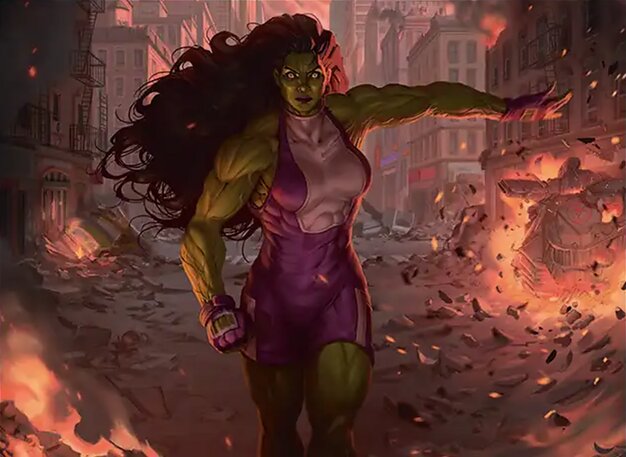
She-Hulk, Jade Defender remains a strong pick as well, particularly because Marvel Super Heroes contains meaningful artifacts and enchantments. Her Power-up ability gives green access to interaction while still leaving behind a relevant threat.
The original version of this guide was right to highlight She-Hulk, Jade Defender, but she is better viewed as one of several premium green uncommons rather than automatically the best uncommon in the entire format.
What Actually Matters When Drafting Marvel Super Heroes
Knowing the best individual cards helps, but Limited is not a checklist where you simply collect every highly rated card you see.
Your curve matters more.
A Draft deck containing five excellent five-drops and no useful two-drops is usually worse than a slightly less powerful deck that spends mana efficiently every turn. Marvel contains enough mana sinks and Power-up abilities that having something productive to do later is rarely difficult; surviving the opening turns is often the bigger concern.
For most normal two-color Limited decks, 17 lands remains the safest starting point. The format also contains common dual lands and green fixing that make splashing possible, but the existence of fixing does not automatically mean every deck should become three or four colors. Limited guides evaluating the format have similarly treated 17 lands as the normal baseline, with 18 sometimes reasonable in slower decks with plenty of mana sinks.
If you are unsure whether your deck is overloaded at four and five mana, our Mana Curve & Deck Analyzer can help you visualize where the deck is likely to stumble before you play the first round.
Removal should also be valued highly, but not blindly. Lightning Strike is attractive because it is efficient and flexible. A narrow removal spell requiring a very specific target may deserve a lower pick even if the effect looks more powerful when everything lines up.
The same principle applies to synergy. Teamwork, Power-up, artifacts, Heroes and Villains can all reward focused drafting, but your deck still has to function when its best synergy piece remains in the bottom ten cards of the library.
Draft and Sealed Need Different Priorities
Draft rewards flexibility.
Early in pack one, I would rather take a powerful card that works in several decks than a narrow synergy piece that only becomes good if the next ten picks cooperate. Once you see which colors are genuinely open, you can begin taking the cards that transform a pile of good individual cards into a cohesive archetype.
Sealed is different because you cannot choose your pool.
Your job is to identify the strongest functional deck hidden inside the cards you opened. Start with your best rares and removal, but do not allow them to force an unplayable mana base. Sometimes the correct deck leaves an excellent rare in the sideboard because the rest of that color is simply not good enough.
Consistency becomes even more important in high-stakes events. If you are considering Arena Direct or another premium Sealed queue, our MTG Arena Direct Marvel guide explains why a functional mana base and reliable curve matter even more when a run can end after only two losses.
In ordinary Sealed, a slightly awkward deck may still be fun. When thousands of gems or a physical prize are involved, every unnecessary splash becomes much harder to justify.
The Cards I Would Pick Early
If I opened a Marvel Super Heroes Draft today and wanted a simple shortlist rather than memorizing an entire tier list, I would pay particular attention to cards such as Hero in Training, S.H.I.E.L.D. Deployment Drone, Cruel Alliance, Lightning Strike and Undercover Skrull at common.
At uncommon, cards such as Red Guardian, Super-Soldier, Justice, Vance Astrovik, Madame Masque, Photon Blast Barrage and Ka-Zar of the Savage Land are strong reasons to pay attention to their colors.
But none of those cards should convince you to destroy an otherwise excellent Draft.
The best Limited players constantly balance raw card strength, mana curve, color availability and synergy. A slightly weaker card in your open color is often worth far more than a powerful uncommon that requires abandoning half of your previous picks.
Final Thoughts: Commons Win More Games Than Mythics
Marvel Super Heroes encourages players to focus on the spectacular cards. That is natural when the set contains some of the most recognizable characters in pop culture.
Limited rewards a different mindset.
Your mythic rare may win the game when you draw it, but the commons determine whether you survive long enough to cast it. Reliable removal keeps opposing bombs under control. Cheap creatures make your curve functional. Card advantage prevents you from running out of resources, while fixing determines whether the spells in your hand can actually be cast.
That is why cards such as Hero in Training, Lightning Strike and Undercover Skrull deserve just as much attention during a Draft as the superhero sitting in the rare slot.
Learn the best cards, but do not draft from a ranking alone. Read the signals, protect your mana curve and build the deck your seat is actually offering you.
That is usually how Marvel Limited trophies are won.


