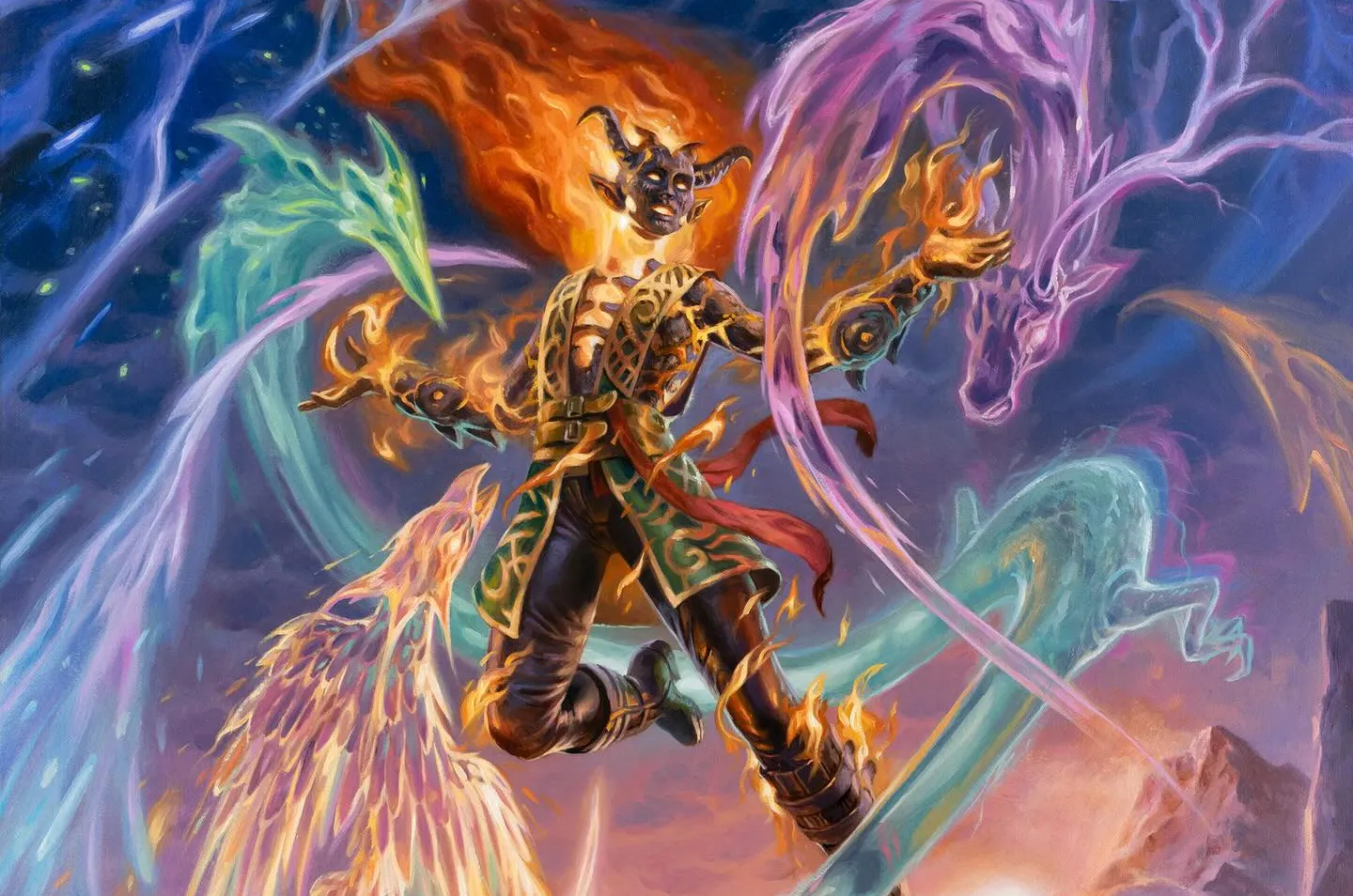
Dance of the Elements is one of those Commander precons where the face commander completely changes how you evaluate the cards around it.
Ashling, the Limitless gives Elemental permanent spells you cast from your hand evoke . Whenever you sacrifice a nontoken Elemental, Ashling then creates a token copy of it with haste. At the beginning of your next end step, that token is sacrificed unless you pay .
That creates a very different style of Elemental deck from simply ramping into large creatures. With Ashling in play, expensive Elementals such as Titan of Industry, Greenwarden of Murasa or Avenger of Zendikar can become four-mana value spells. The original creature enters, generates value, gets sacrificed to evoke, and Ashling replaces it with a temporary copy that can generate its enters ability again and attack immediately.
The stock deck already contains many excellent pieces for that plan, so upgrading Dance of the Elements should not mean tearing it apart. The goal is to increase the number of Elementals that generate value immediately, improve the five-color mana base and make Ashling’s sacrifice-and-copy engine more reliable.
How Ashling, the Limitless Wants the Deck to Play
Ashling rewards Elementals very differently depending on when they generate value.
A creature whose strength comes primarily from remaining on the battlefield for several turns is less exciting to evoke. A creature with a powerful enters-the-battlefield ability is almost perfect.
Mulldrifter demonstrates the engine beautifully. You can already evoke it for , draw two cards and sacrifice it. Ashling sees that sacrifice and creates a token copy, allowing Mulldrifter’s draw trigger to happen again while leaving you with a hasty 2/2 flyer until the delayed sacrifice arrives.
The same principle becomes much more dramatic with expensive Elementals. Titan of Industry normally costs , but Ashling can give it evoke . You get Titan’s enters trigger, sacrifice the original, create a hasty token copy and receive another enters trigger from the copy.
That means the printed mana value of an Elemental matters less than usual. What matters is what you receive before the creature disappears.
The precon understands this surprisingly well. Shriekmaw, Foundation Breaker, Ingot Chewer, Cavalier of Thorns, Greenwarden of Murasa, Bane of Progress and Titan of Industry all provide immediate value.
It also includes Risen Reef, Incandescent Soulstoke, Smokebraider, Flamebraider, Horde of Notions and Muldrotha, the Gravetide, giving the deck multiple ways to turn sacrificed creatures into additional resources.
The best upgrades should reinforce that core rather than distracting from it.
Best Dance of the Elements Upgrades
Panharmonicon
If the deck is built around Elementals entering the battlefield, Panharmonicon is one of the cleanest upgrades available.
Whenever an artifact or creature entering causes a permanent you control to trigger, Panharmonicon causes that ability to trigger an additional time. That means an Elemental with an enters ability can trigger twice when the original resolves and twice again when Ashling produces the copy.
The stock deck already contains Yarok, the Desecrated, which rewards many of the same cards. Adding another way to multiply enters triggers gives the deck far more explosive turns.
Grave Sifter
Grave Sifter is particularly appealing because Ashling naturally fills the graveyard with Elementals.
When Grave Sifter enters, each player chooses a creature type and returns creatures of that type from their graveyard to their hand. Choosing Elemental can recover a large portion of the creatures you have previously evoked or lost to removal.
The interaction becomes even better when Grave Sifter itself is sacrificed. Ashling can create another copy, allowing the enters ability to happen again and giving the deck a repeatable-feeling recursion engine without requiring a complicated combo.
Sundial of the Infinite
Sundial of the Infinite is one of the stranger but most interesting upgrades for Ashling.
Normally, Ashling’s copied Elemental survives until your next end step unless you pay . If that delayed sacrifice trigger goes onto the stack, Sundial can end the turn and exile the trigger from the stack.
The result is that the copied Elemental can remain on the battlefield rather than disappearing.
This is especially valuable when the copy is something you would actually like to keep, such as Titan of Industry, Avenger of Zendikar or another substantial permanent. Sundial does nothing by itself, so I would not build the entire deck around the interaction, but the ceiling is high enough to justify testing it.
Solitude
Solitude fits Ashling almost perfectly.
It is an Elemental with flash and lifelink, and its enters ability exiles another target creature. It also has its own evoke ability, allowing it to function as emergency interaction even when you cannot afford its normal mana cost.
With Ashling on the battlefield, sacrificing the original Solitude can generate a token copy and therefore another exile trigger.
That gives the deck exactly what it wants: interaction attached to an Elemental body that produces immediate value.
Animar, Soul of Elements
Animar, Soul of Elements rewards the deck for doing something it already wants to do: repeatedly casting creatures.
Whenever you cast a creature spell, Animar receives a +1/+1 counter, and your creature spells cost less for each counter on Animar. Those reductions can make Ashling’s evoke cost progressively easier to pay.
Animar also gives the deck another engine that opponents need to respect rather than allowing every game to depend entirely on Ashling surviving.
Parallel Lives
Ashling makes creature tokens constantly, so Parallel Lives provides an obvious way to increase the payoff.
When Ashling creates a token copy of a sacrificed Elemental, Parallel Lives doubles the number of tokens created. That means twice the enters-the-battlefield triggers, twice the potential attackers and dramatically more value from every Elemental you sacrifice.
Do remember that these tokens are still being created through Ashling’s ability. Parallel Lives increases the quantity; it does not magically remove Ashling’s delayed sacrifice condition. The point is to double the value generated before that condition matters.
Which Cards Should You Cut?
The stock list is stronger than the original version of this guide gave it credit for, so I would start with a relatively conservative package of cuts.
Hoofprints of the Stag is one of the easiest. It can eventually create 4/4 flying Elementals, but it asks you to accumulate counters through card draw and then spend mana to produce them. That is slow compared with what Ashling can accomplish by simply casting another high-impact Elemental.
Shatter the Sky is functional interaction, but a conventional board wipe is awkward in a creature-heavy engine deck. There will absolutely be games where you need one, so I would not remove every reset button, but this is a reasonable slot if you want to replace generic interaction with something more synergistic.
Elemental Spectacle is flavorful, but the deck has stronger ways to generate pressure. Ashling already converts sacrificed Elementals into copies, so we should prioritize cards that make those creatures more valuable rather than simply adding another token-producing effect.
Descendants‘ Fury can create exciting tribal turns, but it also asks for setup and a successful combat step before converting creatures into random cards from the library. Ashling’s game plan is more reliable when the payoff is attached directly to creatures entering and leaving the battlefield.
Crib Swap is perfectly playable removal, and being a Shapeshifter gives it some tribal relevance. Still, once we add better interaction attached to Elementals such as Solitude, this becomes an easy place to free a slot.
I would be much less eager to cut Ingot Chewer than the old guide suggested. It may look narrow, but artifact removal attached to an Elemental with evoke is exactly the sort of effect Ashling can exploit. In a typical Commander pod, finding a useful artifact target is rarely difficult.
A simple first upgrade package could therefore look like:
Out: Hoofprints of the Stag, Elemental Spectacle, Descendants‘ Fury, Crib Swap, Shatter the Sky
In: Panharmonicon, Grave Sifter, Sundial of the Infinite, Solitude, Animar, Soul of Elements
From there, Parallel Lives is an excellent next addition if you want to lean harder into Ashling’s token-copy engine.
The Mana Base Is the Biggest Structural Upgrade
Dance of the Elements is a true five-color deck, and that makes its mana base more important than in most precons.
Ashling herself only costs , which means casting the commander is relatively easy. The problem comes later. The stock deck contains cards spread across all five colors, while Ashling asks for the full if you want to keep one of her temporary copies.
The precon compensates with cards such as Chromatic Lantern, Faeburrow Elder, Fellwar Stone, Arcane Signet, Timeless Lotus, Ancient Ziggurat, Secluded Courtyard, Unclaimed Territory and Primal Beyond. Those are useful pieces and I would keep most of them.
Where the deck starts to struggle is the sheer number of lands that can enter tapped. The cycle of Thriving lands and several three-color lands provide broad fixing, but too many slow lands make it much harder to deploy Ashling and immediately follow with an Elemental.
You do not need an expensive fetch-and-shock mana base overnight. Start by replacing some of the slowest lands with untapped multicolor sources that fit your budget, and prioritize green because cards such as Cultivate, Kodama’s Reach, Fertile Ground, Abundant Growth and Faeburrow Elder help turn green access into the rest of your colors.
This is also exactly the kind of precon where our Mana Base Upgrade Guide is useful. Five-color decks punish inconsistent fixing far more severely than a typical two-color Commander deck, so improving lands often produces a bigger real-world upgrade than buying another flashy seven-mana creature.
How the Upgraded Deck Actually Wins
A better Dance of the Elements deck does not need an elaborate infinite combo to become dangerous.
The main plan is still incremental value, except Ashling allows that value to snowball extremely quickly. Cast an Elemental for its normal cost or evoke it. Generate an enters ability. Sacrifice it. Create a copy. Generate another enters ability. Attack with the hasty token and then repeat the process with another creature.
Panharmonicon or the stock Yarok, the Desecrated multiply those triggers. Grave Sifter, Greenwarden of Murasa, Muldrotha, the Gravetide and Horde of Notions keep the graveyard from becoming a dead end.
Eventually the value turns into overwhelming board presence.
Avenger of Zendikar can produce a huge number of Plants. Titan of Industry provides multiple pieces of value every time it enters. Omnath, Locus of Rage turns Elementals dying into direct damage. Maelstrom Wanderer can produce enormous tempo swings while also giving your creatures haste.
And because Ashling’s copied Elementals already gain haste, even creatures that are unlikely to survive the turn can still contribute combat damage before disappearing.
That is the key difference between this deck and a conventional Elemental tribal build. You are not necessarily trying to protect every creature forever.
You are trying to extract as much value as possible from each creature before sacrificing it, then do it again.
PreconForge Verdict
Dance of the Elements already has an unusually strong core.
Ashling, the Limitless turns expensive Elementals into four-mana value engines, while the stock deck provides excellent targets such as Mulldrifter, Shriekmaw, Cavalier of Thorns, Greenwarden of Murasa, Bane of Progress and Titan of Industry.
That means the best upgrade plan is surprisingly restrained.
Add a few cards that multiply enters triggers or reward sacrifice. Improve the five-color mana base. Replace slower cards that do not contribute directly to Ashling’s engine. Most importantly, resist the temptation to remove useful Elementals simply because their printed mana costs look too high.
With Ashling in command, that seven-mana creature may only cost when it matters.
Cards such as Panharmonicon, Grave Sifter, Solitude, Animar, Soul of Elements and Sundial of the Infinite sharpen the engine without changing what made the precon interesting in the first place.
Dance of the Elements does not need to become a completely different deck.
It just needs to make every sacrifice hurt your opponents more than it hurts you.


