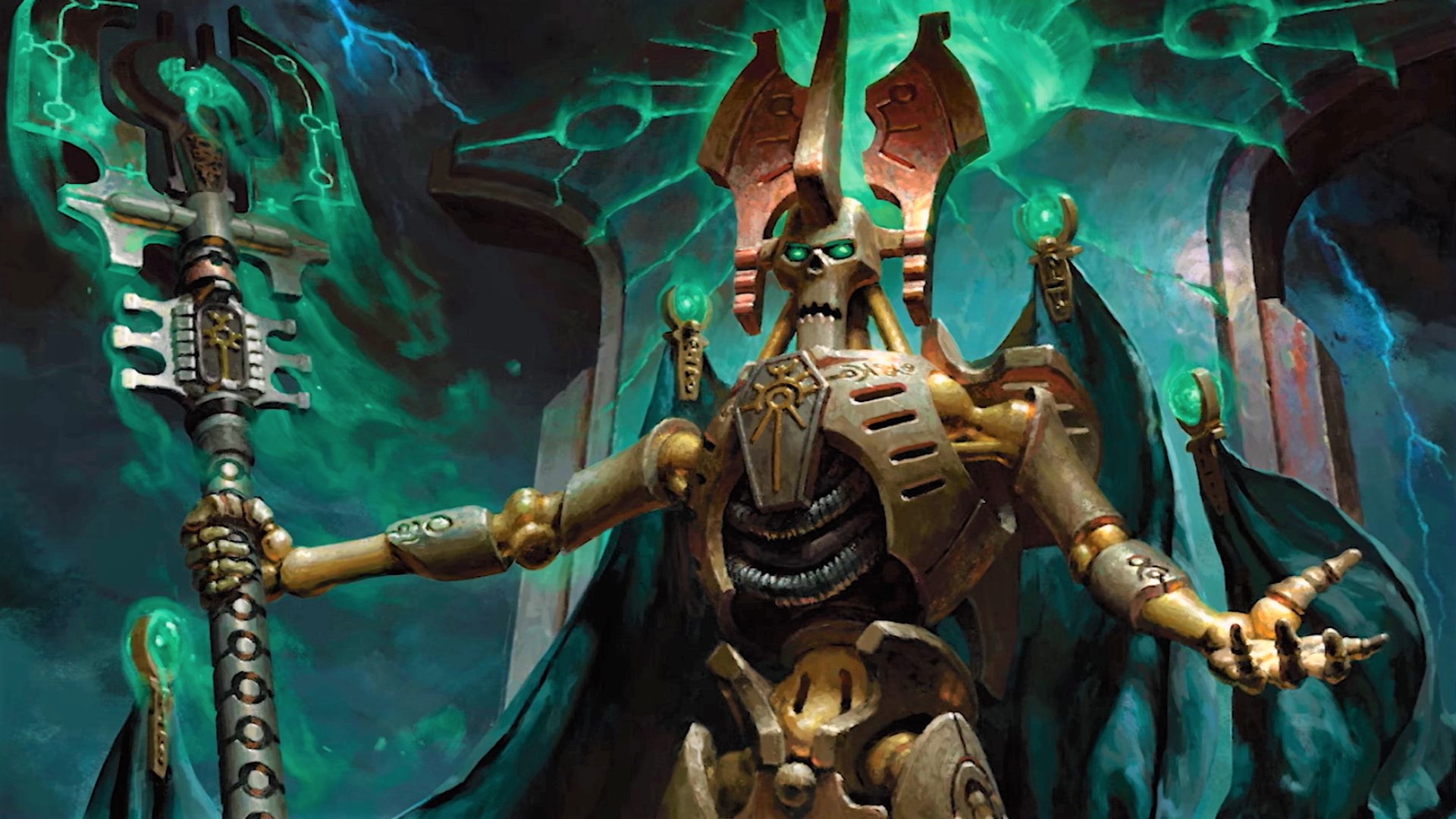
The Warhammer 40,000 Commander decks have been around for years, but Necron Dynasties remains one of Magic’s most cohesive preconstructed decks. Its mono-black identity could have been restrictive; instead, Wizards built almost the entire deck around artifact creatures, self-mill and bringing machines back from the graveyard.
The stock commander, Szarekh, the Silent King, supports that plan by attacking, milling three cards and potentially returning an artifact creature or Vehicle from among those cards to your hand. But the deck’s alternate commander, Imotekh the Stormlord, offers a more focused direction for players who want to turn graveyard recursion into an army.
Whenever one or more artifact cards leave your graveyard, Imotekh creates two 2/2 black Necron Warrior artifact creature tokens. Then, at the beginning of combat on your turn, another artifact creature you control gets +2/+2 and menace until end of turn.
That gives the deck a very clear upgrade philosophy. You do not just want to fill your graveyard. You want artifact cards to leave it repeatedly, preferably in separate events, turning every piece of recursion into another pair of Necrons.
Why Imotekh Changes the Way Necron Dynasties Plays
The phrase that matters most on Imotekh is “one or more.”
If one artifact card leaves your graveyard, you create two Necron Warriors. If five artifact cards leave simultaneously, you still create only two.
That means a card such as Living Death can be enormously powerful without necessarily creating an absurd number of separate Imotekh triggers. By contrast, effects that return or exile individual artifact cards at different times can repeatedly trigger Phaeron.
This is where the original precon is already much better than it may first appear.
Anrakyr the Traveller can cast an artifact spell from your graveyard when it attacks. Casting that artifact causes it to leave the graveyard and triggers Imotekh before the spell even resolves.
Technomancer can return artifact creatures from your graveyard to the battlefield. Triarch Praetorian has unearth, which brings itself out of the graveyard and triggers Imotekh in the process. Dread Return gives you another route to reanimation, while The War in Heaven eventually brings artifact creatures back en masse.
Even Szarekh, the Silent King remains useful in the 99 because attacking with him continues to fill the graveyard while potentially recovering another artifact creature.
The result is less of an “infinite graveyard loop” deck and more of a recursion engine. You fill the graveyard with machines, move those machines back into useful zones, and let Imotekh build an army every time the process happens.
The Best Upgrades Make the Graveyard More Reliable
One of the easiest mistakes when upgrading Imotekh is adding cards that exile your own artifacts solely to trigger the commander.
Technically, that works. Scrabbling Claws can exile an artifact from your graveyard and Imotekh will create two Necrons.
But you have traded a potentially reusable artifact card for a pair of 2/2 tokens.
That can be worthwhile in the right moment, but recursion is usually much stronger than simple exile because you get both the Imotekh trigger and the card back.
Myr Retriever is a great example. When it dies, it can return another artifact from your graveyard to your hand. The returned artifact triggers Imotekh, while Retriever itself is now waiting in the graveyard to become part of a future recursion chain.
Scrap Trawler pushes that idea much further. When one of your artifacts goes to the graveyard, Trawler can return a lower-mana-value artifact card from your graveyard to your hand. Every successful return is another opportunity to trigger Imotekh while keeping resources flowing.
Tortured Existence is another interesting engine because so many Necrons are artifact creatures. For , you discard a creature card and return a creature card from your graveyard to your hand. If the card coming back is an artifact creature, Imotekh sees it leave the graveyard and creates two Warriors.
The deck also benefits from simply putting more cards into its graveyard. Ripples of Undeath is a natural modern addition because it mills cards repeatedly while giving you the option to turn one of those cards into your hand. The stock Out of the Tombs can fill the graveyard even more aggressively, although its escalating mill count means you need to watch your library in longer games.
The important point is that self-mill is only half of the equation. A full graveyard does nothing for Imotekh until you have reliable ways to move artifact cards back out.
The Stock Necron Cards Are Worth Keeping
I would be much more conservative with cuts than the original version of this guide.
Lychguard, for example, should not be dismissed as an overcosted defensive creature. Its ability costs and requires sacrificing itself, but it returns all legendary creature cards from your graveyard to your hand.
Necron Dynasties contains numerous legendary artifact creatures. If several of those leave the graveyard together, Imotekh only triggers once because they moved simultaneously, but Lychguard can still represent a substantial refill after a long game.
Szarekh, the Silent King is also not an automatic cut. He is no longer your commander, but self-milling while recovering artifact creatures is exactly the kind of setup Imotekh needs. A four-mana 3/4 flyer is not spectacular on rate, yet the attack trigger is highly relevant to the deck.
Sautekh Immortal is more expendable. Flash is useful, but its main payoff is entering with +1/+1 counters based on creatures that died that turn. It can become large without contributing much to the graveyard-recursion engine.
Plasmancer is another reasonable place to look. A 3/3 flying artifact creature that puts a basic Swamp into your hand has some value, and being an artifact creature means the deck can recur it, but four mana is a significant investment for fixing rather than true acceleration.
Those are the kinds of slots I would trim first: cards that participate in the artifact theme but do not materially improve the cycle of mill, recur, trigger Imotekh, repeat.
Turning the Necron Warriors Into a Win Condition
Imotekh does not need a separate token subtheme to function. The tokens are already artifact creatures, which means they naturally interact with many of the cards you want to play.
The simplest win condition is combat.
Every Imotekh trigger produces four total power across two bodies, and Grand Strategist makes one of your other artifact creatures larger and gives it menace every combat. There is no mana payment attached to that ability.
As the board grows, Cranial Plating, which is already included in the precon, becomes increasingly dangerous because practically everything you are creating is an artifact.
This is one reason I would not rush to replace the deck’s combat plan with generic aristocrats cards.
Some sacrifice payoffs are excellent, but Imotekh naturally gives you an army capable of attacking. The stronger upgrade is often something that makes the existing artifact army more useful rather than turning every token into disposable material immediately.
Braids, Arisen Nightmare is still a strong addition because a spare Necron token can be sacrificed at the end step for value without requiring the entire deck to become an aristocrats build.
Skullclamp is another natural inclusion if you are willing to sacrifice tokens or other small creatures. The stock deck wants cards flowing into both your hand and graveyard, and Clamp gives expendable bodies a second purpose.
The deck’s own Biotransference is particularly important. It makes your creatures artifacts in every relevant zone and rewards you for casting artifact spells with additional Necron Warriors. In an Imotekh build, that dramatically expands the number of creature cards capable of interacting with his graveyard trigger.
Imotekh Can Combo, but Build the Engine Correctly
If you want to push Necron Dynasties beyond straightforward value, Nim Deathmantle and Ashnod’s Altar create a much more interesting ceiling.
The old version of this guide incorrectly described Chronomancer as a free sacrifice outlet. It isn’t one.
Ashnod’s Altar, however, really is.
With Imotekh, Nim Deathmantle, the Altar and an appropriate nontoken artifact creature, sacrificing that creature produces mana and causes Deathmantle to offer to return it for . When it comes back from the graveyard, Imotekh creates two Necron Warrior artifact creature tokens.
Those tokens can then help pay for subsequent repetitions through Ashnod’s Altar.
Once the engine has enough mana to begin operating, repeated cycles can generate repeated Imotekh triggers and an arbitrarily large token army.
That is a real combo direction, but it is not something the unmodified precon simply does by accident. You need the correct pieces, and Nim Deathmantle alone is not an infinite combo.
For most casual tables, you do not need to go this far. Imotekh already generates plenty of value through normal recursion.
What I Would Upgrade First
If I had a stock Necron Dynasties deck and wanted to move Imotekh the Stormlord into the command zone, I would spend my first upgrade slots on repeatable recursion and sacrifice infrastructure, not expensive finishers.
Myr Retriever gives you another cheap artifact creature that naturally participates in recursion chains.
Scrap Trawler turns artifact deaths into additional cards leaving your graveyard.
Tortured Existence gives you a repeatable way to exchange creatures between hand and graveyard.
Ashnod’s Altar gives the deck a genuine free sacrifice outlet and converts spare Necron Warriors into mana when necessary.
And more consistent self-mill gives all of those cards a larger pool of artifacts to work with.
Only after the recursion engine is reliable would I start adding expensive combo pieces or replacing every slower card in the original list.
Necron Dynasties is unusual among precons because its stock cards already understand what the deck is supposed to do. The goal is not to rebuild it from scratch. It is to remove a handful of weaker links and make the existing graveyard machinery fire more consistently.
PreconForge Verdict
Imotekh the Stormlord is one of the best reasons to revisit Necron Dynasties.
Szarekh, the Silent King gives the original deck a broad self-mill and artifact-value plan. Imotekh narrows that plan into something more precise: every artifact that leaves your graveyard becomes another pair of Necron Warriors.
That makes the best upgrades surprisingly straightforward. Fill the graveyard reliably. Prefer reusable recursion over simply exiling your own cards. Add sacrifice outlets that turn your artifact creatures into resources. Keep the strongest recursion pieces already present in the precon.
Then let the deck do what Necron Dynasties already does well: bury its machines, bring them back and slowly replace the battlefield with an army that refuses to stay dead.
If you are rebuilding more than just the recursion package, our How to Build a Commander Deck: The Complete 100-Card Blueprint is a useful next step for balancing ramp, interaction, card advantage and win conditions without losing the deck’s core identity.


