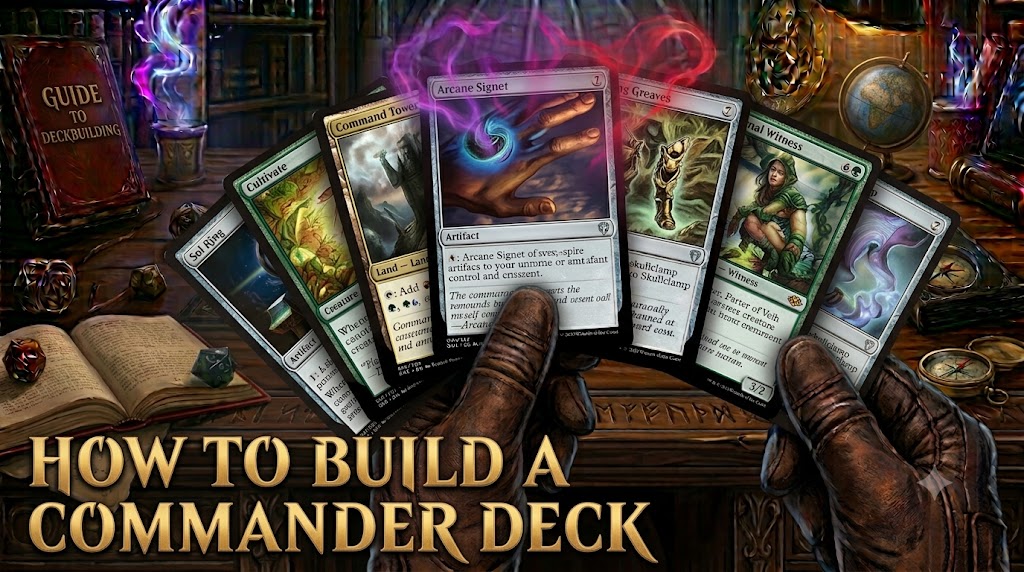
Commander, originally known as Elder Dragon Highlander (EDH), has evolved from an underground multiplayer format into the most popular way to play tabletop Magic: The Gathering in the United States. Unlike standard 60-card formats designed for fast, head-to-head competitive play, Commander is a casual, social, four-player format that celebrates high-variance gameplay, massive board states, and deep personalization.
If you are transitioning from MTG Arena formats like Standard or looking to build your very first physical tabletop singleton deck, navigating the 100-card structural requirements can feel daunting.
Optimized to serve as a quick crafting and deckbuilding checklist on your phone screen, here is the ultimate beginner-friendly guide to mastering the core rules and exact mathematical card ratios needed to build a functioning Commander deck from scratch.
1. The Core Rules of EDH
Before you sort through your collection or buy single packs, your deck construction must adhere to three foundational rules enforced by the Commander Rules Committee.
Rule 1: The Identity (1 Leader + 99 Followers)
Your deck must consist of exactly 100 cards. This total includes your designated Commander (which starts the game in a special zone called the Command Zone) and the remaining 99 cards that make up your main library. If your chosen general utilizes a dynamic mechanic like Partner, you may run two Commanders alongside a 98-card main library.
To qualify as a legal Commander, the card must fulfill one of two parameters:
-
It must carry the Legendary Creature card type.
-
It must explicitly state „This card can be your commander“ within its rules text (frequently found on specialized Planeswalker cards).
Rule 2: Color Identity Restrictions
You cannot include any card in your 99-card library that contains a colored mana symbol not found on your chosen Commander. This structural parameter is called Color Identity, and it evaluates every symbol appearing on the card, including its casting cost and any activated abilities within the text box.
-
Example: If your Commander is Alela, Cunning Conqueror (Blue/Black), every card in your deck must be strictly Blue, Black, or Colorless. You cannot include cards containing White, Red, or Green mana symbols anywhere on the card face.
Rule 3: The Singleton Rule
Aside from basic resource structures like Island, Swamp, or Forest, your library can only contain a single copy of any card by name. You cannot run traditional 4-of playsets.
2. The Golden Deckbuilding Ratios
Because your starting life total is set to a massive 40 life and you are facing three opponents simultaneously, Commander games run significantly longer than standard 60-card matches. To prevent running out of gas or getting stuck without mana, successful deck builders rely on a mathematical blueprint to organize their 99 cards.
Here is the industry-standard template for a reliable, balanced mana and spell distribution:
The Resource Base (36–38 Lands)
The single biggest mistake new players make is running a greedy land count. To consistently hit your land drops through the critical early turns of the match, aim for 37 lands.
-
In multi-color builds, look to maximize color fixing using options like Command Tower or budget dual lands.
-
To ensure your deck doesn’t flood out late-game, utilize modal double-faced cards (MDFCs) which can be played as spells if you already have enough mana.
Mana Acceleration / Ramp (10–12 Slots)
Because Commander spells feature higher mana costs, accelerating your resource development is essential. Dedicate at least 10 slots to cheap mana stones or green sorceries.
-
Core Staple Inclusions: Sol Ring, Arcane Signet, and flavor-aligned lockets or talismans.
Card Advantage / Draw Engines (8–10 Slots)
If you empty your hand early, you will lose the game to the combined resource generation of three opponents. You need dedicated effects that draw multiple cards over time.
-
Core Staple Inclusions: Repeatable draw engines like Rhystic Study or budget bursts of card selection like Read the Bones.
Interaction and Removal (8–10 Slots)
You must be able to answer game-ending threats deployed by your opponents. Your removal package should be split evenly between two styles of interaction:
-
Single-Target Spot Removal (5 slots): Instant-speed spells to eliminate single blockers or combo pieces, such as Swords to Plowshares or Beast Within.
-
Board Wipes / Mass Removal (3–4 slots): Spells to reset the entire battlefield when an opponent’s token swarm or aggro board gets out of control, such as Wrath of God or Blasphemous Act.
The Synergy Core (25–30 Slots)
Once your foundation of land, ramp, draw, and removal is locked in, you are left with roughly 30 open slots. This is where you insert the core theme of your deck—whether you are building a massive token army, a graveyard reanimation package, or a fast combo engine that synergizes directly with your Commander’s unique abilities.
3. Understanding the Commander Tax
When your Commander is destroyed, exiled, or counter-spelled during combat, it does not have to go to the graveyard or exile zone. Instead, the rules allow you to send it directly back to the safety of your Command Zone.
However, calling your leader back into battle gets progressively harder. Every single time you recast your Commander from the Command Zone, you must pay an additional penalty fee of 2 generic mana for each previous time it was cast during that match. This mechanic is known as the Commander Tax.
-
First Cast: Normal casting cost.
-
Second Cast: Normal casting cost + 2 generic mana.
-
Third Cast: Normal casting cost + 4 generic mana.
To protect your strategic investment against aggressive removal strategies, ensure your synergy core includes protection tools like Swiftfoot Boots (Hexproof) or Lightning Greaves (Shroud).
PreconForge Verdict: Start Balanced, Refine Later
Building your first 100-card list is a process of ongoing tuning. By sticking closely to the baseline formula of 37 lands, 10 ramp pieces, and 10 card-draw engines, you ensure that your deck will fundamentally function, cast its spells on curve, and actively participate in the game loop. Once you get a few games under your belt within your local playgroup, you can safely swap out card packages to push your power level or reinforce specific gameplay themes.
Are you looking to build an aggressive token swarm deck or a highly political control shell for your first Commander build? Let’s keep the deckbuilding strategy and economic optimization discussion moving forward!


