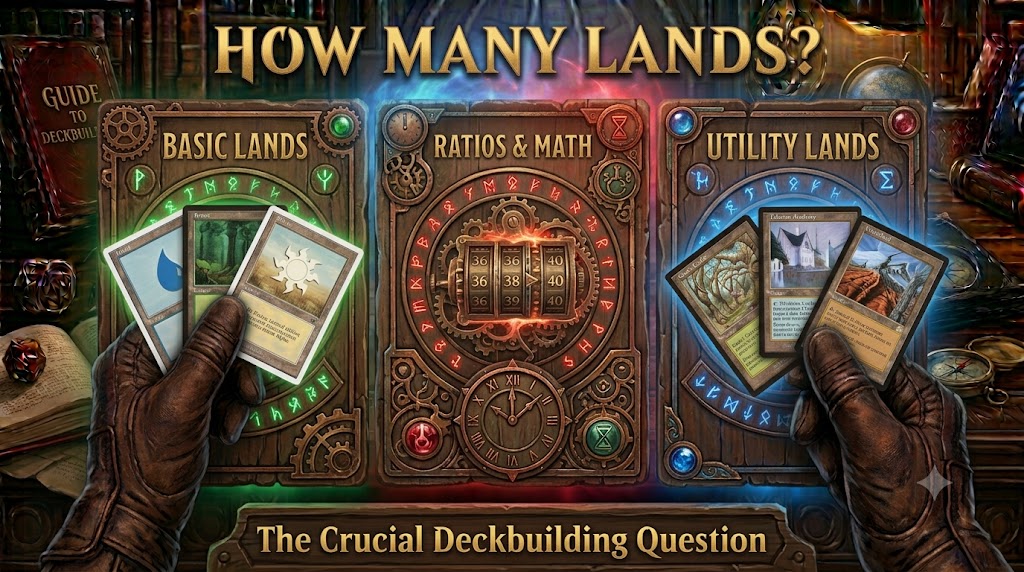
The single most critical factor separating casual deckbuilders from high-level tournament grinders is the structural math behind their land selection. You can draft a flawless curve of mythic threats, but if you cannot consistently cast those spells on time, your deck’s win rate will plummet.
In Magic: The Gathering, designing a mana base is a balancing act. Run too few lands, and you get „mana screwed“ (stuck with zero resources while your spells rot in your hand). Run too many lands, and you get „mana flooded“ (drawing dead resources late-game while your opponent runs you over).
Optimized directly to serve as a fast mathematical blueprint on your phone screen while you brew your next list, here is the industry-standard guide to calculating lands and mana fixing for a standard 60-card deck.
1. The Core Rule: Matching Lands to Archetypes
The old advice given to beginners is to simply run 24 lands in every 60-card deck. While this is a safe baseline for a balanced midrange list, it is incredibly inefficient if you are piloting a hyper-aggressive deck or a slow control shell.
To find your exact starting land count, you must look at your deck’s overall strategy and average mana value (AMV).
Aggro Decks (18–21 Lands)
-
The Strategy: Hyper-fast strategies like Mono-Red Prowess or Boros Aggro.
-
The Math: Your highest-cost spell tops out at 3 mana, and your primary threat curve lives at 1 and 2 mana. Because you never need to hit a fourth land drop to win, running a lean 20 lands keeps your deck packed with action and minimizes dead draws.
Midrange Decks (22–24 Lands)
-
The Strategy: Balanced, flexible decks like Jund Midrange or Golgari Value shells.
-
The Math: Your deck relies on a steady curve, wanting to hit land drops consistently from turns 1 through 4 to deploy core threats like Fable of the Mirror-Breaker or Phlage, Titan of Fire’s Fury. A count of 23 lands ensures operational consistency without flooding out late-game.
Control and Ramp Decks (25–27 Lands)
-
The Strategy: Slow, defensive decks or explosive resource accelerators.
-
The Math: Control decks must hit their first 5 or 6 land drops consecutively without fail to deploy massive board wipes or counterspell backup. To ensure you almost never miss an early land drop, you must dedicate 26 slots of your 60-card layout directly to your resource base.
2. Calculating Your Colored Sources (Mobile Cheat Sheet)
Once you know how many total lands to run, you have to figure out how to split them between different colors if you are building a multi-color deck.
To cast a spell reliably on curve by a specific turn, you need a minimum number of lands in your deck capable of producing that exact color. Based on statistical tracking, here are the target thresholds you must hit:
-
For Single-Mana Spells on Turn 2 (Cost: )
-
Requirement: You need at least 13 Red Sources in your deck.
-
Example Card: Galvanic Discharge
-
-
For Dual-Color Spells on Turn 2 (Cost: )
-
Requirement: You need at least 13 Green Sources AND 13 Blue Sources simultaneously.
-
Example Card: Psychic Frog
-
-
For Double-White Spells on Turn 3 (Cost: )
-
Requirement: You need at least 19 White Sources in your deck.
-
Example Card: Ajani, Nacatl Pariah
-
-
For Triple-Blue Spells on Turn 3 (Cost: )
-
Requirement: You need a massive threshold of 22 Blue Sources.
-
Example Card: Archmage’s Charm
-
The Math in Action
If you are building a Boros Energy deck running Ajani, Nacatl Pariah (which costs ), you cannot simply run 12 plains and 11 mountains. If you do, you will rarely have two white mana sources open by turn 3. You need to utilize multi-color lands (dual lands, fetch lands, or pain lands) to ensure those lands count toward both your Red and White source totals simultaneously.
3. Mitigating Flood: The Utility Land Engine
Running 24 or 26 lands feels safe, but it increases the risk of drawing nothing but land cards during a long game. To combat this, competitive decks leverage utility lands—lands that double as spells or value engines later in the game.
-
Modal Double-Faced Cards (MDFCs): These are cards you can play as a land if you are short on resources, or cast as a spell if you draw them late-game. They are excellent safety nets for smoothing out opening hands.
-
Man-Lands: Lands that can pay a temporary mana cost to transform into an active creature for a turn, such as Restless Anchorage. This gives you an un-counterable threat to attack with after a global board wipe.
-
Channel / Cycle Lands: Lands you can discard from your hand to draw a fresh card or trigger a spell-like effect if you already have enough resources on the battlefield.
PreconForge Verdict: Never Skimp on Your Resources
It is incredibly tempting to cut a land from your deck blueprint to squeeze in an extra flashy rare creature or spicy combat trick. Resist the urge. A mathematically sound mana base is the literal foundation of competitive success. Treat your land count with the same strict optimization you apply to your win conditions, adjust your colored source thresholds to match your casting costs, and use utility lands to turn your resource base into a lethal late-game engine.
Are you running a lean, aggressive 20-land setup in your current lists, or are you packing a heavy 26-land mana base backed by utility slots to dominate the control mirror? Let’s keep the high-level deckbuilding strategy and mathematical optimization discussion moving forward!


