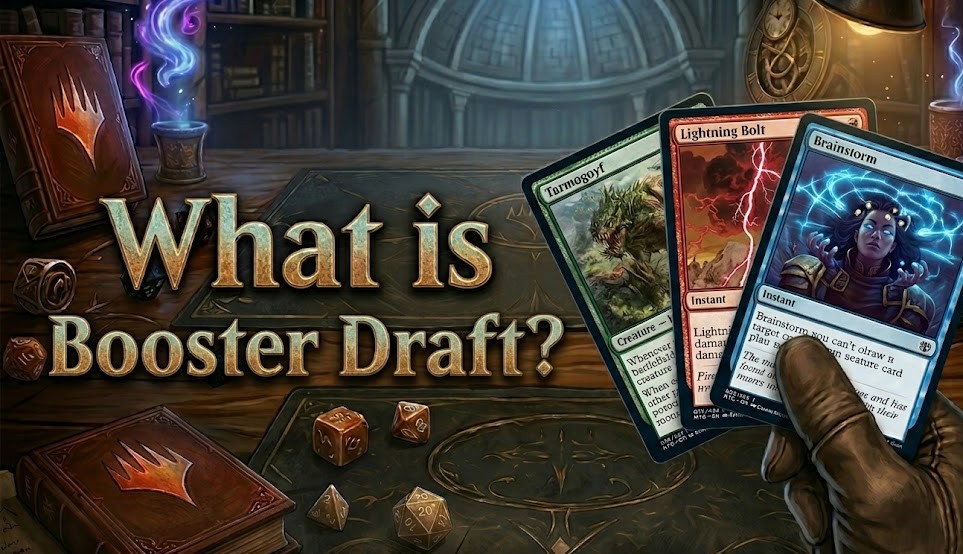
While formats like Commander and Standard allow you to bring a pre-built deck from home, there is a completely different way to play Magic: The Gathering that completely levels the playing field. It is a format where your expensive collection doesn’t matter, because every player starts the tournament with absolutely nothing. Welcome to Booster Draft.
As a corner-stone of the „Limited“ ecosystem, Booster Draft is widely considered by professional players to be the purest test of MTG skill. It requires you to evaluate cards on the fly, read the signals of the players sitting around you, and construct a functional deck right there at the table.
In this PreconForge Beginner’s Guide, we will break down the mechanics of the draft pod, explain the unique deck-building rules of Limited, and give you the essential tools to survive your first pick.
The Core Philosophy: Build It as You Play
Booster Draft is a Limited format traditionally played with a group of 8 players sitting in a circle, called a „Draft Pod.“ Instead of playing with an established deck, every player is given exactly three unopened Booster Packs (traditionally modern Play Boosters).
The thrill of a Draft comes from the hidden information and the shared card pool. You aren’t just opening packs to see what you get; you are actively competing with the rest of the table to intercept the best cards for your specific strategy. Once the draft is complete, you sit down with your freshly drafted pool and build a deck to play in a Swiss-style tournament against the other members of your pod.
How a Booster Draft Works: Step-by-Step
Drafting follows a strict, rhythmic process that ensures every player has an equal opportunity to see the cards moving around the table:
-
Pack One: Every player opens their first booster pack, removes the token/ad card, selects exactly one card to keep for their collection, and places it face-down in front of them.
-
The Pass: You take the remaining cards and pass them face-down to the player sitting on your left. You then pick up the cards passed to you from the player on your right, select one card, and pass the rest to the left again. This continues until all cards from the first pack are gone.
-
Pack Two: Everyone opens their second pack. This time, the drafting process repeats, but you pass the cards to your right.
-
Pack Three: The final pack is opened, and the passing direction switches back to the left one last time.
The 4 Golden Rules of Draft Deckbuilding
Once the draft finishes, you will have a pool of roughly 40 to 42 cards. Now, you must build your deck following the specific constraints of Limited play:
1. The 40-Card Minimum
Unlike Standard’s 60 cards or Commander’s 100 cards, a Draft deck must contain a minimum of exactly 40 cards. Sticking strictly to 40 cards is vital to ensure you draw your absolute best drafted cards as consistently as possible.
2. Basic Lands are Free
You do not need to draft basic lands! The tournament organizer or your friends will provide a shared land station packed with Plains, Islands, Swamps, Mountains, and Forests. A standard 40-card draft deck almost always consists of 23 drafted spells and 17 basic lands.
3. No Duplicate Limits
Because you are working with a limited pool of cards, the standard „playset rule“ is completely thrown out the window. If you are lucky enough to be passed five copies of a premier removal spell or a high-value aggressive creature, you can run all five of them in your deck.
4. Your Pool is Your Sideboard
Any card you drafted that does not make it into your main 40-card deck automatically becomes part of your Sideboard. Between games in a best-of-three match, you can freely swap cards out to adapt to your opponent’s colors.
The B.R.E.A.D. Strategy: A Beginner’s Cheat Sheet
When you open a pack and see 14 cards staring back at you, it can be terrifying to decide what to pick. For decades, players have used a classic acronym called B.R.E.A.D. to prioritize their card choices:
-
B – Bombs: High-impact, high-rarity cards that can win the game completely on their own if left unanswered (e.g., giant legendary dragons or sweeping mythic threats).
-
R – Removal: Spells that destroy, exile, or neutralize your opponent’s threats. Killing your opponent’s best creature is often better than playing your own.
-
E – Evasion: Creatures that are difficult to block, such as those with Flying, Menace, or Trample. These break board stalls and push direct damage.
-
A – Aggro: Efficient, low-cost creatures that fill out your „mana curve“ and ensure you have plays to make on turns two and three.
-
D – Dregs: Low-value filler cards, highly situational combat tricks, or off-color junk that you hope never to cast.
PreconForge Verdict: The Ultimate Equalizer
If you want to experience Magic: The Gathering in its most balanced, strategic form, Booster Draft is an absolute must-play. It removes the financial barrier of collecting, forces you to appreciate the hidden power of common and uncommon cards, and rewards pure tactical adaptability.
Gather some friends, grab a bundle of recent Play Boosters, and prepare to test your drafting instincts at the table!
Are you ready to test your card evaluation skills at a local Friday Night Magic draft, or are you planning to host a casual draft pod at home with your regular playgroup? Let us know in the comments below!


