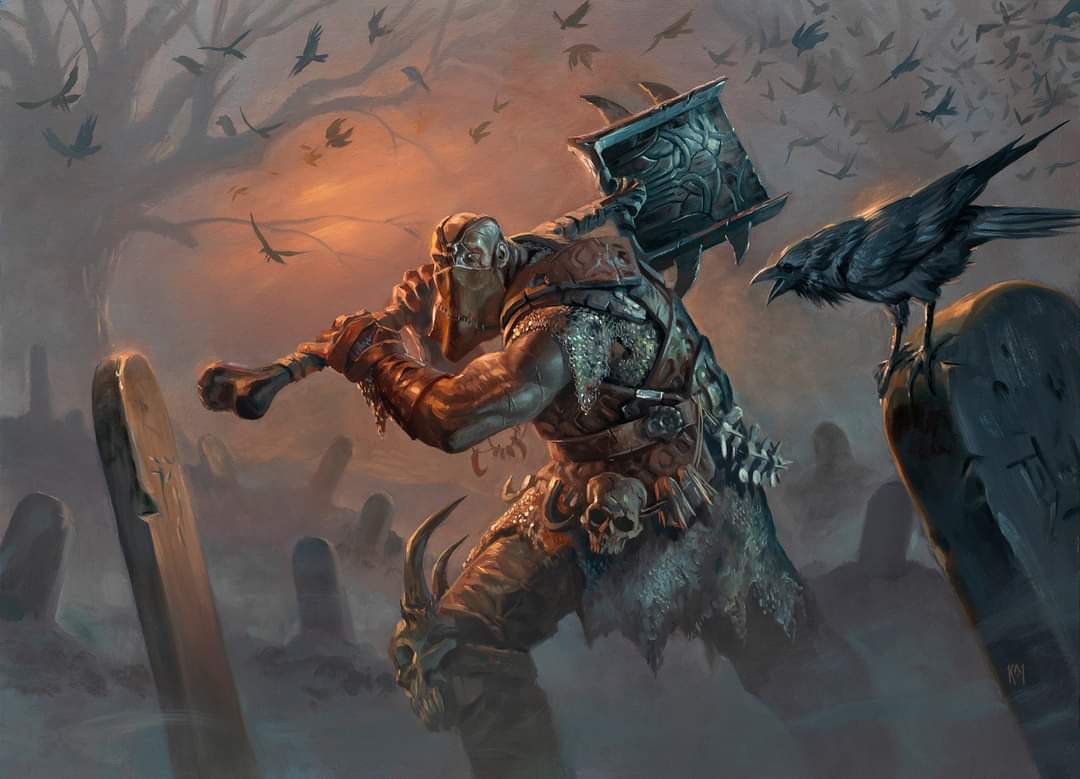
Graveyard Overdrive is already one of the strangest graveyard decks you can open from a Commander precon. Instead of paying mana to reanimate creatures, Disa the Restless simply puts Lhurgoyf permanent cards onto the battlefield whenever they enter your graveyard from anywhere other than the battlefield. That immediately changes the value of discard and self-mill effects, because cards that would normally be setup pieces can become free deployment engines as soon as Disa is in play.
Disa costs , and her second ability gives the deck another reason to attack. Whenever one or more creatures you control deal combat damage to a player, you create a Tarmogoyf token. It does not matter whether those creatures are tokens or nontokens, and hitting multiple players can generate multiple Tarmogoyfs in the same combat. That creates two engines inside the same commander: milling or discarding Lhurgoyfs becomes free reanimation, while getting creatures through combat gradually builds an army whose size scales with the card types accumulating across every graveyard at the table.
The best Graveyard Overdrive upgrade therefore focuses on putting the right cards into the graveyard deliberately, increasing the density of creatures Disa can cheat into play and making sure your growing Tarmogoyf army can reliably connect in combat.
The Stock Deck Gives Disa Almost Everything She Needs
Graveyard Overdrive has a much stronger foundation than the original version of this guide gave it credit for. The official list already contains Pyrogoyf, Polygoyf, Barrowgoyf, Necrogoyf, Mortivore and the original Lhurgoyf, giving Disa several creatures she can put directly onto the battlefield when they are discarded or milled. Barrowgoyf is especially impressive because it combines a scalable body with deathtouch and lifelink while helping put additional cards into graveyards through combat damage. Polygoyf can spread pressure around the table through myriad, and Pyrogoyf turns Lhurgoyfs entering the battlefield into direct creature or planeswalker damage.
The setup package is already good as well. Faithless Looting lets you choose exactly which cards leave your hand, Grisly Salvage digs five cards deep while filling the graveyard, and Stitcher’s Supplier provides cheap self-mill. Grapple with the Past and Deadbridge Chant give the deck even more ways to interact with its graveyard, while Anger and Brawn are often better staying there than being cast. Getting them into the graveyard can give your creatures haste or trample, two abilities that are extremely valuable when Disa wants large creatures to start connecting with players.
The most important stock card, however, may be Maskwood Nexus. It turns creature cards you own outside the battlefield into every creature type, including Lhurgoyf. With Disa and Maskwood Nexus both on the battlefield, a creature card milled from your library or discarded from your hand can satisfy Disa’s first ability even if it was never printed as a Lhurgoyf. That interaction dramatically expands what the deck is capable of doing and is one of the main reasons I would upgrade the existing shell rather than rebuild Graveyard Overdrive as a generic Jund graveyard deck.
Best Graveyard Overdrive Upgrades
Buried Alive is one of the most direct upgrades you can make. Normally, paying three mana to search your library for three creatures and put them into the graveyard is setup for a future reanimation spell. With Disa already on the battlefield, putting actual Lhurgoyf cards into your graveyard can be the reanimation spell. Search for three appropriate Lhurgoyfs, put them into the graveyard, and Disa can immediately put them onto the battlefield. Even when Disa is not available yet, Buried Alive can prepare Anger, Brawn or other graveyard pieces for later turns.
Tarmogoyf is another obvious omission from the precon. Disa already creates token copies of it, but the actual card is itself a Lhurgoyf. If it is milled or discarded while Disa is in play, the commander can simply put it onto the battlefield. More importantly, Tarmogoyf naturally supports the same plan as the tokens Disa creates. Its power is equal to the number of card types among cards in all graveyards, not only your own, and its toughness is one higher. As Commander games progress, several different card types usually reach graveyards without the Disa player having to engineer every one personally.
Nethergoyf gives the deck another extremely cheap Lhurgoyf. Unlike Tarmogoyf, it looks only at card types in your own graveyard, but Graveyard Overdrive is already designed to fill that graveyard quickly. It can also escape later in the game if you draw it after Disa has been removed or need another threat following a board wipe.
Changeling Outcast looks much less impressive until you read Disa carefully. Changeling functions in every zone, so Changeling Outcast is a Lhurgoyf card while it is in your library, hand and graveyard. If it is discarded or milled with Disa on the battlefield, she can put it directly into play. Once there, it cannot be blocked, which gives Disa a cheap and extremely reliable way to trigger her second ability. The card does not need to be large because its real job is making sure the combat engine starts working.
Altar of Dementia gives the deck a free sacrifice outlet that can turn creature power into self-mill. Large Tarmogoyf tokens or creatures that are about to be removed can be sacrificed to mill several cards, potentially finding more Lhurgoyfs for Disa to put directly onto the battlefield. The important distinction is that Disa cannot reanimate a Lhurgoyf that dies from the battlefield, because her first ability specifically requires the card to enter your graveyard from somewhere other than the battlefield. Altar therefore is not a way to sacrifice a Lhurgoyf and immediately return that same creature. It is a way to convert expendable creatures into another wave of self-mill.
That gives us a much cleaner upgrade philosophy than simply adding every graveyard staple available in Jund: controlled self-mill, Lhurgoyfs and changelings that Disa can cheat into play, and creatures capable of turning combat damage into more Tarmogoyfs.
What Should You Cut?
Graveyard Overdrive contains several large creatures that are individually powerful but do not participate efficiently in Disa’s primary engine. Once the deck becomes more focused, seven-mana battlecruiser cards and secondary token themes become the easiest places to create room. Broodmate Tyrant is a seven-mana Dragon that can produce additional flying bodies, but without Maskwood Nexus it is not a Lhurgoyf and cannot be cheated into play by Disa. Paying seven mana honestly is much less attractive when the commander can turn a discarded Lhurgoyf into a battlefield threat for free.
Gluttonous Hellkite is another large flying threat, but its sacrifice theme pulls the deck in a different direction. Graveyard Overdrive certainly has creatures it can sacrifice, yet the upgraded list is much more interested in milling creatures from the library than repeatedly feeding its existing battlefield into another expensive creature. Infested Thrinax rewards your creatures dying by creating Saprolings, but small tokens do not contribute nearly as much to the focused plan as creatures that can either return through Disa or reliably connect with an opponent.
Garruk, Apex Predator is powerful, and putting a planeswalker into the graveyard can increase the size of your Tarmogoyfs. Seven mana is still a major investment, however, and the deck does not need to play an expensive card of every possible card type just to improve its Goyfs. Tarmogoyf counts card types across all graveyards, so opponents will naturally contribute part of that diversity for you. I would also move away from Burnished Hart. Three mana to cast it and another three to sacrifice it is slow compared with the green ramp already available in the deck.
A clean first round of changes would therefore be:
Out: Broodmate Tyrant, Gluttonous Hellkite, Infested Thrinax, Garruk, Apex Predator, Burnished Hart
In: Buried Alive, Tarmogoyf, Nethergoyf, Changeling Outcast, Altar of Dementia
Those changes lower the curve while dramatically increasing the number of cards that interact directly with Disa.
Disa Does Not Reanimate Creatures That Die
This is the most important restriction to understand before upgrading Graveyard Overdrive. Disa the Restless triggers whenever a Lhurgoyf permanent card is put into your graveyard from anywhere other than the battlefield. A Pyrogoyf discarded from your hand works, a Barrowgoyf milled from your library works, and a Tarmogoyf Nest milled from your library also works because it is a Kindred Enchantment — Lhurgoyf, meaning it is a Lhurgoyf permanent card even though it is not a creature card.
But if your Necrogoyf is already on the battlefield and an opponent destroys it, Disa does not bring it back. It moved from the battlefield to the graveyard, exactly the route her ability excludes. That means Graveyard Overdrive should not be treated as a conventional sacrifice-reanimator deck. The premium setup effects are discard and self-mill.
Faithless Looting is excellent because you decide which Lhurgoyf leaves your hand. Grisly Salvage can put multiple cards from the top of the library into the graveyard, while Stitcher’s Supplier begins filling the graveyard for only one mana. Buried Alive is even cleaner because there is no randomness involved. Once Disa is on the battlefield, it effectively lets you choose which three creature cards will enter your graveyard.
The more precisely you control where your Lhurgoyfs are coming from, the less the deck has to rely on blindly milling half its library and hoping something useful happens.
Maskwood Nexus Changes the Entire Deck
Maskwood Nexus deserves its own section because its interaction with Disa is much stronger than simply giving your battlefield creatures extra creature types. Maskwood Nexus says that creatures you control are every creature type, and the same is true for creature spells you control and creature cards you own that are not on the battlefield. That includes your library, hand and graveyard.
As long as Maskwood Nexus and Disa the Restless are both on the battlefield, a creature card moving from your library into your graveyard is a Lhurgoyf card when it arrives there. Disa can therefore trigger and put it onto the battlefield. Suddenly Stitcher’s Supplier is not merely searching for the naturally printed Lhurgoyfs in the deck. It can potentially hit Archon of Cruelty, Junji, the Midnight Sky, Ziatora, the Incinerator or another powerful creature and allow Disa to put that creature directly into play.
The stock deck is already constructed to exploit this interaction, which is one reason I would be reluctant to cut Maskwood Nexus even though four mana for an artifact that initially appears to do nothing can look slow. Changelings give you a smaller version of the same interaction without needing Nexus. Graveshifter is already in the precon and has changeling, meaning it is naturally a Lhurgoyf in every zone. Changeling Outcast is another excellent addition, while cards such as Taurean Mauler can provide more changeling redundancy if you want to push that direction further.
You do not need to turn Graveyard Overdrive into full Shapeshifter tribal. A few carefully selected changelings are valuable because Disa sees them as Lhurgoyfs exactly where it matters.
Tarmogoyf Counts Every Graveyard
The old version of this guide placed too much emphasis on diversifying the card types specifically in your own graveyard, but the actual Tarmogoyf calculation is broader. Tarmogoyf’s power equals the number of card types among cards in all graveyards, and its toughness is that number plus one. The tokens created by Disa are copies of Tarmogoyf and use the same calculation.
That means your opponents are helping. If another player’s graveyard contains a planeswalker, it counts. If somebody has an artifact creature in their graveyard, both artifact and creature are represented. Instants, sorceries, lands, enchantments and Kindred cards across the table can all contribute.
The precon still does a good job contributing unusual types itself. Grist, the Hunger Tide can supply a planeswalker, artifacts naturally reach the graveyard over a long game, and Tarmogoyf Nest is particularly useful because Kindred is itself a card type in addition to enchantment. But I would not distort the deck merely to force every possible type into your own graveyard. Play good cards that advance the strategy, and allow a four-player Commander table to do part of the work for you.
Nethergoyf is the exception worth remembering. It cares about card types in your graveyard, so diversifying your own graveyard makes that particular creature larger even when the ordinary Tarmogoyfs are already benefiting from the rest of the table.
Combat Damage Is the Second Half of the Engine
It is easy to become so focused on Disa’s first ability that the second one becomes an afterthought, but that would be a mistake. Whenever one or more creatures you control deal combat damage to a player, Disa creates a Tarmogoyf token. The trigger is based on the player damaged, not the number of creatures that hit them. Five creatures hitting the same opponent still produce one trigger, but if creatures deal combat damage to three different opponents, Disa can trigger three times and create three Tarmogoyfs.
This makes evasion unusually important. Brawn is already in the deck and can give your creatures trample from the graveyard as long as you control a Forest. Anger can provide haste with a Mountain, letting freshly reanimated creatures begin applying pressure immediately. Kessig Wolf Run can push one creature through blockers, while The Reaver Cleaver gives another creature trample and turns combat damage into Treasure.
This is also where Changeling Outcast becomes much better than its tiny body suggests. It cannot be blocked, so as long as an opponent remains available to attack, it gives you an almost guaranteed Disa trigger. Once those first Tarmogoyfs appear, the engine begins feeding itself. Large creatures make blocking difficult, combat damage produces more Tarmogoyfs, and more Tarmogoyfs create more attackers.
Syr Konrad Is Better Here Than He First Appears
I would also reverse one recommendation from the original version of this guide. Syr Konrad, the Grim should not be an automatic cut. His ability can trigger when another creature dies, when a creature card enters a graveyard from somewhere other than the battlefield and when a creature card leaves your graveyard.
That means a Lhurgoyf milled into your graveyard with Disa on the battlefield can potentially interact with Konrad twice: once as the creature card enters the graveyard and again as Disa moves that card from the graveyard onto the battlefield. He also gives the deck incidental damage for doing something it already wants to do rather than asking you to build around an unrelated subtheme.
Five mana is not cheap, and you certainly do not need to protect Konrad at all costs. But unlike several of the expensive creatures we removed, his text directly interacts with the graveyard movement at the heart of Disa’s strategy. That makes him worth keeping during the first round of upgrades.
The Mana Base Needs Speed More Than Luxury
Graveyard Overdrive has to support three colors while also trying to cast a five-mana commander on time. The stock mana base is functional, but it contains enough tapped lands that early sequencing can become awkward. Command Tower, Exotic Orchard, Cinder Glade, Smoldering Marsh, Mossfire Valley, Shadowblood Ridge and the Tainted lands provide a reasonable starting point.
The deck also has useful acceleration in Sol Ring, Arcane Signet, Talisman of Resilience, Talisman of Indulgence, Talisman of Impulse, Ignoble Hierarch, Rampant Growth and Sakura-Tribe Elder. That makes the weakest lands the obvious place to improve first.
Temple of Malady, Temple of Abandon and Temple of Malice always enter tapped in exchange for a single scry. Terramorphic Expanse and Evolving Wilds are useful budget fixing, but they also slow down the turn when played. Disa costing five mana makes this particularly noticeable because the difference between casting her on turn four or five after ramping and waiting another full turn can determine whether your discard and mill cards function as explosive reanimation or merely graveyard setup.
I would upgrade the mana base gradually rather than replacing ten lands at once. Start with the always-tapped sources whose utility matters least and move toward untapped Jund fixing according to budget. Our Mana Base Upgrade Guide is useful here because Graveyard Overdrive does not require an expensive land package to work. It simply benefits enormously from being able to deploy Disa before using the cards that fill the graveyard.
How the Upgraded Graveyard Overdrive Deck Wins
The opening turns should establish mana and begin preparing the graveyard without wasting your best payoff cards too early. Ignoble Hierarch, Rampant Growth and Sakura-Tribe Elder help reach five mana, while cards such as Faithless Looting can put Anger or Brawn into the graveyard before Disa arrives.
Once Disa the Restless is on the battlefield, the nature of your self-mill changes completely. Grisly Salvage can become a free-creature generator if it sends a Lhurgoyf to the graveyard, and Buried Alive can deliberately find multiple Lhurgoyfs and put them exactly where Disa needs them. With Maskwood Nexus active, even ordinary creature cards can join that engine.
From there, combat becomes the priority. You do not necessarily need to send every creature at the same opponent. Disa rewards spreading combat damage around the table because each player damaged can generate another Tarmogoyf trigger. Changeling Outcast provides reliable chip damage, Brawn helps larger creatures trample through blockers, Polygoyf naturally pressures multiple players, and Kessig Wolf Run can force another large threat through a crowded battlefield.
Every successful connection adds another Tarmogoyf to the board. Those tokens become larger as more card types reach graveyards across the table, so Graveyard Overdrive naturally becomes more dangerous as the game progresses. Opponents trading creatures, casting removal and using fetch lands can all contribute to the same graveyard ecosystem your army cares about. If opponents answer the battlefield, the deck still has enough graveyard infrastructure to rebuild. Self-mill continues loading resources, Eternal Witness recovers important cards and Disa only needs another Lhurgoyf to enter the graveyard from the right zone to begin producing threats again.
That gives the upgraded deck a very natural progression. Early ramp enables Disa, discard and self-mill become free deployment, free creatures begin connecting with opponents, and combat damage creates Tarmogoyfs that grow into an increasingly difficult army to contain.
PreconForge Verdict
Graveyard Overdrive already contains most of the pieces required for a powerful Disa the Restless deck. The stock list gives you Pyrogoyf, Polygoyf, Barrowgoyf, Necrogoyf, Mortivore, Lhurgoyf, Faithless Looting, Grisly Salvage, Stitcher’s Supplier, Anger, Brawn and, most importantly, Maskwood Nexus.
The biggest mistake would be turning it into generic Jund graveyard goodstuff and ignoring what makes Disa unusual. She does not require you to cast a reanimation spell after filling the graveyard because she is the reanimation spell. Buried Alive gives you direct control over what reaches the graveyard, Tarmogoyf and Nethergoyf add more natural Lhurgoyfs, Changeling Outcast doubles as a reanimation target and reliable combat trigger, and Altar of Dementia converts creatures that have outlived their usefulness into another wave of self-mill.
Most importantly, keep Maskwood Nexus in mind whenever you evaluate future upgrades. Once every creature card in your hand, library and graveyard can count as a Lhurgoyf, Disa stops being restricted to a small tribal card pool and becomes a much more dangerous Jund reanimation commander. Build around that interaction, give your creatures enough evasion to spread combat damage around the table, and Graveyard Overdrive can turn a few cards disappearing into the graveyard into an entire battlefield of creatures without ever paying their mana costs.


