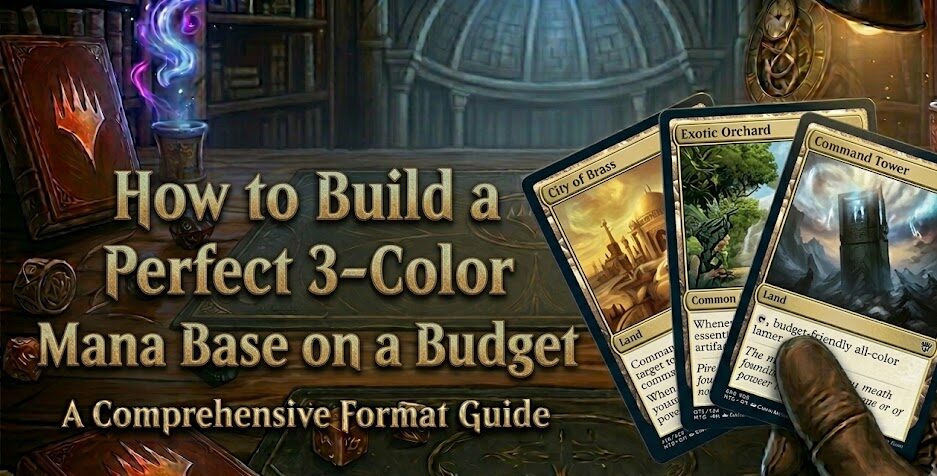
Stepping up from a simple two-color deck to a three-color Commander powerhouse (like an Esper enchantment fortress or a Grixis Marvel archetype) unlocks an incredible pool of synergy. However, it also introduces the ultimate deckbuilding headache: color screw.
Nothing feels worse than sitting with a hand full of game-winning spells but being completely unable to cast them because you are missing a single white or red mana pip.
While the standard advice is to drop hundreds of dollars on premium Fetch lands and Shock lands, you absolutely do not need to empty your wallet to achieve a flawless resource engine. By practicing structural discipline and utilizing highly efficient, overlooked dual cycles, you can construct a fast, reliable three-color mana base for under $20.
The Golden Rules for Budget Brewing
Before looking at specific lands, every optimized three-color budget deck must follow two core mathematical principles:
-
Kill the „Always Tapped“ Common Lands: Completely throw away generic bulk tap-lands like Guildgates or Vivid Grove. If your first three turns consist entirely of playing lands that enter the battlefield tapped, your opponents will completely outpace you.
-
The Rule of 37: Aim for a rock-solid foundation of 37 total lands, paired with roughly 10 to 12 low-mana ramp pieces (like Signets, Talismans, or green sorcery search tools).
The Ultimate 3-Color Budget Blueprint
For a perfectly balanced, responsive phone-scannable setup, use this exact slot breakdown to structure your 37 lands:
1. Universal All-Stars (4 Slots)
These are mandatory five-color engines that provide unparalleled color-fixing flexibility for pennies:
-
Command Tower: The undisputed king of the format.
-
Exotic Orchard: In a four-player game, this almost always taps for every single color you need based on your opponents‘ land selections.
-
Path of Ancestry: Enters tapped, but fixes all three colors perfectly and rewards you with passive Scry utility when casting your commander.
-
The Tri-Land Block (e.g., Crumbling Necropolis or Arcane Sanctum): An acceptable single tap-land slot because it effortlessly bridges all three of your deck’s specific color requirements.
2. The Pain Lands (3 Slots)
-
The Cycle: Lands like Sulfurous Springs, Yavimaya Coast, and Caves of Koilos.
-
Why they are elite: Thanks to recent mass reprints, these are historically cheap. They provide colorless mana completely for free, or colored mana at the minor cost of 1 life. In a 40-life format, trading a few points of life for untapped colored precision on turn one or two is an incredible bargain.
3. The Check Lands (3 Slots)
-
The Cycle: Lands like Glacial Fortress, Dragonskull Summit, and Rootbound Crag.
-
Why they are elite: These lands enter the battlefield untapped as long as you control a basic land matching one of their types. Since our budget formula runs a healthy chunk of basic lands, these will reliably enter untapped from turn two onward.
4. The Snarl / Reveal Lands (3 Slots)
-
The Cycle: Lands like Furycalm Snarl, Vineglimmer Snarl, and Choked Estuary.
-
Why they are elite: These enter untapped simply by revealing a basic land type from your opening hand. They are exceptional for securing your specific colored casting costs on the absolute most critical opening turns of the game.
5. The Tango / Battle Lands (3 Slots)
-
The Cycle: Lands like Canopy Vista, Sunken Hollow, and Smoldering Marsh.
-
Why they are elite: These enter untapped as long as you control two or more basic lands. They function beautifully alongside a basic-heavy budget setup and feature basic land types, meaning green land-search spells can pull them straight out of your library.
6. The Basic Backbone (21 Slots)
-
The Breakdown: Run roughly 7 Forests, 7 Plains, and 7 Swamps (adjusted based on your deck’s specific color intensity / mana pips).
-
Why they are elite: Basic lands are immune to nonland destruction, never enter the battlefield tapped, and guarantee that your Check, Tango, and Snarl lands function at peak efficiency.
Top 5 Budget Mana Traps to Avoid
When building your resource pool, do not fall for these slow, clunky traditional traps that sink your velocity:
-
Temple of the False God: A land that cannot produce a single drop of mana unless you already control four other lands. It ruins early-turn spell-chain chains and leaves you mathematically behind.
-
Myriad Landscape: A utility land that enters tapped and requires you to sink two additional mana and sacrifice it just to ramp. It is far too slow for multi-color decks that need colored targets immediately.
-
Deep Analysis: A slow, sorcery-speed drawing tool. Spending four mana on your own turn to filter your hand leaves you completely unable to hold up reactive mana or defensive interaction.
-
Hornet Queen: A heavy seven-mana defensive creature. While excellent in green-heavy decks, a multi-color budget deck needs its high-cost slots reserved strictly for color-stable win conditions, not heavy defensive blocks.
-
Magnifying Glass: A highly inefficient three-mana artifact mana rock. Sinking four additional mana just to investigate completely drains the resources you need to hold open to activate your untapped dual lands.
PreconForge Verdict: Balance Over Budget
Building a perfect three-color mana base doesn’t require a massive financial investment – it requires structural balance. By pairing a solid core of basic lands with hyper-efficient, reprint-heavy cycles like Pain lands, Check lands, and Tango lands, you create a fast, resilient engine that keeps your game plan moving perfectly on curve. Treat your mana base with discipline, and you will never find yourself sitting helplessly color-screwed again!
Are you leaning heavily into a green-based deck to utilize cheap land-cycling and sorcery ramp to fix your colors, or are you running a non-green shell that relies on Signets and Talismans to carry the load? Let’s keep the strategy discussion moving forward!


