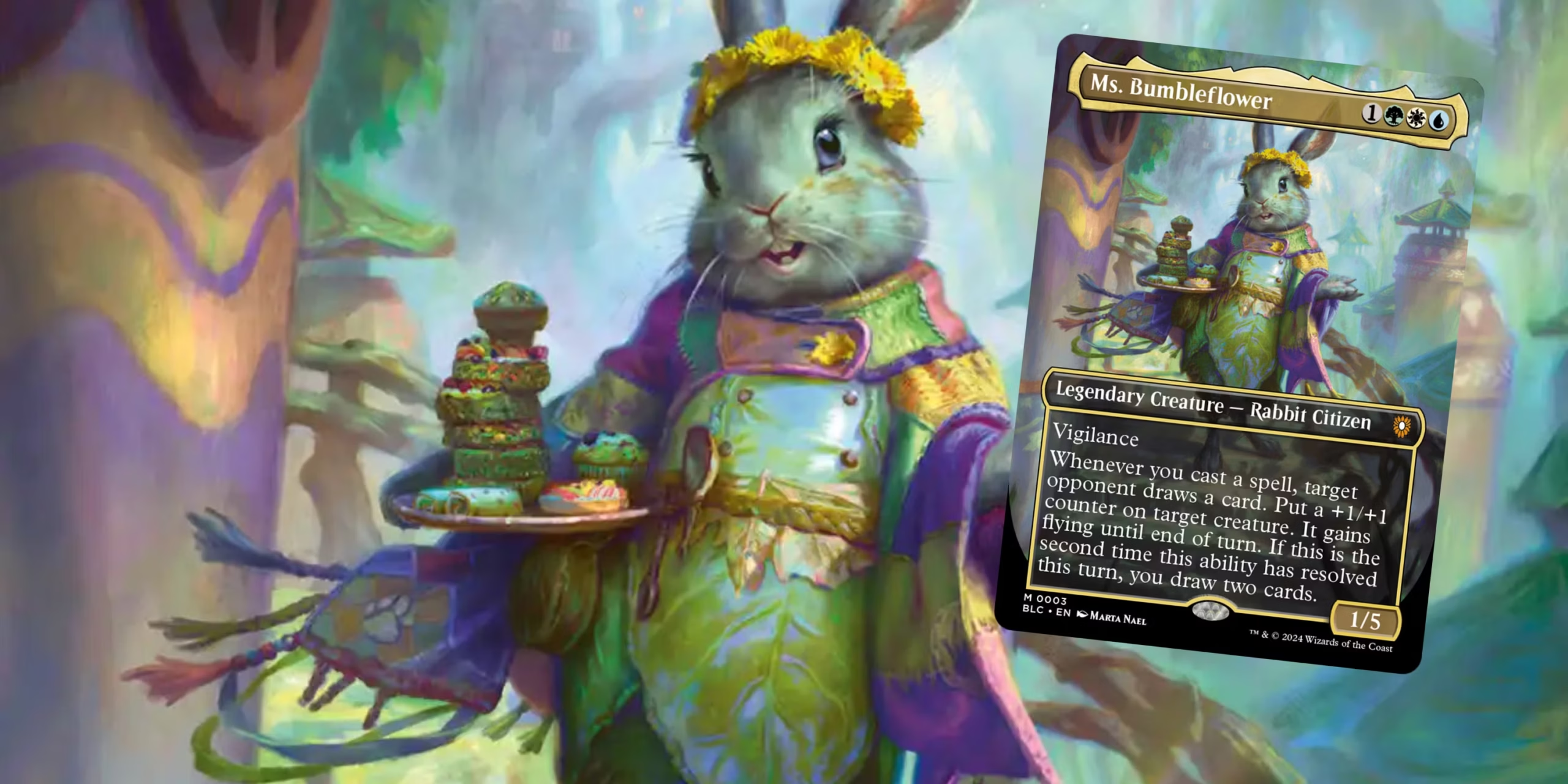
Peace Offering looks like a friendly group-hug deck, but Ms. Bumbleflower rewards a much more deliberate style of generosity. Every spell you cast gives an opponent a card, puts a +1/+1 counter on a creature and gives that creature flying for the turn. When her ability resolves for the second time in a turn, you draw two cards yourself.
That makes the deck much more proactive than a traditional political Commander list. The goal is not to give every player unlimited resources and hope they leave you alone. You want to cast inexpensive spells frequently, choose carefully which opponent receives the extra card and use Bumbleflower’s counters to turn a few creatures into increasingly dangerous evasive threats.
Peace Offering already has strong payoffs in Forgotten Ancient, Kalonian Hydra, Chasm Skulker, Psychosis Crawler and Simic Ascendancy. The best upgrades should make it easier to cast two spells in a turn, punish opponents for the cards you are giving them and ensure your own creatures benefit more from the exchange than theirs do.
How Ms. Bumbleflower Rewards Cheap Spells
Ms. Bumbleflower costs for a 1/5 Rabbit Citizen with vigilance. Whenever you cast a spell, target opponent draws a card, you put a +1/+1 counter on target creature and that creature gains flying until end of turn. If this is the second time that ability has resolved during the turn, you also draw two cards.
The important number is therefore two spells. Casting one spell gives an opponent a card and improves a creature, but casting a second spell in the same turn gives you two cards back. Once you can reliably reach that second trigger, Bumbleflower stops feeling like a commander that gives away too many resources and starts becoming a repeatable card-draw engine.
Cheap spells are particularly valuable because they let you reach that threshold without spending an entire turn. Opt and Consider are simple upgrades, but that simplicity is exactly the point. For , either spell advances Bumbleflower’s trigger count while replacing itself and leaving most of your mana available.
Instant-speed spells raise the ceiling further because Bumbleflower counts separately during every turn. You can cast two spells during your turn, then potentially do the same during an opponent’s turn if you have enough cards and mana. You do not need to force that pattern every round, but building the deck with cheap interaction and flash effects gives you far more opportunities than a list filled with expensive sorceries.
Best Peace Offering Upgrades
Faerie Mastermind is one of the cleanest additions because Bumbleflower is already making opponents draw cards outside their normal draw step. The first time an opponent draws their second card each turn, Mastermind draws you a card as well. That turns some of Bumbleflower’s generosity into additional advantage for you without asking the deck to change direction.
Smothering Tithe attacks the same interaction from a different angle. Every card an opponent draws can produce a Treasure unless they pay . Because Bumbleflower deliberately hands out additional cards, Tithe can make those gifts considerably less one-sided and provide the mana needed to keep casting spells. It is a premium upgrade rather than a requirement, but few cards connect the group-hug and multi-spell sides of the deck so cleanly.
Danny Pink is particularly appealing if you want to lean harder into +1/+1 counters. Whenever one or more counters are put on a creature you control for the first time each turn, you draw a card. Bumbleflower is already distributing counters as part of her normal trigger, so Danny creates another source of advantage while helping justify the counter package beyond simply making creatures larger.
Kami of Whispered Hopes supports that same plan while helping with mana. If one or more +1/+1 counters would be put on a permanent you control, it adds another counter, and Kami can tap for mana based on its power. Bumbleflower can therefore grow your creatures more quickly while eventually turning Kami itself into a substantial mana source.
For a higher-end card, Consecrated Sphinx can generate an enormous amount of cards because Bumbleflower is actively causing opponents to draw. It is powerful enough that it can quickly become the biggest threat at the table, so it belongs more naturally in a stronger version of the deck than in a light precon upgrade. The important principle is broader: the best additions make the cards you give opponents produce something useful for you as well.
Keep the Counter Payoffs Already in the Deck
Peace Offering already contains several cards that become much stronger once Bumbleflower is consistently triggering. Forgotten Ancient accumulates counters whenever other players cast spells and can move those counters onto other creatures during your upkeep. Bumbleflower adds even more counters directly, letting you create large threats without dedicating the deck entirely to counter-specific cards.
Kalonian Hydra is an obvious finisher for the same reason. When it attacks, it doubles the number of +1/+1 counters on each creature you control. A creature that Bumbleflower has been growing gradually can suddenly become a genuine lethal threat, especially because Bumbleflower can also grant flying during the turn.
Chasm Skulker provides another natural payoff for all the cards you draw. It gains a +1/+1 counter whenever you draw, then leaves behind Squid tokens when it dies. Psychosis Crawler converts your draws into direct life loss for every opponent, giving the deck a way to win even when creature combat becomes difficult.
The stock Simic Ascendancy gives the counter strategy an alternate win condition. It should not become the sole objective of the deck, but Bumbleflower, Forgotten Ancient and Kalonian Hydra can accumulate growth counters surprisingly quickly. These cards already give Peace Offering enough payoff that I would spend the first upgrade slots on efficiency and interaction, not additional five- and six-mana counter engines.
Give Cards Selectively, Not Equally
The political part of Bumbleflower is more important than it first appears because you choose which opponent draws from each trigger. There is no reason to distribute those cards evenly.
If one opponent is struggling on mana while another already has a dominant board, helping the player who is behind may be advantageous. If someone has already committed most of their hand to the battlefield, giving them one card can be less dangerous than feeding the player holding six cards and representing a combo. Bumbleflower gives you a political resource, but you should still use it strategically.
This is also why I would avoid overloading the deck with symmetrical group-hug cards. Rites of Flourishing, Ghirapur Orrery, Kwain, Itinerant Meddler and similar effects can accelerate everyone regardless of whether doing so benefits you. Bumbleflower already gives opponents enough cards to create political deals without needing the entire deck to hand out free resources.
By contrast, cheap interaction works beautifully. A card such as An Offer You Can’t Refuse is already in the stock list and simultaneously protects your position, counts toward the second Bumbleflower trigger and costs only one mana. Adding similarly efficient protection such as Snakeskin Veil makes it easier to keep Bumbleflower alive while continuing to trigger her ability.
The upgraded version therefore becomes less about passive group hug and more about controlled generosity. Other players still get cards, but you determine who receives them while your own deck is specifically constructed to extract additional cards, counters and mana from the exchange.
What to Cut
Ghirapur Orrery is one of the first cards I would consider removing. Additional land drops can be useful, but the effect is symmetrical and its card-draw ability depends on having no cards in hand. A tuned Bumbleflower deck should rarely be empty-handed once the commander is functioning.
Secret Rendezvous also becomes less attractive. Three mana to draw three cards is efficient on paper, but giving another player the same three cards is a substantial cost when Bumbleflower already provides all the political generosity the deck requires. More flexible instant-speed draw makes it easier to trigger the commander during different turns.
Triskaidekaphile offers an entertaining alternate win condition, but maintaining exactly thirteen cards in hand does not naturally align with a commander that wants you to keep casting spells. If you enjoy the novelty it can certainly stay, but it is an easy slot when prioritizing consistency.
Sunscorch Regent can become enormous as opponents cast spells, yet it is another five-mana creature competing with stronger counter payoffs. The deck already has several ways to create large threats, so replacing it with a cheap spell or engine generally improves how quickly Bumbleflower becomes productive.
I would be slower to cut Forgotten Ancient, Chasm Skulker, Psychosis Crawler or Kalonian Hydra. They each turn the deck’s normal card-draw or counter activity into a real payoff rather than simply giving opponents more resources.
The Bant Mana Base Mostly Needs More Speed
Peace Offering has a respectable stock mana base with Adarkar Wastes, Brushland, Yavimaya Coast, Seachrome Coast, Razorverge Thicket, Glacial Fortress, Hinterland Harbor, Sunpetal Grove, Flooded Grove, Canopy Vista and Prairie Stream. For a three-color precon, that is already a useful foundation.
The slower lands are the natural upgrade targets. Temple of Enlightenment, Temple of Mystery and Temple of Plenty offer scry but always enter tapped, while Seaside Citadel fixes all three colors at the same tempo cost. The Thriving lands and Terramorphic Expanse are also functional rather than essential.
The reason speed matters here is not simply casting Bumbleflower on turn four. Once she is on the battlefield, you want to cast multiple spells with the same pool of mana. Entering the turn with four usable lands instead of three can determine whether you reach that second trigger at all.
The stock Sol Ring, Arcane Signet, Fellwar Stone, Mind Stone and Faeburrow Elder already provide useful acceleration, so I would prioritize faster lands over adding more mediocre ramp. Our Mana Base Upgrade Guide covers additional affordable Bant fixing if you want to rebuild this part of the deck further.
How the Upgraded Peace Offering Deck Plays
The early game is about developing mana and keeping a few inexpensive spells available rather than casting everything immediately. Once Bumbleflower enters, the value of a one-mana instant changes dramatically because it is now part of a larger sequence.
Cast your first spell, choose which opponent gets the card and place a counter where it matters. Cast the second and Bumbleflower gives you two cards while adding another counter and another temporary source of flying. With cards such as Danny Pink or Faerie Mastermind involved, the same sequence can produce even more cards.
Those counters gradually turn utility creatures into real combat threats. Forgotten Ancient accelerates that growth, Kalonian Hydra can double an established battlefield and Bumbleflower’s flying makes it much easier for a large creature to actually connect. Meanwhile Psychosis Crawler gives all the extra cards another route to reducing life totals.
The strongest version of Peace Offering therefore does not need to choose between politics, card draw and combat. The political card draw keeps opponents engaged, your cheap spells keep Bumbleflower triggering and the +1/+1 counters eventually turn that incremental advantage into a win.
PreconForge Verdict
Peace Offering already has the right payoffs for Ms. Bumbleflower. Forgotten Ancient, Kalonian Hydra, Chasm Skulker, Psychosis Crawler, Simic Ascendancy and Faeburrow Elder are all part of the official deck, so there is little reason to replace the precon’s strongest engines.
The best upgrades make Bumbleflower easier to trigger repeatedly. Opt and Consider lower the curve, Faerie Mastermind helps you profit when opponents receive additional cards, and Danny Pink converts the counter plan into another source of draw. Premium additions such as Smothering Tithe can make Bumbleflower’s generosity fund your next sequence of spells.
Most importantly, you do not need to make the entire table rich to play Ms. Bumbleflower well. Give cards selectively, cast inexpensive spells often and make sure your side of the battlefield benefits from every exchange. Once the second-spell trigger becomes routine, Peace Offering starts drawing enough cards and distributing enough counters that the “group hug” commander becomes a surprisingly effective engine for your own game plan.


