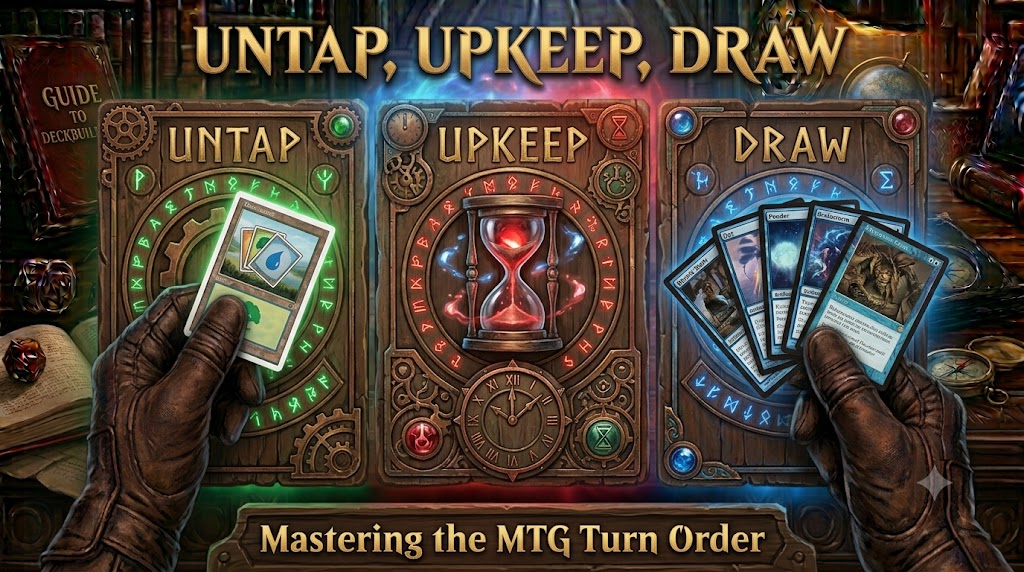
One of the biggest hurdles for intermediate players making the jump from casual matches to competitive tournaments—or moving from the automated prompts of MTG Arena to physical tabletop play—is mastering the hidden structure of a single turn.
In Magic: The Gathering, a turn is not just a loose sequence of drawing, attacking, and passing. It is a rigid, mathematically precise framework divided into 5 distinct phases, which are further broken down into 12 specific steps.
Understanding exactly when you have „priority“ (the legal right to cast a spell or activate an ability) determines whether you can successfully pull off a mid-combat trick or get caught in a game-ending trap.
Optimized as a quick structural checklist on your phone screen during your next match, here is the definitive breakdown of the MTG turn order.
1. The Beginning Phase
This phase happens automatically at the start of your turn. No player receives priority during the first two steps, meaning spells cannot be cast here unless an ability explicitly triggers.
-
Unstep Step
You untap all of your tapped permanents (lands, creatures, artifacts). You cannot cast instants or activate abilities during this step.
-
Upkeep Step
This is where „At the beginning of your upkeep“ triggers go onto the stack. Once those triggers are placed, players receive priority to cast instants or activate abilities before moving forward.
-
Draw Step
The active player draws a card from their library. After the card is drawn, both players get priority to cast instants or activate abilities.
-
Tactical Tip: This is the final window to cast a discard spell like Thoughtseize to strip a card from an opponent’s hand before they can cast it during their own main phase.
-
2. Main Phase 1 (Pre-Combat)
This is your first opportunity to advance your board state. As the active player, you have sorcery-speed priority, meaning you can cast any card type from your hand.
-
You can play a land (limit one per turn).
-
You can cast Creatures, Sorceries, Artifacts, Enchantments, and Planeswalkers.
-
Tactical Tip: Unless your creature gives an immediate combat benefit (like Haste or a combat pump), it is almost always mathematically correct to save your mana and cast your threats during Main Phase 2 instead. This keeps your opponent guessing about your available mana during combat.
3. The Combat Phase
The combat phase is highly interactive and features five individual steps. Both players receive priority to cast instants and activate abilities during every single one of these steps.
-
Beginning of Combat Step
The active player officially announces they are entering combat. This is the absolute last chance for a defending opponent to use a removal spell or tap down a potential attacker using an effect like Phelia, Exuberant Shepherd.
-
Declare Attackers Step
The active player selects which creatures are attacking and taps them. Once attackers are locked in, players can cast instants.
-
Declare Blockers Step
The defending player chooses which creatures are blocking which attackers.
-
Tactical Tip: This step is the premier window for combat tricks. If your opponent blocks your creature, wait until after blockers are legally declared to cast a pump spell like Giant Growth or give your unit Protection to blow out their blocker.
-
-
Combat Damage Step
All survival combat damage is dealt simultaneously. No spells can be cast during damage calculation; priority is only given after damage has already successfully processed and state-based actions check for dead creatures.
-
End of Combat Step
Creatures are still technically considered „attacking“ or „blocking“ for a brief window. Players can cast specialized instants that target attacking units before the phase officially closes.
4. Main Phase 2 (Post-Combat)
Your second main phase is structurally identical to your first main phase. You possess sorcery-speed priority once again.
-
You can cast any non-instant spells (Creatures, Sorceries, Artifacts) that you held back before combat.
-
If you did not play a land during Main Phase 1, you can legally play your single land drop here.
-
This is where you deploy mid-range threats or value engines like Fable of the Mirror-Breaker after seeing how your combat step resolved.
5. The Ending Phase
The turn draws to a close through two highly specific cleanup sequences.
-
End Step
This is where „At the beginning of your end step“ triggers (such as those found on Ocelot Pride) are placed onto the stack. This is the most popular window for defending opponents to cast instant-speed card draw or flash in threats, because the active player cannot retaliate with sorcery-speed spells.
-
Cleanup Step
If the active player has more than 7 cards in their hand, they must discard down to their maximum hand size. All marked damage is removed from creatures simultaneously, and „until end of turn“ effects expire. No player receives priority here unless a card ability explicitly triggers due to a discard event.
PreconForge Verdict: Respect the Pass of Priority
The structural order of an MTG turn is designed to prevent players from shouting over one another during complex board states. By training yourself to mentally check off each step—especially the tight transitions within the Combat Phase—you protect your spells from being blown out by opponent interactions and gain total control over the flow of the stack.
Are you utilizing the End Step window to maximize your flash threats and instant-speed removal, or do you find yourself accidentally jamming spells too early during Main Phase 1? Let’s keep the strategic gameplay and turn-structure optimization discussion moving forward!


