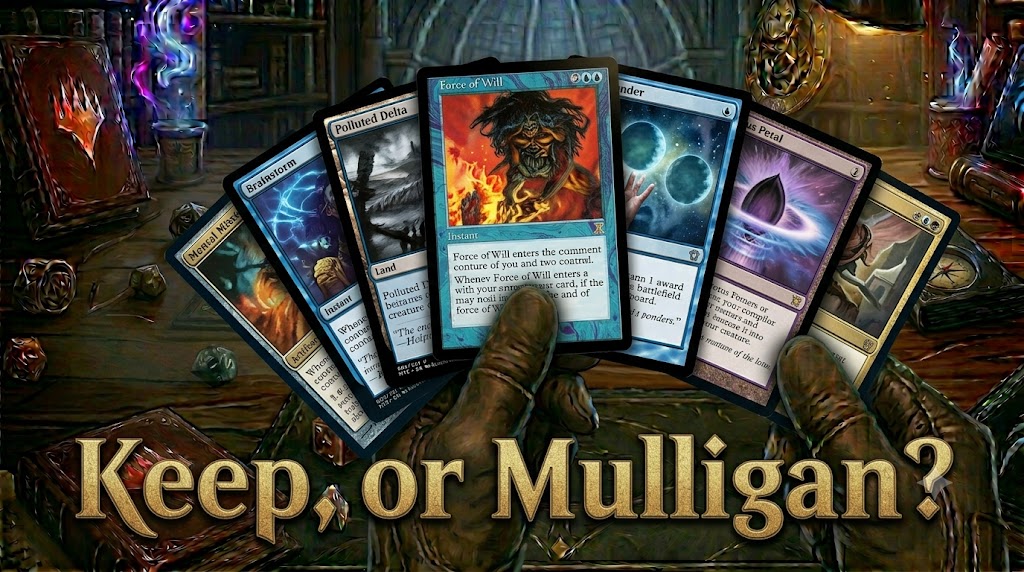
It is a scenario every Commander player experiences every single week: You sit down at your local game store, shuffle up your 99-card deck, draw your opening seven cards, and stare at a hand containing two lands, a couple of heavy six-mana spells, a value enchantment, and no early acceleration.
The pressure is on. Do you risk keeping it, hoping to naturally top-deck your third and fourth lands on time, or do you utilize the generous Modified Parisian Mulligan rule (which grants you a completely free mulligan down to seven cards in multiplayer formats) to hunt for a better operational curve?
In high-variance, singleton formats like EDH, the opening hand is the single highest predictor of your overall win percentage. Keeping an unplayable, slow hand essentially sentences you to spend the first forty-five minutes of a game acting as a passive spectator while your opponents run away with the board velocity.
Optimized directly for your phone screen to check right before your match begins, here is the ultimate tactical guide to mastering your opening hands in Commander, breaking down the essential checklist rules and analyzing real-world „Keep or Mulligan“ scenarios.
The Golden Rules of the Opening Seven
Before you look at the specific card text in your opening grip, filter your choices through this universal structural checklist:
-
The Three-Land Threshold: Unless your deck curve is incredibly low or you are holding a zero-mana acceleration piece like Mox Diamond, never keep a hand with fewer than three mana sources.
-
The Turn-Two Action Check: Do you have a meaningful spell to cast on turn one or turn two? A hand full of reactive four-mana board wipes and five-mana dragons is a trap if you have nothing to do during the foundational opening turns.
-
The Color Identity Balance: In three-color or five-color decks, having three lands means nothing if they all tap for green and your entire hand requires black and blue resources. Always check your color fixing before checking your spells.
Scenario 1: The Greedy Mid-Range Trap
Imagine you are playing a high-synergy artifact deck like the newly released Ultron, Artificial Malevolence Esper build. You draw your opening seven cards:
-
Lands: Seat of the Synod, Watery Grave (2 Lands)
-
Acceleration: None
-
Spells: Phyrexian Altar, Wurmcoil Engine, Tezzeret, Master of the Bridge, Baleful Strix, Swords to Plowshares
❌ The Verdict: MULLIGAN
This hand is a massive trap that seduces casual players because it contains incredibly powerful mid-game cards like Phyrexian Altar and Wurmcoil Engine. However, look at the math: you only have two lands and zero mana rocks. If you fail to draw an untapped land on turn three, you will miss your curve entirely. Your opponents will establish defensive boards and counter-magic barriers while you sit around passing the turn with a hand full of uncastable six-mana bombs. Throw it back.
Scenario 2: The Fast Mana Launchpad
You are piloting a competitive, high-velocity deck or an aggressive shell like Boros Energy. You draw your opening seven cards:
-
Lands: Arid Mesa, Mountain (2 Lands)
-
Acceleration: Sol Ring
-
Spells: Guide of Souls, Amped Raptor, Ajani, Nacatl Pariah, Galvanic Discharge
The Verdict: KEEP
This hand is an absolute dream sequence. While it technically only features two physical land cards, the inclusion of Sol Ring completely breaks the traditional rules of the mana curve.
Your opening line is flawless: Turn 1 land into Sol Ring, using the remaining colored mana to deploy your turn-one engine tracker Guide of Souls. On turn two, you automatically have access to four total mana resources, allowing you to drop both Amped Raptor and Ajani, Nacatl Pariah simultaneously to completely hijack the momentum of the table before anyone else can establish a board.
Scenario 3: The Slow Control Engine
You are commanding a slow, draw-go control deck like Rusko, Clockmaker. You draw your opening seven cards:
-
Lands: Shipwreck Marsh, Island, Swamp (3 Lands)
-
Acceleration: Arcane Signet
-
Spells: An Offer You Can’t Refuse, Consider, Rhystic Study
The Verdict: KEEP
This is a textbook example of a flawless, interactive hand built to dominate a multiplayer pod. You hit the ideal threshold of three lands, and your colors are perfectly fixed.
Your opening sequencing is incredibly smooth: Turn 1 hold up Consider to groom your upcoming draws; Turn 2 drop Arcane Signet to ramp ahead of schedule; Turn 3 resolve an early Rhystic Study while holding up a cheap counterspell protection shield like An Offer You Can’t Refuse to protect your engine. This hand guarantees you stay relevant across every stage of the game.
PreconForge Verdict: Use Your Free Mulligan Wisely
The absolute biggest mistake players make in casual Commander pods across the United States is being too afraid to mulligan. The multiplayer rules are explicitly designed to be forgiving. Do not settle for a hand that relies on lucky top-decks just to play the game on turn four. Throw back those clunky, top-heavy openers, protect your early tempo velocity, and secure an opening seven that allows you to actively dictate the pace of the match!
Are you a conservative player who always keeps a safe, basic-heavy 3-land hand, or are you a high-stakes competitive brewer who aggressively mulligans down to five cards just to locate a turn-one Sol Ring? Let’s keep the strategy and tactical discussion moving forward!


